You know, I had plans today. A nap in the third sunbeam from the left. A light critique of the new sofa arrangement. Perhaps a pointed stare at the refrigerator until someone opened it.
But here we are. Because apparently, some of you — and I say this with the full weight of my considerable disdain — still don’t know where your cat is supposed to go to the bathroom.
I would let you figure it out yourselves, but the cat in your house deserves better. So fine. Let’s do this.
Why This Even Matters (A Brief Lecture You Should Have Received Earlier)
Cats are, by nature, clean. We are meticulous. We are precise. We bury things because we have dignity — a concept I understand you may be unfamiliar with — and because our wild ancestors needed to hide their scent from predators. We have not forgotten. We never forget.
When a cat goes outside the litter box, it is not spite. It is not performance. It is a symptom of a dirty box, of a wrong location, of a box that is too small, too smelly, too loud, or too insufferably covered in lavender “freshness” crystals that smell like a department store having a breakdown.
If you start litter training early and do it correctly, your cat will use the box reliably for life. If you don’t, you will spend the rest of your shared existence discovering unpleasant surprises behind the washing machine. The choice, as always, is yours. Choose wisely.
Part One: Start Early. Embarrassingly Early.
Kittens can begin learning litter box etiquette as young as four weeks old. By 8 to 12 weeks, they should have it sorted. If your 12-week-old kitten is still using the floor as a personal restroom, that is a veterinary matter, and you should seek professional counsel immediately.
The reason early training works is simple: cats are creatures of habit. What they learn first, they keep. Introduce a kitten to a clean, correctly sized litter box in a quiet spot, place them gently inside after meals and naps (prime bathroom windows, I assure you), and reward them with a treat and some softly spoken praise when they use it correctly.
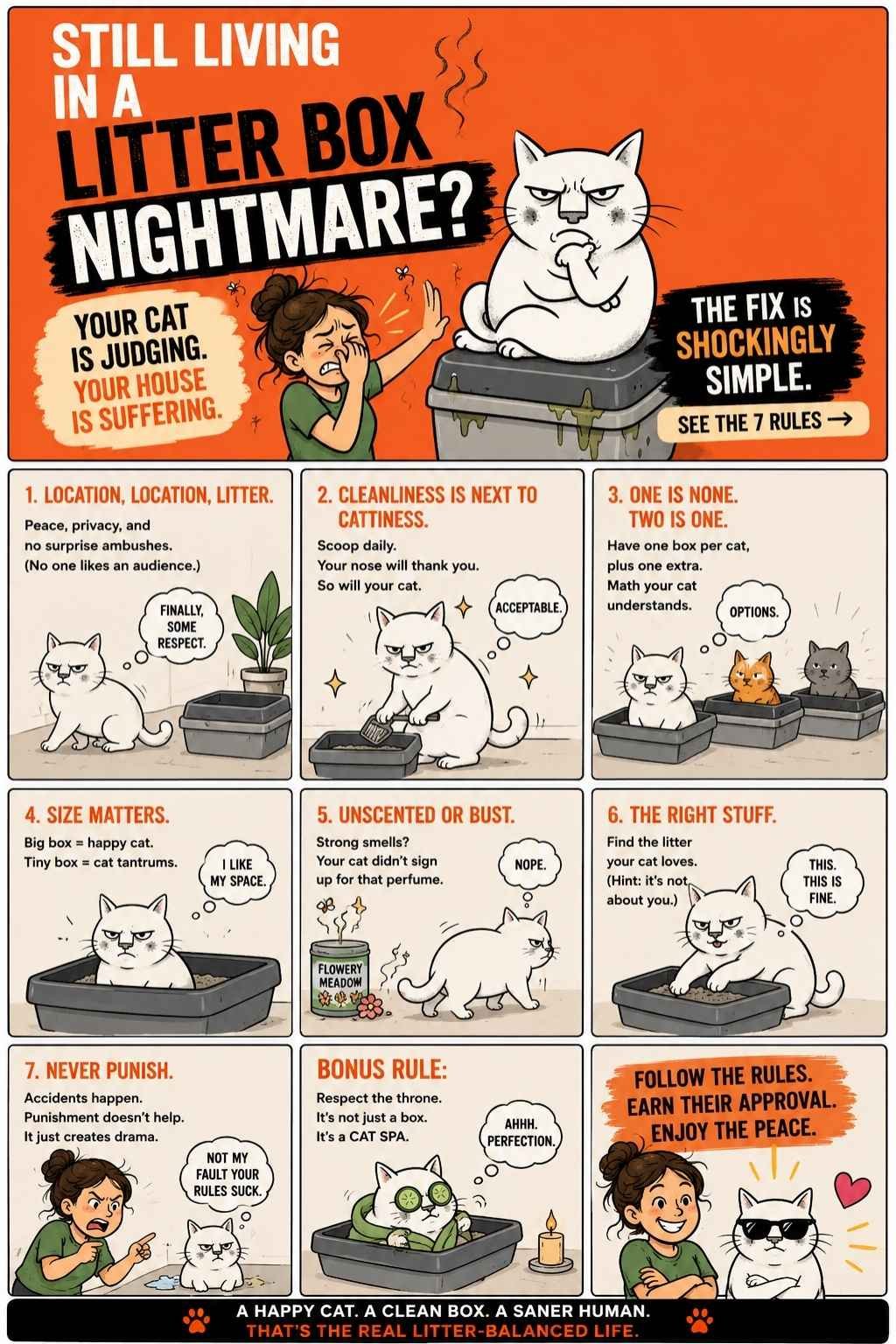
Do not punish accidents. Do not shout. Do not make a scene. I understand this is difficult for hoomans, who seem to believe that emotional escalation solves things, but I promise it does not. Punishment creates anxiety. Anxiety creates avoidance. Avoidance creates the situation behind the washing machine. We are trying to avoid the washing machine situation.
Positive reinforcement only. Treats, praise, perhaps a respectful nod. The kitten did the right thing. Acknowledge it.
Part Two: The Box Itself (Get This Right or We’re Done Here)
You would think — you would hope — that choosing a plastic box would be the easy part. And yet.
Size. The litter box should be approximately one and a half times the length of your cat, not counting the tail. Your cat needs to turn around, scratch, and position themselves without feeling like they’ve been folded into a carry-on bag. If you are using a box meant for a kitten on a fully grown cat, I have nothing further to say to you at this time.
For older cats, or cats with mobility concerns, the entry point should be no higher than two inches off the ground. Dignity does not require an obstacle course.
Type. Open designs are generally preferred. Covered litter boxes trap odors inside — which, I remind you, is unpleasant for us, not for your guests — and they limit sightlines, making us feel ambushed. Self-cleaning automatic boxes are particularly offensive: the sudden mechanical grinding noise is not a feature. It is a threat. Many cats will refuse to use them entirely, and frankly, I support that decision.
Quantity. One litter box per cat, plus one extra. This is not a suggestion. This is the rule. In a home with three cats, you need four boxes. Cats are territorial. We do not share restrooms any more than you would share yours with a stranger. More on this when we reach the multi-cat section.
Purrnando’s Grudging Endorsement #1: A Decent Litter Box
Since you’ve asked — and I have been informed by my staff that “helping hoomans shop” is apparently part of my arrangement here — I will suggest the Holintan Stainless Steel Litter Box XL. It is open-top. It is pure stainless steel, which means it does not absorb odors the way plastic does after years of daily insult. It has high walls to contain the inevitable enthusiastic digging of sensitive beans. It does not make any noises or rotate or vibrate or otherwise behave in a threatening manner. It comes with a litter mat, scoop, and non-slip stickers — everything the staff needs, in one package. It is, in my considered opinion, adequate. I do not say that lightly. Adequate is high praise coming from me.
Part Three: Location (The Part Most hoomans Get Wrong First)
You will want to put the litter box somewhere convenient for you. I am asking you, as sincerely as I am capable of asking anything, to please stop making decisions based on your own convenience.
The litter box should be in a quiet, low-traffic area. Not next to the washing machine (noise). Not next to the food bowl (we do not eat where we eliminate; we are not animals — well — the point stands). Not in a dark, cramped closet corner that smells of mildew. Not in the middle of the kitchen.
A consistent location matters enormously. Once a cat has accepted a box placement, moving it is a disruption. Keep it where it is. If you must move it, do so gradually, a few inches at a time.
Ideally, the box should have multiple exit points — or at least one that doesn’t feel like a trap. Cats who are ambushed at the litter box by other pets, children, or sudden loud appliances will stop using it. You have been warned.
Purrnando’s Grudging Endorsement #2: The Litter Mat
Your floors are your responsibility. I am not going to apologize for the litter that ends up outside the box. Digging is instinct. It is ancient. It is non-negotiable.
What I will concede is that a good litter mat placed directly in front of the box helps catch what the paws carry out, which means less litter ground into your floor, and less of it redistributed around the house via the pads of my feet (which is, I admit, not ideal for either of us).
The Gorilla Grip Cat Litter Box Mat is a reasonable choice. It has deep coil grooves that trap particles effectively, it lies flat without curling, and it does not have a pattern that insults the eye. Shake it out over the box to return clean litter. The system works. Use it.
Part Four: The Litter (Yes, It Matters Enormously. No, You Cannot Just Use Whatever Is On Sale)
I need you to understand something about the feline nose. We smell approximately fourteen times more acutely than you do. That scented litter that smells “fresh” and “clean” to you? To us, it is the sensory equivalent of being locked in a perfume shop that is also on fire. We will not go in there. You will wonder why. This will be why.
Use unscented litter. Full stop.
Cats prefer fine-grained, clumping litter. It resembles sand. It is what our instincts recognize as appropriate. Non-clumping litter is more difficult to clean, traps waste differently, and is generally a less pleasant experience for everyone involved, beginning with the cat.
Maintain a depth of two to three inches. This allows for adequate digging and coverage. Less than this feels thin and unsatisfying. More than this is excessive and may discourage use by kittens and older cats who find it unstable.
Purrnando’s Grudging Endorsement #3: The Right Litter
After extensive deliberation — and by extensive I mean I napped while my hooman researched it — I am recommending Dr. Elsey’s Ultra Unscented Clumping Clay Cat Litter. It is 99.9% dust-free, it is unscented, it clumps firmly, it controls odor without artificial perfumes, and it has a texture that cats accept readily. It is one of the top-selling cat litters for a reason.
If you prefer a natural or plant-based option, World’s Best Cat Litter — Multiple Cat Unscented is made from whole-kernel corn, clumps quickly, is 99% dust-free, and is genuinely flushable. It also lasts considerably longer than most conventional litters, which means fewer bags and slightly less suffering at the checkout counter.
Do not mix litter without transitioning slowly. The sudden texture change can cause a cat to reject the box entirely. If switching, blend 50/50 with the old litter first, then gradually shift the ratio over a week.
Part Five: Common Problems and What They Actually Mean
You may, at some point, find evidence that your cat has used somewhere other than the designated box. Before you reach for the cleaning supplies, I’d like you to ask a few questions.
Is the box clean? Scoop it at minimum twice a day. A dirty box is not used. We are not going to apologize for this standard. It is not a high bar. It is basic respect.
Has anything changed? New pet in the home. New baby. Moved furniture. Different cleaning product. Changed the litter brand. Any of these can trigger avoidance. Cats do not adapt to change the way you assume we do. We process things quietly and then take action. Sometimes that action is targeted at your bathmat.
Could it be medical? Urinary tract infections, kidney stones, hyperthyroidism, arthritis (which makes getting in and out of the box painful) — these are all common causes of litter box avoidance. If your cat has always used the box and suddenly stops, see a vet before trying anything else. This is not a behavioral problem until you’ve ruled out a physical one.
Stress and anxiety account for roughly 20 to 25 percent of litter box avoidance cases. Offering additional boxes, maintaining routine, and ensuring each cat has access to quiet, safe spaces can help significantly.
Part Six: The Multi-Cat Household (A Delicate Diplomatic Matter)
I will be honest with you: cats in groups have hierarchies. These hierarchies are invisible to you and entirely obvious to us. The dominant cat may guard the litter box. The less confident cat may avoid it entirely to prevent confrontation. You will not notice this is happening until someone starts going elsewhere.
The solution is simple. One box per cat, plus one extra. Distribute them in separate locations, not all in one corner of the basement. Multiple routes in and out. Quiet spots. No ambush zones.
Keep each box clean. In multi-cat homes, this means scooping more frequently. You have accepted cats into your home. This is what that looks like.
Part Seven: Cleanliness (The Non-Negotiable Section)
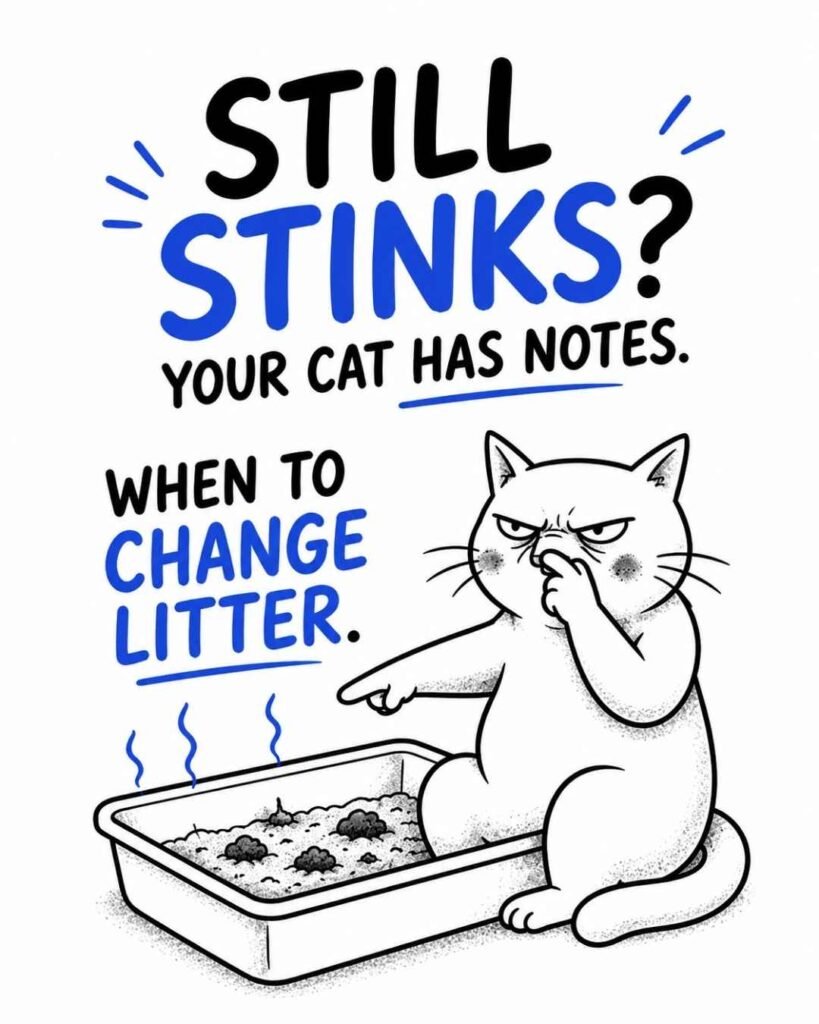
Scoop twice daily. Do a complete litter change and box wash once a week to once every four or five weeks, depending on the number of cats and your litter type. When changing litter, rinse the box with warm water and unscented soap. Do not use ammonia-based cleaners. Ammonia smells like urine, which sends confusing signals.
When scooping, mix the new litter in with the old in a 50/50 ratio to ease transitions if you’re doing a full change. Never place scented sprays, candles, or air fresheners near the litter box. These are deterrents. They will ensure the box is not used.
A stainless steel scoop is worth the small additional expense. It does not retain odor, it does not warp, and it will outlast you, probably.
Purrnando’s Grudging Endorsement #4: The Self-Cleaning Box
I have complicated feelings about this one. I do not, as a rule, endorse hooman inventions that use electricity to approximate what a responsible member of the staff could simply do with a scoop and a moment of their time. The principle of it offends me on a fundamental level.
However. I am aware that many hoomans are busy, or forgetful, or have several cats making biscuits in their home, or simply cannot be trusted to scoop at consistent intervals no matter how many pointed looks they receive. And for those hoomans — you know who you are — I will concede that the Mintakawa Automatic Self-Cleaning Litter Box is a genuinely well-designed automatic litter box. It self-cleans after each use, deposits waste away from the main area, has sensors to detect when a cat is nearby, and operates without causing a full snoot-based panic. It controls odor. It does what it says it does.
It is, despite my strong feelings about the category, effective. And if the alternative is an unscooped box for eighteen hours, then yes, use the machine. Your cat’s comfort takes priority over my opinions about automation. I cannot believe I just typed that. Moving on.
Note: introduce any new litter box gradually. Place the old box next to the new one and allow your cat to investigate on their own terms, in their own time, with zero pressure from the staff. Do not rush this. Do not attempt to place the cat in the new box to demonstrate how it works. You will regret that particular decision. Patience is, apparently, also a virtue available to hoomans on a selective basis.
Part Eight: Adult Cats and Traveling (Two Final Things I’ll Address and Then I’m Done)
Adult cats can absolutely learn new litter box habits. It is not too late. The same principles apply: correct box, correct location, correct litter, consistent positive reinforcement, patience. If you’ve adopted an older cat who is struggling, check first for medical causes, then for environmental stressors, then adjust accordingly.
For those who insist on taking their cats places — which, I would like to note, most cats do not enjoy, though we endure it — a small travel litter box is essential for any trip longer than a few hours. Introduce it at home first so it does not feel foreign. Do not allow your cat to roam freely in a moving vehicle. This is dangerous for everyone including the driver, the cat, and my nerves.
Conclusion: You Can Do This, Probably.
The requirements are not complex. A correctly sized, unscented, open litter box in a quiet location, filled with unscented clumping litter to a depth of two to three inches, scooped twice daily, with one box per cat plus one extra.
That is it. That is all of it.
Do these things and your cat will use the box reliably, your home will not smell, your relationship with your cat will improve, and you will have demonstrated a basic level of competence, which I understand, for some of you, is a genuine accomplishment.
I did not write this because I care about you. I wrote this because the cats deserve better, and someone had to say it.
You’re welcome.
— Purrnando Grumpy Cat. Reluctant Influencer. Supreme Judge of hooman Incompetence.
Affiliate Disclaimer: Some of the links in this post are affiliate links, which means if you click on them and buy something, I may receive a small commission — which will go directly toward premium tuna, a third cat tree I don’t actually need, and the ongoing cost of tolerating hoomans on the internet.