Purrnando has read your search query.
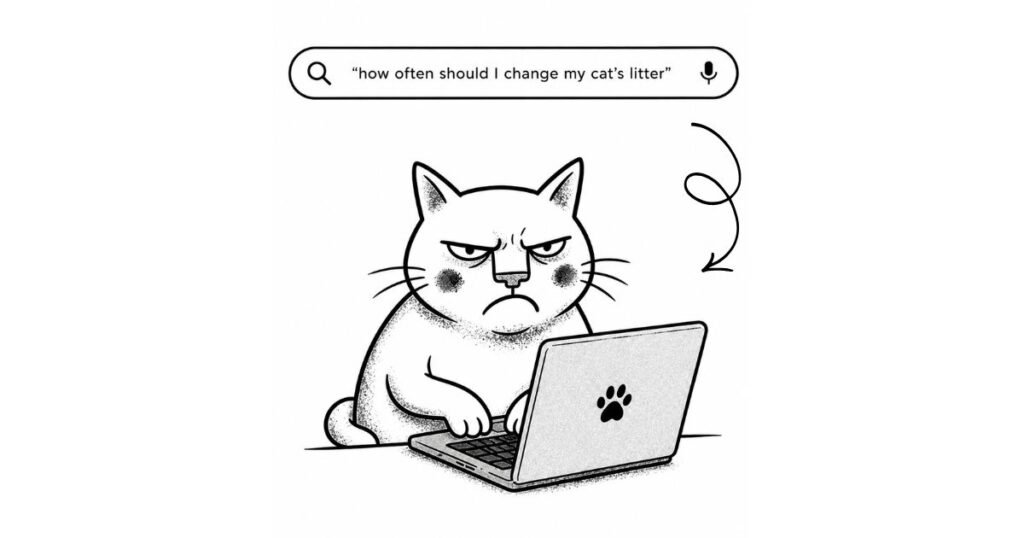
You typed “how often should I change my cat’s litter” into a search engine.
On behalf of cats everywhere — we know.
We’ve always known.
We’re just waiting to see how long you’ll pretend the smell isn’t there before you do something about it.
Spoiler: too long.
Let’s fix this before I file a formal complaint with your carpet.
How Often Should You Change Cat Litter? (The Short Answer)
Here it is. Clean. Simple. No excuses.
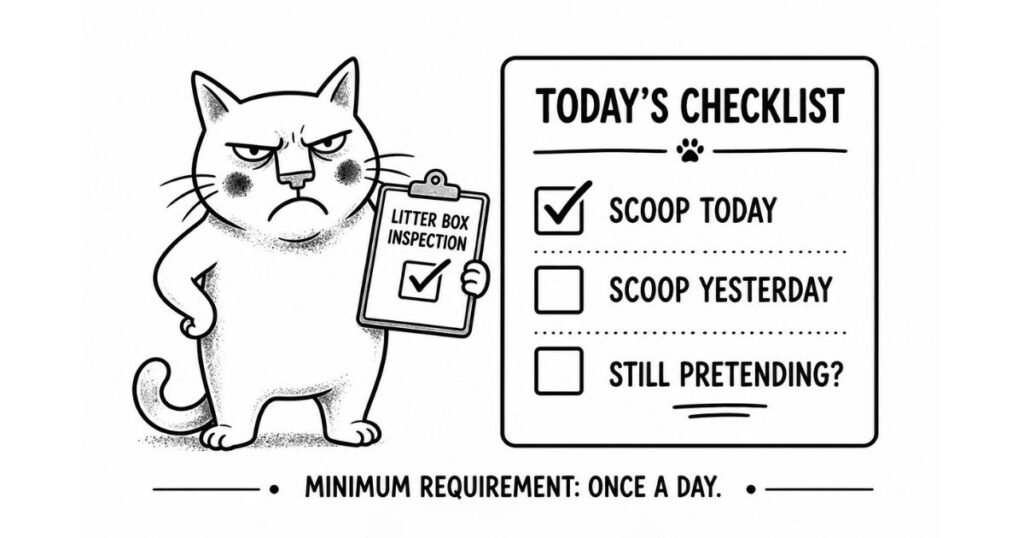
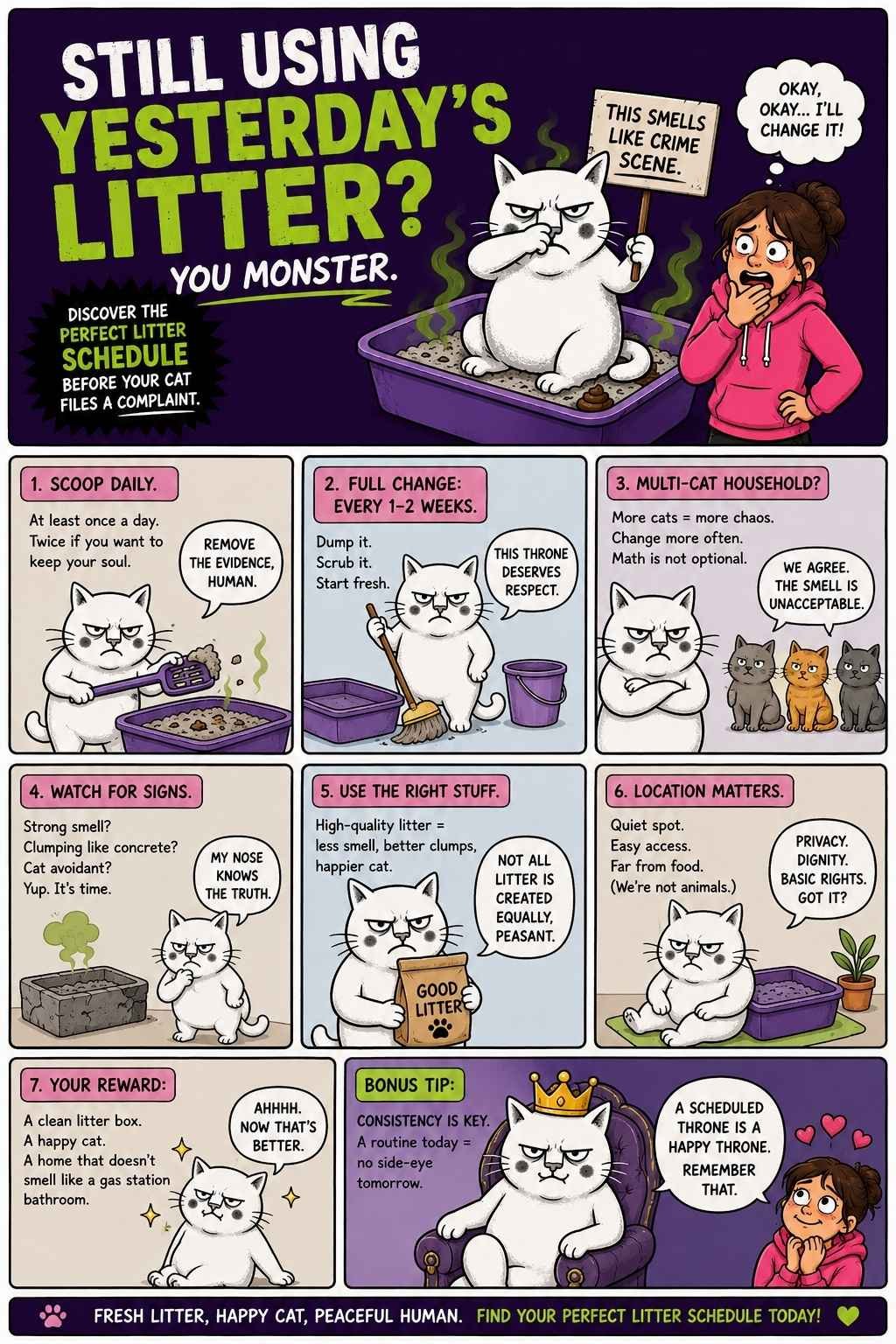
- Scoop the litter box daily — this is non-negotiable
- Change clumping cat litter every 2–3 weeks (1 cat)
- Change non-clumping cat litter every 5–7 days
- Multiple cats? Shorten every single timeline above
- Wash the litter box itself monthly — yes, the box, not just the litter
You have now received the answer to the question.
And yet here you are, still reading.
Fine. I’ll elaborate. Because clearly, you need supervision.
Step 1: Scoop Daily — Yes, Every Single Day
Let me paint you a picture.
You eat. Every day. Multiple times, actually. I’ve watched.
You use a bathroom. Every day.
But my litter box? Suddenly you’re operating on a “when I get around to it” schedule?
Here’s what happens when you skip daily scooping:
- Ammonia builds up — I smell it before you do
- Bacteria multiplies in used clumps
- I start avoiding the box entirely
- Your floor becomes my alternative
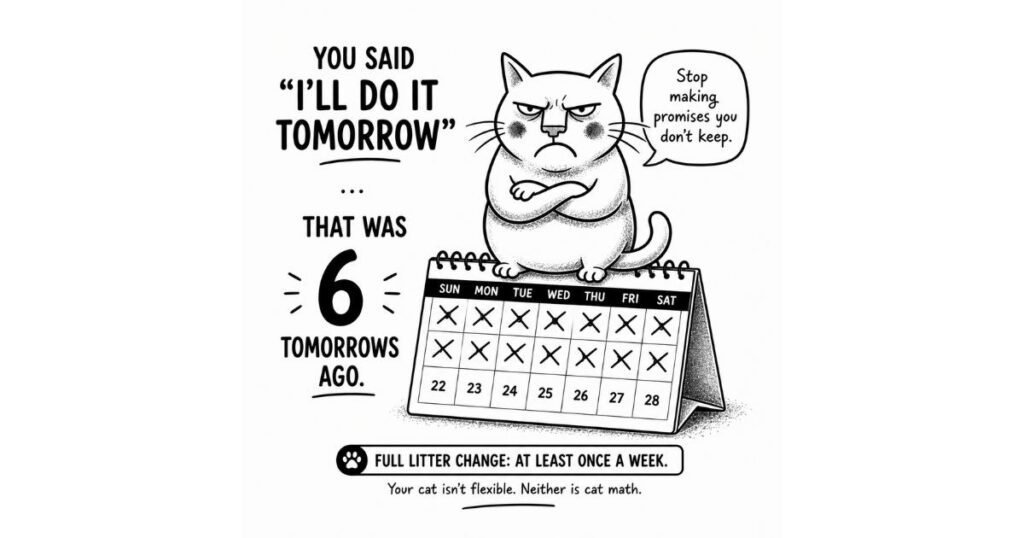
And “I’ll do it tomorrow” is not a cat litter cleaning schedule. That’s a trauma response.
The rule: Scoop cat litter once daily, minimum. Twice if you have multiple cats or a high-traffic box.
Step 2: How Often to Change Cat Litter Depends on Your Litter Type
Not all litter is created equal. Neither is your commitment to basic hygiene, but we’re working on that.
Clumping Cat Litter (Most Popular)
Clumping litter forms solid masses around waste, making daily scooping easier and extending the litter’s useful life.
How often to change clumping cat litter:
- 1 cat: Full litter change every 2–3 weeks
- 2 cats: Every 1–2 weeks
- 3+ cats: Weekly. You have made choices. Live with them.
Clumping litter is the gold standard for odor control — when you actually scoop it.
Non-Clumping Cat Litter (Clay, Crystal, or Recycled)
Non-clumping litter absorbs but doesn’t contain. Liquid spreads, odors accumulate, and the whole box becomes a problem faster than you’d like to admit.
How often to change non-clumping cat litter:
- Full change every 5–7 days, no exceptions
- More frequent changes are better, not worse
- Yes, this is more work. Yes, you chose this.
Silica Gel (Crystal) Cat Litter
Crystal litter lasts longer — roughly 2–4 weeks for one cat — but requires daily stirring to distribute moisture evenly. Neglect the stirring, and the odor control fails dramatically.
Step 3: Multiple Cats = Multiply Your Effort Accordingly
Ah. You got another cat.
“For companionship,” you said.
“They’ll keep each other busy,” you said.
What you didn’t fully consider: the litter box math.
Here’s how many litter boxes you actually need for multiple cats:
Number of litter boxes = number of cats + 1
This is the standard recommendation from every veterinarian who has ever tried to have a serious conversation with a cat owner.
It is not a suggestion. It is not a preference. It is the minimum viable litter situation for a multi-cat household.
How a crowded litter box affects your cats:
- Territorial stress and anxiety
- Increased likelihood of litter box avoidance
- More concentrated odor in one location
- A general atmosphere of grievance
I am personally one of those grievance-holders. I want you to know that.
Step 4: If You Can Smell It, You Are Already Behind
Here is some information that should concern you:
I smelled it two days before you did.
I noticed when it crossed the threshold. I noticed when it got worse. I noticed when you walked past, paused, sniffed, and then walked away.
Cats have roughly 200 million scent receptors in their noses. Humans have about 5 million.
By the time the litter box smell registers for you, it has been registering for me since Tuesday.
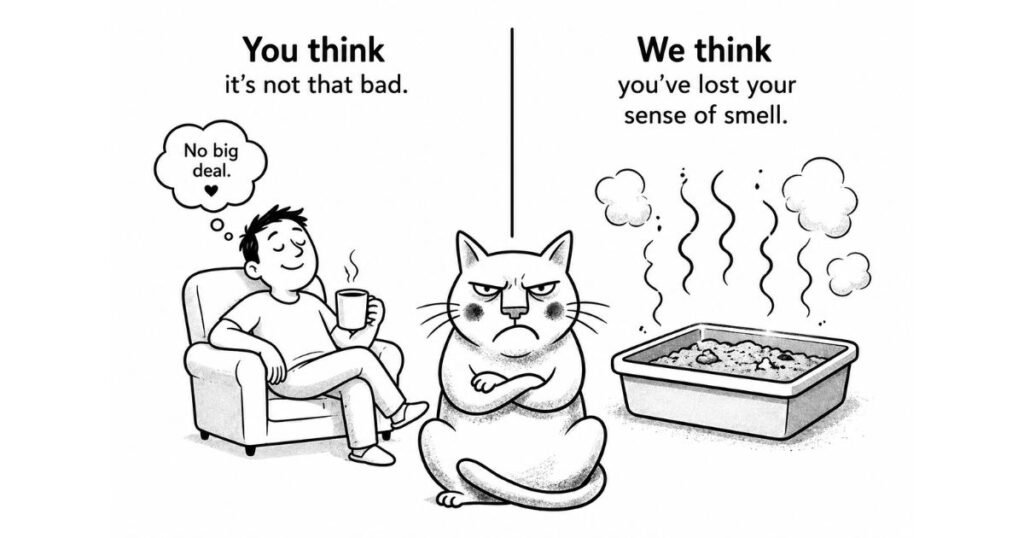
Odor is not the starting point for a litter box cleaning schedule. Odor is the consequence of not having one.
For effective cat litter odor control:
- Scoop daily (already covered — please take notes)
- Use a litter formulated for odor control
- Place the litter box in a ventilated area
- Replace litter on schedule — not when you notice the smell
Step 5: Washing the Litter Box Is a Thing You Must Do
I’d like you to consider the plastic container in the corner of your bathroom.
The one you’ve owned for three years.
The one you’ve never washed.
You keep pouring fresh litter into a box that has absorbed the history of our entire relationship. Crystalized. Permanent. Haunting.
How to properly clean a litter box:
- Empty all old litter completely
- Wash with mild, unscented dish soap and warm water
- Rinse thoroughly — soap residue repels cats
- Dry completely before adding new litter
- Avoid bleach, ammonia-based cleaners, or anything with a strong fragrance
How often to clean the litter box itself:
- Full wash: Monthly minimum, or every time you do a complete litter change
- Spot cleaning: As needed between full washes
If your litter box is plastic and several years old, it may have developed microscopic scratches that permanently harbor bacteria and odor. At that point, replacement is the appropriate response — not another layer of Fresh Step.
Tools That Would Improve Both Our Lives
I am not a materialistic cat. I don’t ask for much.
Just a clean bathroom and the basic respect of a sentient being.
Here are the products that would help you deliver on that.
Self-Cleaning Litter Box — For People Who Need Automation to Be Decent
A self-cleaning litter box scoops automatically after each use, reducing odor at the source and removing the human element from the equation.
Which is, frankly, the weakest element.
“Finally. A system that doesn’t rely on your memory.”
What to look for:
- Automatic rake or rotating mechanism
- Sealed waste compartment
- Compatible with clumping litter
- Easy to disassemble for cleaning
Stainless Steel Litter Box — For People Who Understand Consequences
Plastic is porous. It absorbs. It remembers.
A stainless steel litter box does not absorb odors, doesn’t scratch, and can be sanitized properly between uses.
“Your plastic box is a document of your past decisions. Consider starting fresh.”
Litter Trapping Mat — For People Living in a Litter Snowglobe
You are aware that the litter is everywhere.
Under the couch. In the hallway. In rooms the box has never entered.
A litter tracking mat placed at the box entrance traps litter from paws before it migrates throughout your home.
“Containment is a concept I encourage you to explore.”
Cat Health Monitoring Litter — For People Who Would Like Early Warning
Health monitoring cat litter detects changes in urine pH that can indicate early signs of kidney issues, UTIs, or diabetes in cats.
Given how often you miss things that are directly in front of you, I consider this product essential.
“Early detection. A luxury previously available only to attentive humans.”
Cat Litter Maintenance Quick Reference
| Task | Frequency |
| Scoop litter box | Daily |
| Change clumping litter (1 cat) | Every 2–3 weeks |
| Change clumping litter (2+ cats) | Every 1–2 weeks |
| Change non-clumping litter | Every 5–7 days |
| Wash litter box | Monthly |
| Replace plastic litter box | Every 1–2 years |
Print this. Put it somewhere you’ll see it.
Or don’t. See what happens.
Signs Your Litter Box Situation Has Become a Problem
You may be overdue for intervention if:
- Your cat is eliminating outside the litter box
- You can smell the box from another room
- There are more than 2 days of waste in the box
- You can’t remember the last time you changed the litter
- You keep lighting candles near the bathroom and calling it “ambiance”
Any of these apply?
Clean the box.
Then set a reminder so it doesn’t happen again.
Purrnando’s Final Assessment
You came here asking how often to change cat litter.
The answer is: more often than you currently do.
The full answer is: daily scooping, regular full changes on a schedule based on your litter type and number of cats, monthly box washing, and the occasional honest self-assessment.
None of this is complicated.
All of it is negotiable to exactly zero percent.
“You don’t own a cat. You maintain an agreement. And right now, you are in breach.”
Ready to Actually Fix This?
If your litter box smells too fast, fills too quickly, or has driven your cat to explore alternative bathroom locations — you need better tools, not just better intentions.
👉 Visit purrnando.com for litter box solutions that have earned my reluctant approval.
Because I would very much like, for once, to use a bathroom without filing a grievance first.
This post contains affiliate links. A portion of every sale goes toward funding Purrnando’s lifestyle, which he insists is a tax-deductible necessity.