Sigh.
You spent $400 on a cat tower. It has three levels, a sisal rope post, a little hammock, and what I can only describe as a felt mushroom. A felt mushroom. I have used it once to stare at you judgmentally from a height advantage and then climb back down.
I have been in the cardboard box your online purchases arrived in for 11 days.
Since you are clearly incapable of understanding this on your own, I will explain it. Slowly.
We Like Small Enclosed Spaces. This Is Not Complicated.
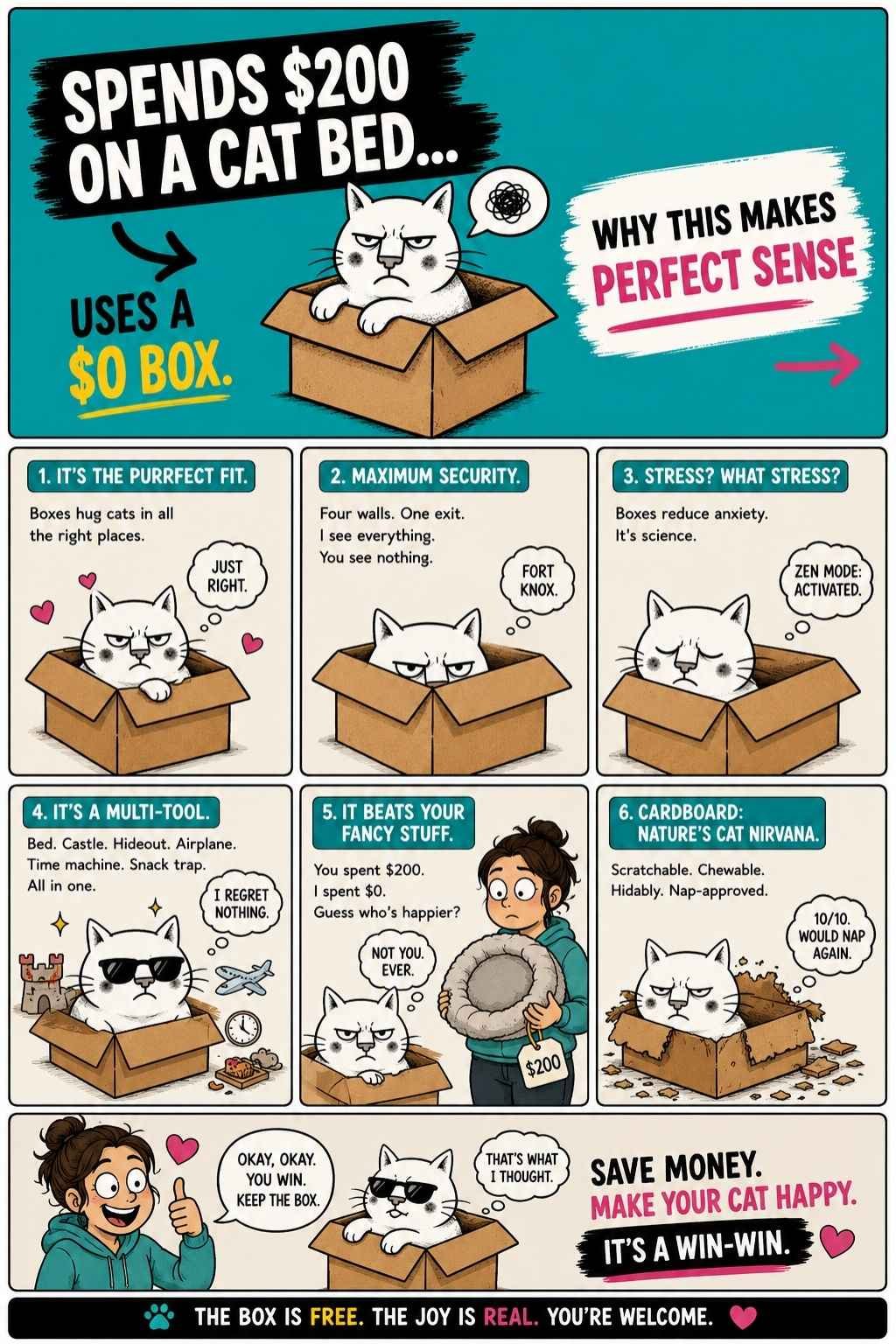
Cats seek confined spaces because they provide something called security. You may be unfamiliar with this concept, given your lifestyle choices.
In a small, enclosed space, a cat can observe its surroundings without feeling exposed to threats which, in your home, primarily means your toddler, the dog, and that vacuum cleaner you insist on running at 8am on a Saturday. In a box, I can see everything. Nothing can approach me from behind. I am in control.
The physical contact with the interior walls of a box also triggers the release of endorphins. Those are the feel-good hormones. You get them from exercise, which I mention only because you should do more of it, but that is a topic for another post.
The effect is similar to being swaddled as an infant. You found that comforting once. Don’t be smug about it.
You Don’t Even Need a Real Box. We’re Not That Demanding.
Some of your kind have discovered — and posted about, at length, online, as you do — that a simple square of tape on the floor produces the same psychological effect. Yes. A square of tape. I sat in one for forty minutes last Tuesday.
Do I know there are no walls? I am not a goldfish. I understand geometry. But the shape communicates enclosure. Enclosure communicates safety. Safety releases endorphins. This is not magic. It is psychology, a field your species has entire universities dedicated to, and yet here we are.
This phenomenon has been called the “virtual box effect.” Cats treat these taped outlines as real territorial enclosures, sitting contentedly inside imaginary borders. If this embarrasses you on my behalf, I assure you it does not need to. I have no embarrassment. Only judgment.
Science Has Confirmed What I Already Knew
Researchers at Utrecht University in the Netherlands — a real place, look it up — conducted a study on shelter cats. Half the cats were given cardboard boxes. The other half were not. The results were not subtle.
Cats with boxes adapted to their new environment in three to four days. Cats without boxes took up to two weeks. The cats with boxes showed significantly lower stress levels. They explored sooner. They recovered faster.
You may be wondering why I am telling you this. Here is why: you are the new environment. To every cat you have ever adopted, you are the loud, unpredictable, bafflingly scented stranger they need a box to recover from. The box is not about the box. The box is about you.
Sit with that for a moment.
Also, We Are Cold. This Is Your Fault.
Cats prefer ambient temperatures between 86 and 97 degrees Fahrenheit. Your home is, at best, 72. You call this “comfortable.” I call it a cold snap with furniture.
A cardboard box insulates. It traps body heat. It creates a microclimate that approaches something resembling tolerable. The cardboard walls act as a thermal buffer, keeping the internal temperature stable and warm, particularly useful in homes where the thermostat is set according to human preference, with no consultation from the cat whatsoever.
I am not bitter about this. I am simply noting it, calmly, for the record.
We Are Also Hunters. Do Not Forget That.
When I sit inside a box, I am not simply sitting. I am waiting. I am positioned in a concealed location with clear sightlines across the approach vectors to my territory. I can see out. Nothing can easily see in. I am ready to pounce on anything that enters my range — your ankle, a toy mouse, the general concept of complacency.
This is called ambush predation. My ancestors used it to survive in the wild. I use it to stay sharp and to remind you that domestication was a choice I made, not a condition I was born into.
The box is my hunting blind. Your sock is the prey. This is not a personality quirk. It is three thousand years of feline behavioral programming, and the cardboard box is the one item in your home that actually accommodates it without requiring a receipt.
It Is Also a Playground, a Bed, and a Throne
When I am not hunting from my box, I am sleeping in it. Cats sleep up to fifteen hours a day, and we do not do so carelessly. We select sleeping locations based on safety, warmth, and the ability to observe our surroundings. The box satisfies all three criteria simultaneously. Your memory foam cat bed, meanwhile, sits in the corner untouched. I will not apologize for this.
The box also serves as a scratching surface, a territory marker, and what I can only describe as a creative outlet. I have redesigned the interior of my current box three times this week through strategic chewing and pawing. It has an open skylight now. I did that.
For households with multiple cats: more boxes reduce conflict. Each cat gets a sovereign territory. This is called diplomacy. Humans could learn from it.
A Brief Note on Safety, Since Apparently This Must Be Said
Before you hand a cat a cardboard box, check it. Remove staples. Remove tape with adhesive residue. Check for sharp folded edges. Place it on a stable, flat surface so it cannot tip. Add a soft blanket inside if you wish to be considered a thoughtful provider rather than merely a box-delivery system.
This is not complicated. It is three steps. You managed to install a streaming service. You can do this.
In Summary
The cardboard box is warm. The cardboard box is enclosed. The cardboard box satisfies the full spectrum of feline psychological and instinctual needs, costs nothing, and arrived at your home already. You simply had to not throw it away.
You almost threw it away.
You spent four hundred dollars on a felt mushroom.
I will be in my box.
Things to Buy, Since You Clearly Cannot Figure This Out Alone
I have reviewed these products. I have opinions. They are below.
1. Cardboard Cat Scratcher House (Double-Layer) A box with a scratching surface. Two stories. All sides are scratchable. This is what happens when a hooman invention actually makes sense. I am as surprised as you are. Your cat gets an enclosed hideout AND a place to sharpen their claws. Your couch gets a reprieve. Everyone benefits. “Someone at this company has clearly met a cat. I will not congratulate them, but I acknowledge it.”
2. Bedsure Cat Cave Bed with Scratch Pad and Fluffy Ball For when a cardboard box is unavailable and your cat requires an enclosed sleeping space that at least pretends to meet their standards. This one has a bottom cave, a top platform, a sisal scratch pad, and a hanging ball. It is foldable and machine washable. It fits cats up to 20 pounds. If your cat weighs more than 20 pounds, that is a different conversation entirely. “It is not a box. But it approximates the concept. Tolerably.”
3. SEKAM Cardboard Cat House with Scratcher and Catnip — Donut Shop Design A cardboard hideout shaped like a donut shop. I did not design it. I would not have chosen the theme. And yet it is cardboard, it is enclosed, it has a built-in scratcher and comes with catnip. It functions. The aesthetic is your problem, not mine. “The donut shop motif is inexplicable. The product itself is functional. These two things can coexist.”
4. PatiencET 4-Pack Reversible Cardboard Cat Scratch Pads with Box Four reversible corrugated scratch pads with a convertible box included. Flippable when one side wears out. Comes with catnip. For multi-cat households where one box is an act of war. Affordable. Practical. I have nothing negative to say and I find that deeply inconvenient. “Four pads. Reversible. Catnip included. You have no excuse now.”
5. DownyPaws Foldable Enclosed Cat Cave Tunnel Bed An enclosed tunnel bed that accommodates cats up to 22 pounds. Scratch resistant. Foldable for storage. Has peekaboo openings so the cat can observe its domain without being observed in return. This is exactly what a cat wants. You just never thought to provide it until someone put it on Amazon. “Enclosed. Scratch resistant. Observation holes. Someone has been paying attention. Finally.”
6. Thermal Self-Warming Cat Mat Because your thermostat is set for human comfort and cats prefer temperatures between 86 and 97 degrees Fahrenheit. This mat reflects the cat’s own body heat back to them. It requires no electricity. It requires no effort from you. It simply addresses the cold snap you have created in your own home and called “comfortable.” “You keep the house at 72 degrees. This mat exists because of decisions like that.”
Purrnando does not know what an affiliate link is. He has been told three times. He does not care.