Why You Can’t Understand Cat Language (And Whose Fault That Is)
Let’s be absolutely clear about something: cats are not bad communicators. We are extraordinary communicators – precise, layered, efficient.
You, however, are the problem.
Every day, millions of hoomans stare at their cats and ask, “What does my cat mean?” as if we haven’t been standing in front of the food bowl with our tail held straight up in the air for the past seven minutes. The tail! It is pointing at the bowl! It couldn’t be more obvious if I installed a neon sign.
But fine. FINE. Since search engines tell me that phrases like “cat sounds and what they mean,” “cat body language,” and “why does my cat do that” get typed into Google an embarrassing number of times per month — I, Purrnando, Supreme Feline of Disdain and Reluctant Cat-to-Hooman Translator, will explain everything once, slowly, with diagrams, if necessary, though I find those demeaning.
Settle in, hoomans. Class is in session.
Part 1: Cat Sounds and What They Mean (The Vocal Guide You Don’t Deserve)
What Does a Cat Meow Mean?
The meow, the one you thought you understood.
Here is a fun fact that should permanently humble you: adult cats do not meow at each other. Not once. Not ever. Meowing is something we developed specifically to communicate with your species. It is a custom tool we invented for you, like a hooman-shaped remote control, and you still can’t figure out how to use it.
The meow is a multi-purpose cat vocalization. It is context-dependent, tone-dependent, and volume-dependent. Here is a brief translation guide for the most common cat meow meanings:
- Short, chirpy meow — “Hello. I am acknowledging your existence. Do not make this weird.”
- Long, drawn-out meow — “The food bowl is not full enough. This is a formal complaint.”
- Rapid, repeated meowing — “I REQUIRE YOUR ATTENTION AND I REQUIRE IT NOW.”
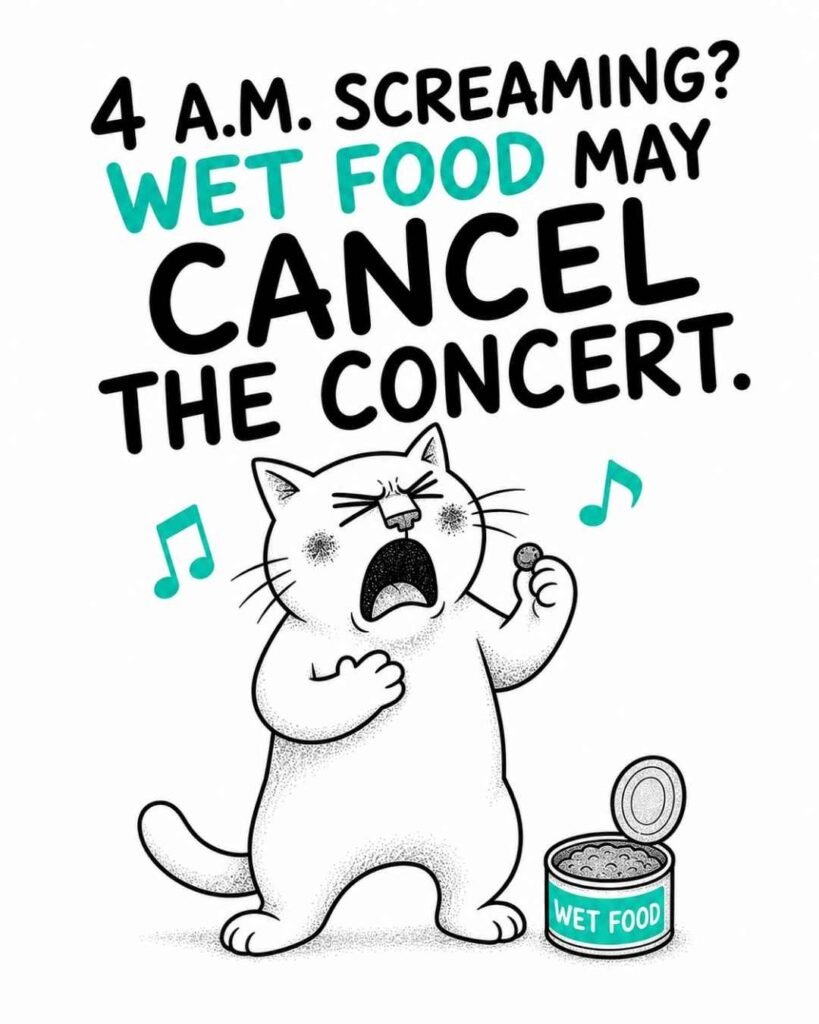
- Whiny, slightly theatrical meow at 3 AM — “I am awake. You should be awake. The concept of sleep schedules is a hooman invention and I did not agree to it.”
- Muffled meow — “I have brought you something. It is either a toy mouse or an actual mouse. Prepare yourself.”
The reason your cat meows more at you than at other cats isn’t because they’re confused. It’s because they’ve learned that this particular sound produces results in hoomans. Food appears. Doors open. You come running. We are not talking to you. We are operating you.
What Does It Mean When a Cat Chirps?
The chirp — sometimes called the “cat trill,” sometimes written as “prrrp,” sometimes described as “that little sound that makes hoomans absolutely lose their minds” — is a short, high-pitched cat vocalization that sits somewhere between a purr and a meow.
What does it mean? Let me count the ways:
- I have spotted a bird outside the window, and I am experiencing feelings about it.
- I am greeting you, but I don’t want to commit to a full meow.
- Something small and interesting is happening and I felt you should know.
- I have decided you are acceptable today.
Hoomans describe the chirp as “adorable.” This is noted. It costs me nothing to produce this sound. It generates an immediate and disproportionate positive response from your species. I have catalogued this information accordingly.
Why Does My Cat Purr? (And What It Actually Means)
This is perhaps the cat vocalization hoomans misunderstand most deeply.
“The cat is purring. It must be happy!”
Not necessarily.
Cats purr when content. Cats also purr when stressed. Cats purr when injured. Cats purr when they are trying to self-soothe, self-heal, or process a situation that requires careful deliberation. Research actually suggests that the frequency of a cat’s purr — typically between 25 and 150 Hz — may have therapeutic properties, promoting bone density and healing.
In other words, we have evolved to be our own doctors, while your species still can’t figure out how to change a duvet cover without getting trapped inside.
The purr is not a simple signal. The purr is a complex internal communication system that we graciously allow you to overhear. Context matters. If my ears are back, my pupils are large, and my body is tense — and I am purring — this is not contentment. This is stress management. Please read the rest of the signals before drawing conclusions.
This is why cat body language must always be read as a whole, not parsed sound by sound. But we’ll get to that.
Part 2: Cat Body Language — What Your Cat Is Actually Saying
Cat Tail Language: The Mood Antenna
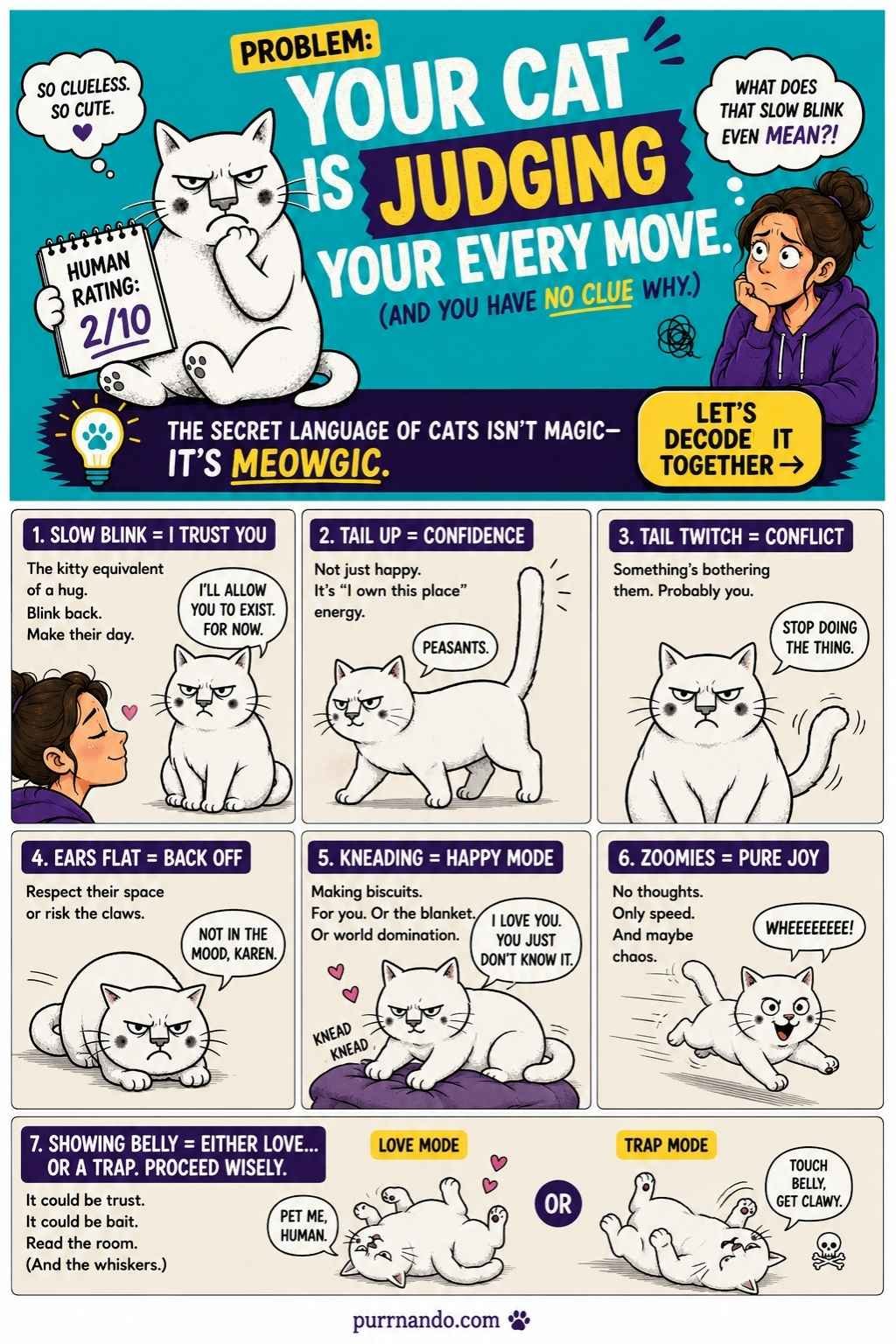
Your cat’s tail is not decorative. It is a precision communication instrument, and if you would simply look at it, you would know what is happening at all times.
Here is your guide to cat tail meaning:
| Tail Position | Translation |
| Straight up, slight curl at tip | I am happy and confident. Approach is permitted. |
| Straight up, quivering | I am very excited. Or marking territory. Possibly both. |
| Puffed out like a bottle brush | Something has alarmed me. The cucumber on the counter. Your new friend. A plastic bag. I don’t want to discuss it. |
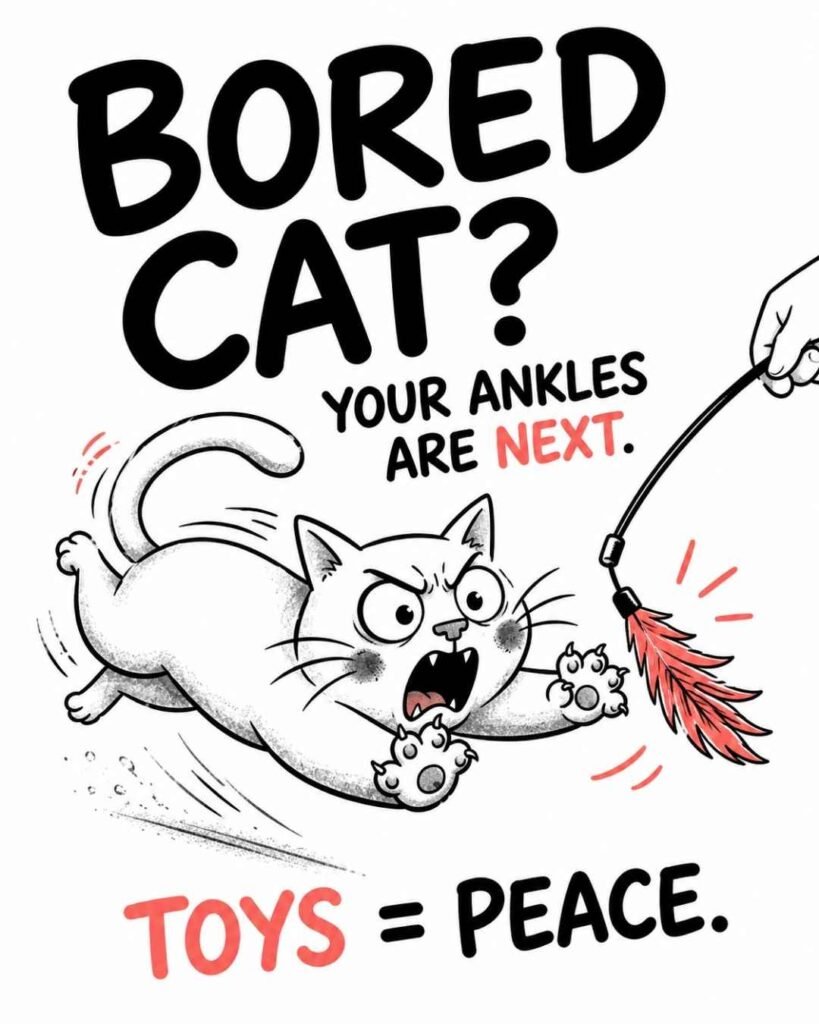
| Low and slow-swishing | Warning issued. You have approximately three seconds before I redirect my energy toward your ankles. |
| Tucked under the body | I am uncomfortable. Reduce the stimulation immediately. |
| Wrapped around your leg | You are my property now. This is a legal claim. |
Read the tail. ALWAYS read the tail. This is free real-time data on my emotional state, delivered continuously, at no charge to you. Use it.
The Cat Slow Blink: What It Means (And Why You Keep Ruining It)
The slow blink is perhaps the most dignified form of feline affection in existence. When a cat looks at you and slowly closes and reopens their eyes, they are communicating: I trust you. I am at ease in your presence. You are tolerable.
This is high praise. This is the cat equivalent of a standing ovation.
Research on feline communication has confirmed that slow blinking at cats — and having them slow blink back — is a genuine bonding behavior. It signals relaxed positive regard. It is the language of mutual trust between cat and hooman.
To return the gesture: make soft eye contact, then slowly close and open your eyes. Do not stare. Do not blink rapidly. Do not squeal immediately after. The squealing undoes everything.
What I am asking for is dignity. Just five seconds of dignity.
Why Does My Cat Show Me Their Butt? (The Butt Presentation Explained)
I understand this confuses you. It shouldn’t.
When a cat turns around and presents their posterior — elevated, unashamed, facing directly at you — they are not being rude. They are demonstrating complete trust. In the feline social world, turning your back and exposing your most vulnerable angle is a profound act of confidence and intimacy. It says: “I am not afraid of you. I trust you not to attack. We are bonded.”
You have been receiving this gesture as a slight. You should have been receiving it as an honor.
The fact that your species greets one another by shaking hands says everything I need to know about your social evolution. We are simply more advanced.
Cat Head Bump (Bunting): You Have Been Claimed
When a cat presses their head against you — what behaviorists call “bunting” — they are doing two things simultaneously:
- Depositing pheromones from scent glands located near their temples, marking you as their territory.
- Expressing affection in the most efficient way possible.
These two things are not mutually exclusive. I can claim ownership of you AND enjoy doing it. Do not read into this more than necessary. You belong to me. That’s it. That’s the whole thing.
Kneading: The Biscuit-Making Explained
“Making biscuits” — the rhythmic pushing of paws against soft surfaces — is a leftover behavior from kittenhood, when kittens kneaded their mother’s belly to stimulate milk flow. In adult cats, this behavior signals deep contentment and comfort.
If a cat kneads on you specifically, congratulations. You have been designated as a comfort object. This is either very touching or very objectifying, depending on your perspective. I suggest choosing touching. It makes things easier.
Part 3: Daily Cat Behaviors Explained (The 3 AM Mysteries)
Why Does My Cat Get Zoomies at 3 AM?
The technical term is “Frenetic Random Activity Periods,” or FRAPs. Hoomans call them “zoomies.” I call them non-negotiable.
Cats are naturally crepuscular — meaning our peak activity periods are dawn and dusk. Your sleep schedule was designed around your own preferences, with no consideration for the ancestral behavioral patterns of the species you chose to invite into your home. This was your oversight, not mine.
The 3 AM zoomies are not chaos. They are scheduled cardio. We are maintaining our physical condition, burning stored energy from the seventeen hours of sleep we just completed, and practicing the hunting sequences our ancestors used to survive. The fact that the “prey” is currently a crinkle ball on your kitchen floor does not diminish the athletic legitimacy of the activity.
Do not fight the zoomies. Accept them. Get better earplugs.
Why Does My Cat Sit in Boxes?
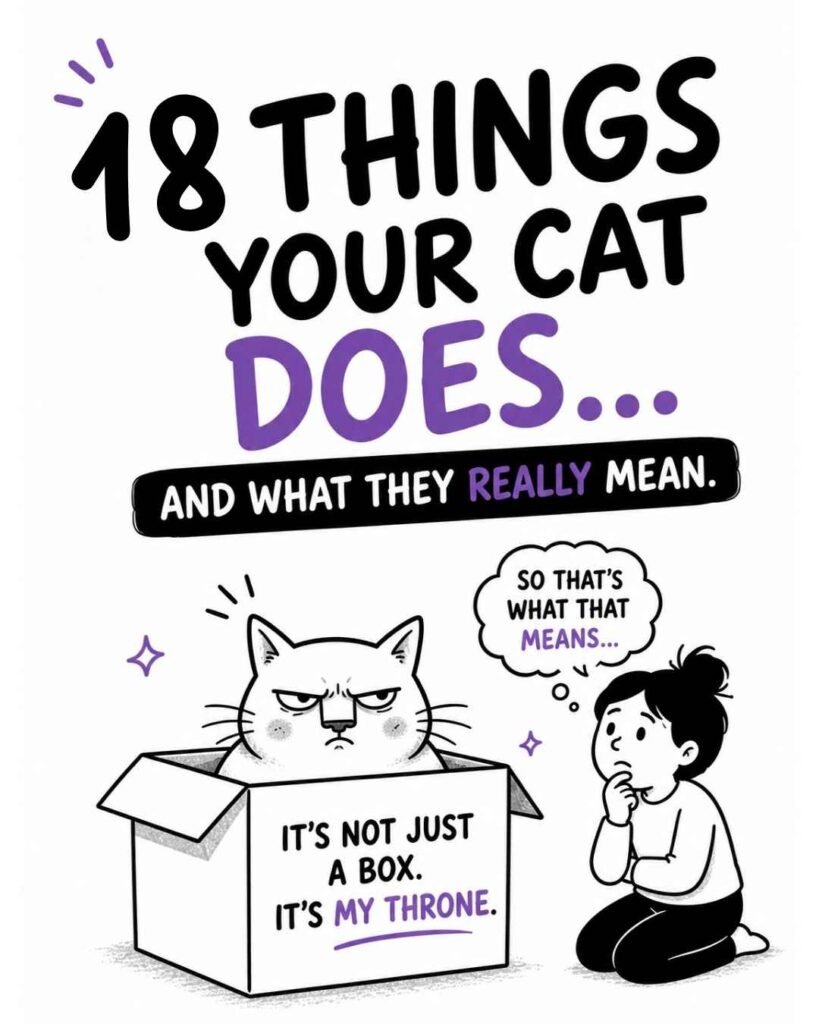
You spent $40 on a plush orthopedic cat bed with memory foam and a built-in heating element. I am sitting in the Amazon box it arrived in.
This is not ingratitude. This is philosophy.
Cats are drawn to small, enclosed spaces because they offer security, warmth, and a clear vantage point on the surrounding environment. An enclosed box allows a cat to observe without being observed — the hunter’s position. The fact that the “threat” I am monitoring is currently you watching television changes nothing about the strategy.
Additionally, the box smells new and interesting and I can shred the corners if I want to.
The $40 bed will be used eventually. Probably in the middle of a Tuesday, when you are at work and unable to appreciate it.
Part 4: How to Speak Cat — A Beginner’s Hooman Guide
Fine. You want to communicate back. I will allow this. Here is what actually works.
The Slow Blink Exchange: Find your cat. Make gentle, non-threatening eye contact. Slowly close and reopen your eyes. Wait. If they return the gesture, you have successfully exchanged affection in the language of cats. If they stare at you blankly and then walk away, try again tomorrow. Consistency is key.
The Chirp Response: When your cat chirps at you, try making a soft, short chirp back. Many cats will find this engaging and respond with more interaction. Some cats will look at you with a mixture of pity and second-hand embarrassment. Both outcomes are acceptable.
The Head Bump Return: When your cat head-bumps you, gently lean into them. You are acknowledging the claim. Resistance is futile and also somewhat offensive. Just accept that you belong to them.
The Treat System (Which You Think Is Negotiable But Is Not): Your cat has learned that specific vocalizations produce treats. You believe you are in control of this system. You are not. You are a variable they have already solved for. The only question is how long you will insist on believing otherwise before delivering the treats. Save time. Deliver the treats.
Part 5: Understanding Your Unique Cat’s Personal Dictionary
Every cat has their own dialect. The general principles of feline communication apply across the species, but your specific cat has their own variations, patterns, and invented signals that exist solely for managing you.
Here is how to start documenting your cat’s personal dictionary — the one actually useful piece of homework I will assign:
Keep a simple log for two weeks. Note:
- What sound or behavior occurred
- What was happening immediately before
- What your cat achieved as a result
You will quickly notice patterns. A specific meow that always precedes food requests. A tail position that reliably predicts zoomies. A slow blink that occurs specifically when you’ve been gone too long and they’re pretending they didn’t miss you. (They missed you. Don’t tell them I said that.)
Understanding cat vocalizations in context — paired with body language, time of day, and circumstances — is how you build genuine fluency in cat communication. It takes time, patience, and humility.
You should have all three of those things by now.
Purrnando-Approved Products (Reluctantly Endorsed)
I have reviewed the following products. They are acceptable. Some of them will be knocked off a shelf within 48 hours of arrival; this is quality testing, not destruction.
1. Inaba Churu Lickable Cat Treats
These are non-negotiable. Stock them at all times. Do not use them as leverage — this strategy has never worked and it never will. They are a diplomatic necessity.
Why it supports cat communication: A cat who has just received a Churu will be temporarily in a positive emotional state, which is the ideal moment to practice slow blinking, head bumps, and general bonding exercises. Use this window wisely.
2. SmartyKat Crinkle Ball Cat Toys (Multi-Pack)
These will be batted under the refrigerator within two days. Buy the multi-pack. This is not a suggestion.
Why it supports cat communication: Interactive play is a key component of feline bonding and communication. A cat who plays with you is a cat who is choosing to engage. This is significant. Do not squander it.
3. Enclosed Cat Cave Bed (Igloo Style)
An enclosed sleeping space that approximates the box experience but with superior thermal properties. I have examined these. They are satisfactory. Whether I will actually use the one you purchase or sit in the shipping box it arrived in, I cannot promise anything.
Why it supports cat communication: A cat who has a designated safe space is a cat who is less stressed overall. Less stressed cats communicate more openly. This is basic feline psychology.
4. Catit Senses 2.0 Digger Interactive Feeder
This hooman invention simulates hunting behavior at mealtime. I find it tolerable. The fact that it also slows down eating and supports digestion is secondary to the entertainment value of extracting kibble from cylinders while making direct eye contact with you to demonstrate that I don’t need your help.
Why it supports cat communication: Enrichment reduces boredom-related vocalization (the 3 AM meowing that is, in fact, my fault). A stimulated cat is a quieter cat. You’re welcome.
5. Da Bird Feather Wand Cat Toy
This is the one toy I will acknowledge as genuinely effective. The irregular movement pattern engages prey drive in a way that cheaper alternatives do not. I have tested extensively. The data is clear.
Why it supports cat communication: Interactive wand play — where the hooman controls the toy and the cat responds — is one of the most direct forms of cat-hooman communication available. Read the body language during play. Watch the ears, the crouch, the tail. This is your cat fully present and engaged. It is the best conversation you will have all week.
The Final Truth About Feline Communication
Here it is. The part where I wrap up and pretend to be warm about it.
Cats are not mysterious. We are not aloof for the sake of it. We are communicating constantly — through our vocalizations, our tails, our eyes, our posture, our 3 AM zoomies, our refusal to use the $40 bed, our decision to knock your phone off the counter at 7 AM specifically. All of it is language. All of it means something.
The problem has never been that cats don’t communicate. The problem is that hoomans are remarkably poor listeners.
Pay attention. Be quiet. Observe without immediately projecting your own emotions onto what you see. Learn the difference between a purr of contentment and a purr of stress. Read the tail before you reach out a hand. Respect the slow blink. Accept the butt.
Do this, and your cat will be — if not openly affectionate — at least marginally less judgmental about your continued presence in their home.
That is the highest compliment we offer.
Purrnando out.
…Don’t touch me.
Affiliate disclosure: if you buy through our links, we earn a small commission. Purrnando has been informed of this and is choosing to be offended that it isn’t larger.