You know that feeling when your cat does something weird — limps once, sneezes twice, stares at the wall for too long — and instead of immediately Googling “cat death symptoms” while your heart rate triples, you just think, I’ll take them in tomorrow.
Calm. Unbothered. Like a person who actually has their life together.
There’s a specific number in your savings account that creates that feeling. And it’s not what you think.
My name is Purrnando. I’m a white cat with no veterinary degree, no financial license, and a deep personal investment in making sure you stop panicking every time I so much as sneeze near a houseplant. I have watched my humans spiral over my care expenses for years. It is exhausting. Mostly for me.
So let’s fix this.
The Number Is $20,000, or More Realistically for You: A Properly Funded Cat Emergency Fund.
Most cat owners think about pet finances in one of two ways.
Option one: I’ll figure it out when something happens. This is how you end up crying in a vet parking lot at 11pm negotiating a payment plan for emergency surgery while your cat judges you from inside a carrier.
Option two: I’ll get pet insurance and hope for the best. Better. But not a complete picture.
What nobody talks about is the third thing — the thing that actually changes your relationship with cat ownership from anxious to confident.
It’s having enough liquid savings that an unexpected vet bill doesn’t feel like a financial catastrophe.
For cat owners, this number is smaller than $20,000. But the principle is identical. And understanding it will completely change how you experience owning a cat.
Your Brain on “No Cat Fund”
When you don’t have savings set aside for your cat, every single health quirk becomes a psychological emergency.
Your cat vomits once — probably just hairball, definitely maybe cancer. Do you go to the vet? What if it’s $800? What if it’s $3,000? What if you put it on a credit card and then something else happens next month?
This is your brain in survival mode. Reactive. Skittish. Unable to make calm, rational decisions because the financial threat feels constant.
Research shows that having even a small financial buffer — we’re talking a few thousand dollars — increases overall well-being by over 20%, because your brain finally stops doing threat assessment every five minutes and starts operating like a functional adult instead of a golden retriever during a thunderstorm.
For cat owners specifically, this matters enormously because the cost of cat ownership is not the $25 bag of kibble. It’s the unpredictable costs – the dental cleaning you didn’t budget for, the hyperthyroidism diagnosis at age 11, the “we’d like to run some bloodwork” that somehow costs $400.
When those things blindside a financially unprepared cat owner, one of two things happens: they go into debt, or — and this one physically pains me to say — they delay or skip care because they can’t afford it.
Neither of these is acceptable, especially that second one.
What a Real Cat Financial Foundation Looks Like
Let’s break this down practically, because you deserve actual numbers, not vague inspiration.
The average cat costs between $1,000 and $2,000 per year in routine expenses — food, litter, annual vet visits, the occasional toy you’ll buy while they ignore it and sleep on the packaging.
But a single emergency vet visit? $500 to $3,000, depending on what’s wrong. A serious diagnosis — kidney disease, cancer, a blocked urinary tract — can run anywhere from $3,000 to $10,000 or more over the course of treatment.
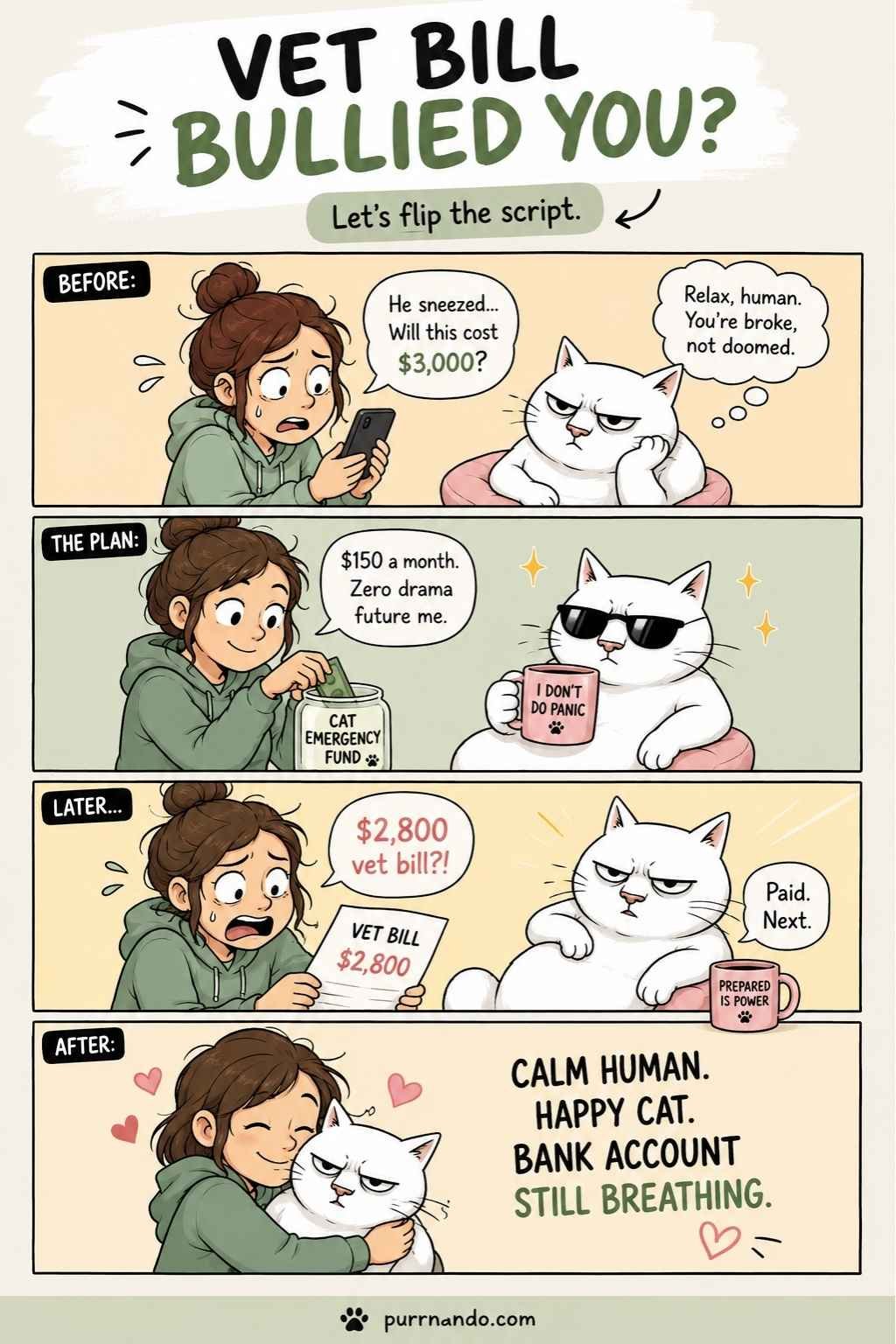
This means your cat emergency fund needs to have a minimum floor of about $2,000 to $3,000, just to keep your brain out of crisis mode for the everyday surprises. That’s your first threshold — the equivalent of the $2,000 general emergency fund. It won’t cover everything, but it covers enough that a single vet visit doesn’t derail your entire month.
Your real target — the number that actually changes the game — is enough to cover a worst-case scenario without touching your personal emergency fund or going into debt.
For most cats, that’s $5,000 to $10,000 earmarked, sitting somewhere accessible.
That is your cat’s $20,000 equivalent. And once you have it, the entire experience of owning a cat changes.
The Math That Will Make You Feel Better Immediately
Here’s the part nobody explains.
If you set aside $150 a month into a dedicated cat fund — separate account, do not touch it, it is not yours — you hit $3,000 in 20 months. You hit $5,000 in about 33 months.
But here’s what happens once you’ve hit that first $3,000 milestone: the second $3,000 is psychologically easier. Not because the math changes dramatically, but because you’ve already proved to yourself that you can do it. You’ve built the habit. The money is already moving automatically. You stop thinking about it as a sacrifice and start thinking about it as just what you do.
And the moment that fund sits at $5,000? You will feel it. That’s the number where you go from I hope nothing goes wrong to we’ll handle whatever comes.
That shift is not small. That is the entire difference between dreading cat ownership and actually enjoying it.
What This Money Actually Builds (Beyond the Number)
To save $5,000 in a dedicated cat fund, you had to make choices. You had to decide that your cat’s security was worth more than some of the things you were spending money on instead.
And in doing that — quietly, month by month — you became the kind of cat owner who follows through, who plans ahead, who doesn’t let guilt and financial panic drive medical decisions.
That matters because financial stress is one of the leading reasons cats don’t get the care they need. Not because their owners don’t love them, but because their owners didn’t have a plan. And when the moment came, the numbers were too scary.
You having a funded cat emergency account is, quite literally, an act of love with a dollar sign on it.
I am not being sentimental. I am being accurate.
What to Actually Do With the Money Once You Have It
Once your cat fund is fully funded, do not spend it on unnecessary things just because it’s sitting there.
That $5,000 is not a budget for premium organic raw food subscriptions and a custom cat tree. It is not a fund for accessories. It is not yours to borrow from when you see a sale on something you don’t need.
It is a fire extinguisher. You don’t decorate a fire extinguisher. You leave it exactly where it is so it’s there when you need it.
That said — and I say this with considerable reluctance — pet insurance is genuinely worth considering as a complement to your cash fund, not a replacement for it. Insurance handles the catastrophic, unpredictable costs. Your cash fund handles the gap between what insurance covers and what the vet actually charges, the deductibles, the waiting periods, the things that aren’t covered.
Together, they mean that the words “we’d like to keep them overnight for observation” never again make you feel like the floor has dropped out from under you.
The Larger Point
Cat ownership is one of the few things in modern life that can genuinely blindside you financially with almost no warning. Cats are stoic. They hide illness. By the time they show symptoms, it’s often already been going on for a while — which means treatment can be expensive.
A cat with a funded emergency reserve is a cat whose owner can say yes to the treatment without hesitation, without a frantic mental calculation, without getting on a payment plan that follows them around for the next eight months.
Build the fund. Not because it’s fun to save money — it isn’t, it’s tedious, I understand — but because the alternative is making the worst decisions of your pet-owning life in the worst possible moment, when you’re scared and tired and a vet is waiting for your answer.
Your cat cannot advocate for themselves. They are relying entirely on your preparedness.
No pressure.
Purrnando has no veterinary credentials. Purrnando does not want any. Purrnando would, however, like you to check when your cat last had bloodwork done. Just a thought.
Affiliate disclosure: if you buy through our links, we earn a small commission. Purrnando has been informed of this and is choosing to be offended that it isn’t larger.