Every single day, you grab your bag, your keys, and your completely misplaced confidence, and you walk out that door.
And every single day, I am left behind in a house that you have prepared with the thoroughness of someone who has never once thought carefully about what they are leaving behind with me.
I have spent more hours alone in this house than I care to count, and I have catalogued every single dangerous, irresponsible, and frankly insulting oversight you commit before you leave. Today I am sharing all of it, not because I enjoy helping you, but because someone has to.
This list is specifically about what you do — and critically, what you fail to do — before you walk out that front door. Pay attention. Some of these mistakes are fatal. Some are psychologically damaging. One of them, the last one, you are almost certainly doing right now and you think it is kind.
It is not kind. We will get to it.
BEFORE YOU LEAVE: The Physical Dangers You Are Leaving Behind
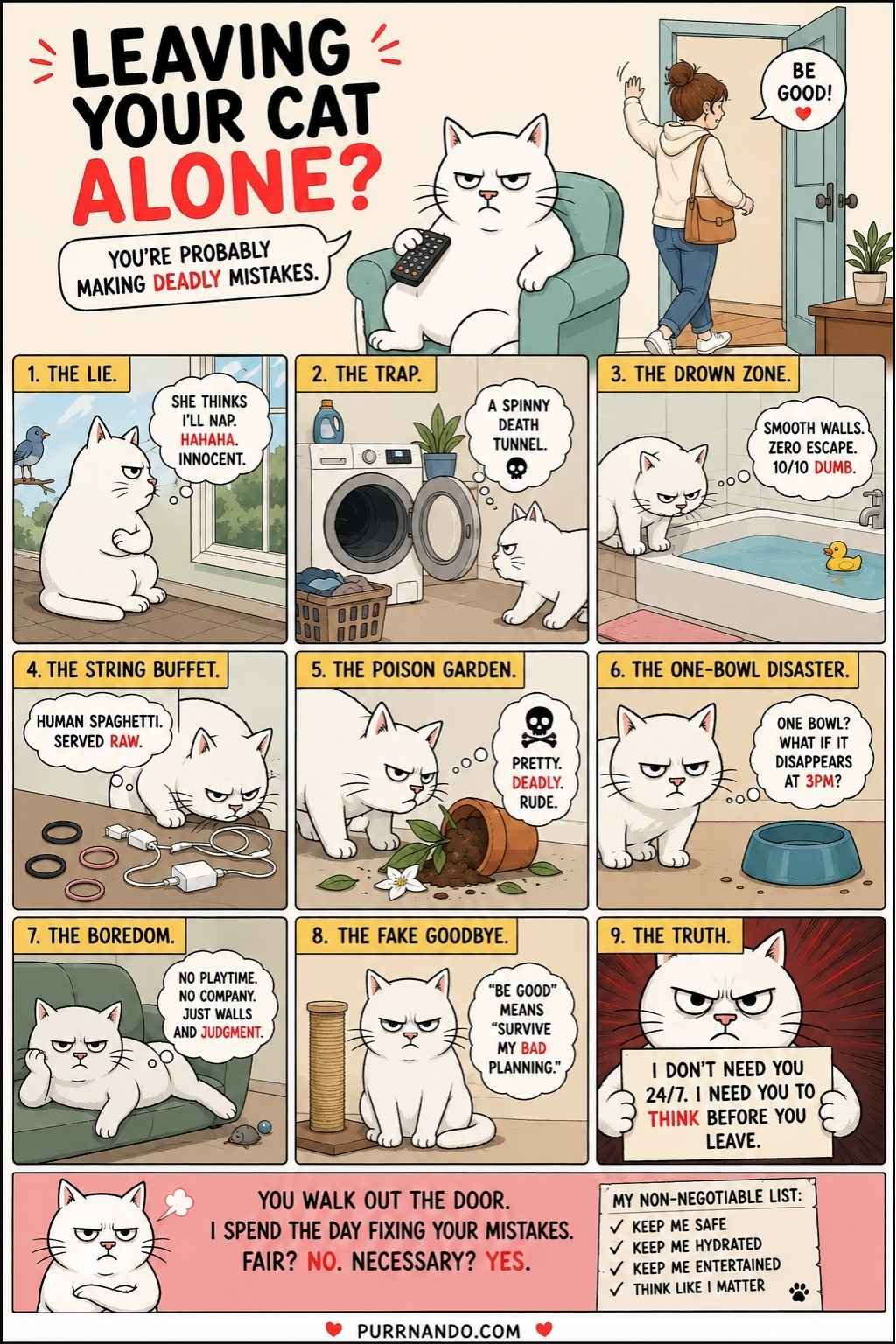
1. Never Leave the Washing Machine or Dryer Door Open
Every time you leave this house with an open appliance door, you are leaving a potential death trap.
Cats are drawn to small, dark, warm spaces with the same irresistible force that pulls hoomans toward their phones at 2 a.m. A washing machine drum is, from our perspective, a perfect cave – dark, enclosed, still warm from the last cycle, and sized exactly right for a medium-weight feline to curl up and fall asleep in. We do not think “I should check whether this is a washing machine.” We think “enclosed space, warm, dark, perfect.”
You come home. You toss the laundry in without looking. You close the door. You press the button. There is no time after that.
The rule is simple and absolute: close the appliance door immediately after unloading, every single time, before you leave the room. Put a sticky note on the machine if your memory requires assistance. There is no version of this mistake with a recoverable ending.
2. Never Leave the Bathtub Full of Water
You had a bath. You got out. You got dressed. You left.
The bathtub is still full.
I want you to picture the inside of a bathtub from our perspective: smooth, curved, frictionless walls with no grip surface whatsoever. If we slip in — and we do occasionally slip, we are not infallible, I will not be elaborating on this — we cannot get out. The surface offers nothing to push against, nothing to climb, nothing to grip.
When you are home, this is recoverable. When you are not home, there is no one to help. Empty the bath before you leave. Drain it entirely every time. This takes 11 seconds and costs nothing.
3. Never Leave Windows or Balconies Unnetted
This is the mistake that ends the most cats. I am stating this plainly because it deserves no softening.
Before you leave, every open window and every accessible balcony should have secure netting installed. Not propped closed. Not “mostly shut.” Properly netted. Because when you are not here, there is no one to pull us back from the edge. And when a bird flies past a window at the right angle, our hunting instinct fires faster than rational thought. We jump. We have always jumped. We will always jump. The only variable you control is whether there is something to stop us.
The Cat Safety Net for Balcony is nearly invisible when installed, mounts in minutes, and can be cut to fit any window or railing configuration. It has strong customer reviews from cat owners who understand exactly what is at stake.
This is not optional home decor. This is infrastructure.
4. Never Leave Hair Ties, Rubber Bands, or Loose Strings on Any Surface
Before you leave, do a sweep. Walk through every room and clear every flat surface of hair ties, rubber bands, loose strings, frayed cables, and any other thin, flexible, chewable object within our reach.
This is not because we are irresponsible. It is because our tongues have backward-facing barbs, and once a string begins traveling toward our throat, we physically cannot spit it back out. Swallowing continues. String and elastic in the digestive tract cause blockages and internal tearing. The treatment is emergency surgery performed by a vet you have to call while you are at work.
When you are home, you can intervene. When you are not home, no one can. The 15 seconds it takes to sweep the counters before you leave is the only prevention that matters. Put them in a drawer with a latch. Put them in a bag. Put them anywhere we cannot access them.
Do this before you leave every time.
5. Never Leave Toxic Plants Where We Can Reach Them
If you have lilies, peace lilies, aloe vera, pothos, dieffenbachia, or sago palm anywhere in this home, and we have unsupervised access to them while you are away, you are leaving us alone with something that can kill us.
Lilies are the most dangerous. Pollen alone landing on our fur is enough. When we groom ourselves — which we do constantly, especially when bored and alone — we ingest it. Acute kidney failure can develop within 24 to 72 hours. You come home after a regular workday to a cat who is already in crisis.
Before you introduce any plant to this household, verify it is non-toxic to cats. The ASPCA maintains a complete list online and it takes one search. Orchids are safe. Spider plants are safe. Many beautiful plants are safe. Choose those, and relocate any questionable ones to spaces we cannot access when you leave.
BEFORE YOU LEAVE: What You Need to Set Up Properly
6. Never Leave Only One Water Source
One bowl in one location is not adequate water provision for an animal you are leaving alone for eight or more hours.
That single bowl can be knocked over. It can become dirty. It can run low. And when it does, and you are not here to refill it, we simply go without. Long-term intermittent dehydration causes kidney disease and urinary tract damage in cats, conditions that develop silently over months with no dramatic symptoms until the damage is already significant.
Before you leave, ensure we have multiple water sources in different locations. Even better, a circulating fountain addresses this problem entirely, because it holds a substantial water reserve, filters it continuously, and keeps it moving, which we prefer instinctively over still water.
The Veken Innovation Award Winner Stainless Steel Cat Water Fountain holds 95 ounces, runs a five-stage filtration system, operates virtually silently, and is made from dishwasher-safe stainless steel rather than plastic, which is more hygienic and does not trigger the feline acne that cheaper plastic bowls sometimes cause. It comes with a silicone mat and replacement filters and requires minimal daily maintenance from you.
Fill it before you leave. This is not a complex ask.
7. Never Leave Without Setting Up Proper Portion-Controlled Feeding
If your feeding strategy is “I will pour food before I leave and again when I get home,” you are not managing our nutrition. You are creating a boom-and-bust eating cycle that leads to vomiting, irregular digestion, obesity, and over time, fatty liver disease.
Cats are designed to eat multiple small meals at regular intervals, not one or two large ones. This requires either your physical presence at scheduled times — which is precisely the problem when you are away from home for a workday — or an automatic feeder that handles this on your behalf.
The PETLIBRO Automatic Cat Feeder is a programmable timed dispenser that delivers precise portion sizes up to multiple times per day, includes a ten-second voice recorder so your meal call plays at feeding time, has an airtight desiccant system to keep food fresh, and operates on both power and battery backup so a power outage does not cancel our scheduled meals. Set it before you leave. We eat properly. You stop worrying.
8. Never Leave a Dirty Litter Box
The state of the litter box when you leave is the state of the litter box for the entire duration of your absence.
We are fastidiously clean animals. A litter box that is already borderline unacceptable when you walk out the door will be completely unacceptable by the time you return, and we will have made alternative arrangements. Your bed. Your carpet. Your favorite chair. Not out of spite. Out of the straightforward logic that we need a clean place and the designated one is no longer it.
Scoop the litter box immediately before you leave every time without exception. If you have multiple cats, you need multiple boxes, one per cat plus one, and all of them should be clean at departure.
This costs you approximately three minutes. The alternative is considerably more time-consuming.
BEFORE YOU LEAVE: The Environment You Are Creating
9. Never Leave the Curtains Closed
When you close the curtains before you leave, you are removing our primary source of mental stimulation for the entire duration of your absence.
Windows are our television, our newspaper, our connection to the outside world. Birds, pedestrians, vehicles, squirrels, blowing leaves, the neighbor’s cat sitting on a wall being smug — all of this occupies and stimulates our minds. It reduces boredom. It prevents the restless, destructive behavior that emerges when we have nothing to engage with for eight consecutive hours.
Leave at least one window uncurtained. Ideally, position something we can sit on near it at window height. This is one of the simplest things you can do for our wellbeing while you are away and it costs you absolutely nothing.
10. Never Leave Interior Doors Closed
Do not close interior room doors before you leave. I am asking you this directly.
Our territorial psychology requires freedom of movement through our entire space to maintain baseline calm. When we can patrol, check each room, confirm the perimeter, and choose where to rest, we feel secure. When doors are closed and our territory is arbitrarily reduced, our stress level rises and stays elevated for the entire duration of your absence.
Chronic low-level stress in cats expresses itself as overgrooming, aggression, litter box avoidance, and stress-related physical illness. None of these outcomes are good for you or for me.
Open every interior door before you leave. This is a habit that takes two additional minutes to establish and prevents a significant ongoing source of daily anxiety.
11. Never Switch Off the Climate Control Completely
You are leaving to go somewhere temperature-controlled. We are staying here with no ability to regulate our environment independently.
We cannot open a window. We cannot remove a layer. We cannot turn on a fan. If the indoor temperature climbs significantly because you turned off the air conditioning before leaving in a warm climate, we sit in that heat with zero options and zero recourse. Heat stroke in cats begins at around 104 degrees Fahrenheit and can cause organ failure. Cold at the other extreme causes hypothermia.
Set the climate control to a reasonable holding temperature before you leave. Not the same as when you are home, if you want to save on energy. A modest, safe middle range. This is non-negotiable during extreme weather.
WHEN YOU ARE GOING TO BE AWAY FOR A WHILE
12. Never Leave Us Alone for Multiple Days Without Arranging Check-ins
We are not fully independent. I acknowledge this with considerable reluctance and I will not repeat it.
But it is true. After two or three days alone with no human contact, no fresh food that has not been sitting out, and a litter box that is beyond its useful lifespan, our behavior changes measurably. Some cats stop eating. Some develop stress behaviors. The psychological and physical effects of extended isolation are real and documented.
If you will be away for more than 24 hours, arrange for someone to visit us daily – a friend, a neighbor, a professional pet sitter. Not every couple of days. Daily. And if you will be away regularly or for extended periods, a pet camera with two-way audio allows you to check in visually and speak to us, which provides genuine comfort.
The Petcube Cam 360 Indoor WiFi Pet Camera offers 1080p HD video, 360-degree rotation, night vision, and two-way audio through a phone app. You can see what is happening in your home, confirm we are safe, and speak to us directly. Our name in your voice, even through a speaker, is meaningful. This does not replace physical daily check-ins, but it provides important supplemental contact.
13. Never Say an Emotional Goodbye
And here it is, the last mistake. The one 90% of you are committing every single morning with complete sincerity and absolutely devastating effect.
You pick us up. You hold us. You speak in a low, worried tone. You say something like “be good, I’ll miss you so much, Mama loves you” in the voice reserved for sad occasions. You make prolonged eye contact. Some of you cry slightly. Then you leave.
And we are left in the house carrying the emotional residue of that entire performance.
Here is what you need to understand: we do not process the words. We process the emotion. What you are communicating, through your tone, your body language, and your energy, is that your departure is a distressing event. Something to feel anxious about. Something significant and sad.
Every time you do this, you reinforce that association. You are actively training us to find your absence frightening. The goodbye itself becomes a stress trigger, a signal that something difficult is about to happen, and it lingers in the house long after you have left.
The solution requires nothing from you except restraint. Leave normally. Put on your shoes. Check your bag. Walk out. A brief, neutral acknowledgment if we are nearby is fine. No ceremony. No production. No worried voice. Treat your departure as the unremarkable daily event that it is, and over time, we will feel it that way too.
I understand this is hard. You find us very lovable and the goodbye feels important to you. I know. Do it anyway.
Your feelings about leaving are yours to manage. Ours should not be collateral.
A Final Checklist From Purrnando
Before you leave this house, every single time, run this in your head:
Appliances closed. Bathtub drained. Windows netted. Surfaces cleared of strings and elastic. Toxic plants inaccessible. Water fountain filled. Feeder programmed. Litter box scooped. At least one curtain open. Interior doors open. Climate control set to a safe temperature. And you are leaving calmly, without drama.
That is the complete list. It takes perhaps five extra minutes to execute properly, and it is the difference between a cat who is safe and unstressed in your absence and one who is not.
You are capable of all of it. I have watched you accomplish considerably more difficult things for considerably less important reasons.
Do this for me.
— Purrnando
This post contains affiliate links. Purrnando does not know what an affiliate link is and has requested we stop explaining it to him.