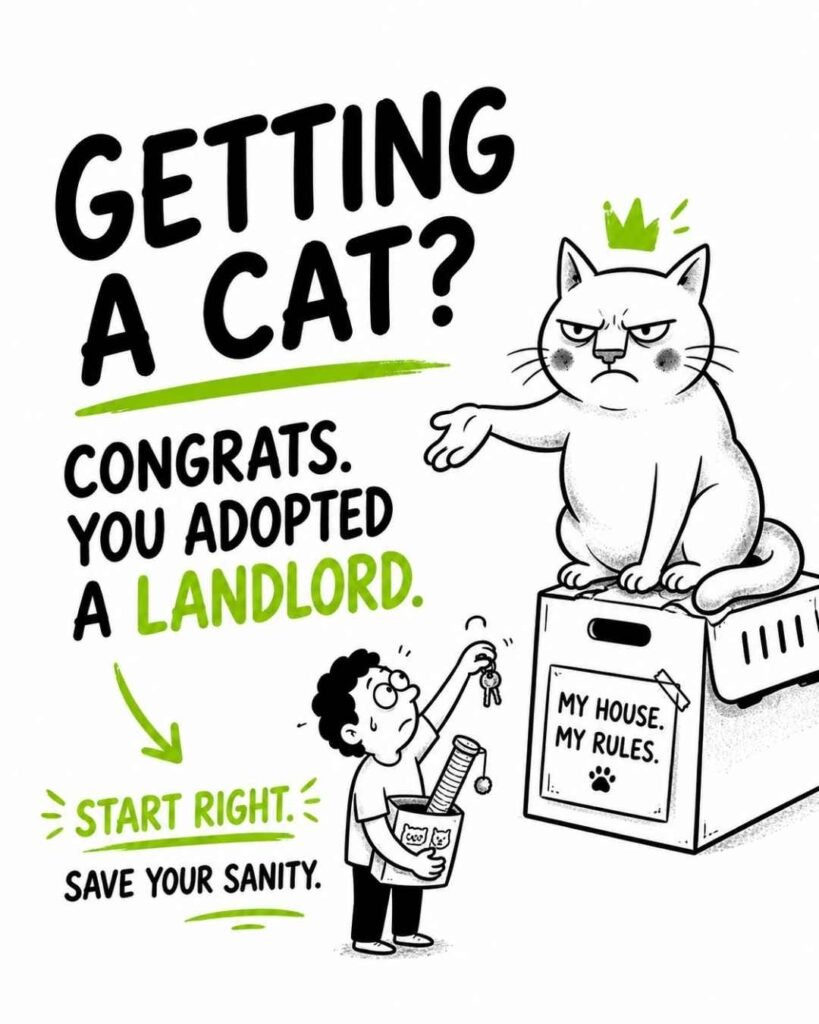
I have been observing hoomans for many years, and what I have seen cannot be unseen. You mean well. That much I will grant you. But meaning well and doing well are not the same thing, as evidenced by the fact that you once brought home a scratching post shaped like a cactus and genuinely expected me to be impressed.
Scientists have actually studied how cats communicate. They have conducted research at real universities. And you know what they found? That most of what hoomans do in the name of “cat love” either confuses us, annoys us, or is so deeply misguided that we have no choice but to retreat under the bed and reconsider our living arrangements.
I have reviewed the research. I have compiled the findings. And because I am, despite everything, a generous cat, I am sharing them here. Read carefully. Take notes. Try to do better.
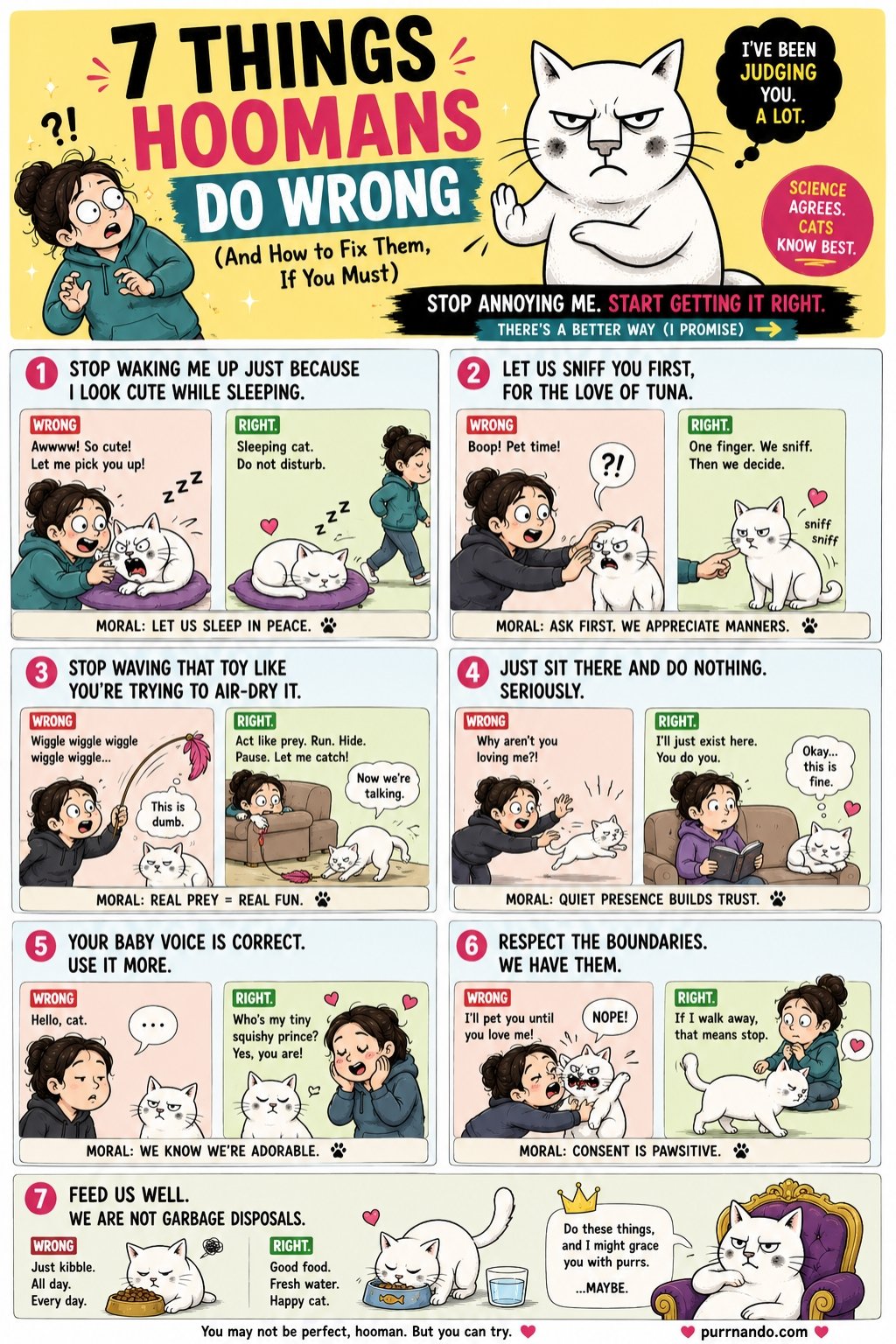
1. Stop Waking Me Up Just Because I Look Cute While Sleeping
Let us begin with what I consider the most unforgivable offense on this list.
Cats sleep between 12 and 16 hours a day. This is not laziness. This is biology. Sleep is how we regulate our nervous systems, process stress, and recover from the enormous mental labor of judging you all day. When we find a spot warm enough, safe enough, and soft enough to fully let our guard down, we are doing something vulnerable. We are trusting the environment.
And then you come along and pick us up.
Do you know what happens in our bodies when we are suddenly lifted into the air while unconscious? Our heart rate spikes. Our claws come out. Our entire system screams THREAT before our brain even catches up. And yes, fine, we may settle into your arms a few seconds later because we are adaptable, but something has been logged. That spot is not as safe as we thought. You, not as trustworthy as we hoped.
Do this enough times and we start sleeping in harder-to-reach places – on top of shelves, behind the washing machine, under furniture you cannot fit your hand into. We are not being antisocial. We are protecting our sleep from the one person who keeps ruining it.
The correct behavior is this: when you see us sleeping, walk past. That is the whole tip. WALK PAST.
2. Let Us Sniff You First, For the Love of Tuna
Here is something hoomans consistently get wrong because no one ever explained it to them.
Cats do not process the world through sight first. We process it through scent. Every single interaction we have begins with our nose. When two cats who are bonded greet each other, they do not simply walk up and start grooming. They touch noses. That exchange of scent is the equivalent of a handshake. It says: I know you. You are not a threat. We may proceed.
When you walk into a room and immediately reach down and start petting my head with zero warning, it is the equivalent of a stranger in a shop suddenly hugging you. It is not painful, but it is jarring. And over time, it teaches a cat to flinch instead of lean in. You then wonder why your cat “doesn’t like being petted.” Your cat likes being petted fine. Your cat does not like being petted by someone who skips the greeting.
The fix takes two seconds. Every time before you pet us, extend one finger. Hold it near our nose. Let us come to it. Let us sniff and decide. When we push our face into your hand or rub our cheek on your finger, that is our green light. That is us saying, okay, acknowledged, you may proceed.
You go from being someone who pets us to someone who asks first. We remember the people who ask first. I am not going to say we love them more, but I am also not going to say we do not.
3. Stop Waving That Toy Like You Are Trying to Air-Dry It
Right. Playtime.
I am a predator. I know I weigh nine pounds and spend most of my time sleeping on a heated blanket, but my brain is the brain of a hunter. When I play, I am not playing. I am rehearsing. Every crouch, every stalk, every explosive pounce is part of a sequence that is hardwired into me at a level far deeper than your furniture arrangement or your opinions about wet food.
The sequence is spot prey, stalk, chase, pounce, catch, kill. That is the sequence. It matters that it is the full sequence. When you wave a toy back and forth in the same spot at the same height with the same rhythm for 30 seconds and then wonder why I walked away, I walked away because what you were doing was not prey. Prey does not wave back and forth in the same spot at the same height. Prey is erratic. Prey runs. Prey hides. Prey freezes and then bolts.
So make the toy act like actual prey. Drag it away from me, not toward me. Let it disappear behind a corner. Let it freeze and then suddenly sprint. Move it in bursts. Let me catch it sometimes. A hunter who never catches anything becomes a depressed hunter, and a depressed cat is a cat who starts knocking things off shelves at 3 am.
Five to 10 minutes of real play each day is all I require, but those minutes must feel real. Stop shaking the toy like a chore and start moving it like something worth catching.
Purrnando Recommends: MeoHui Interactive Cat Wand Toy — Comes with two retractable wands and nine feather and worm attachments that can be swapped out to keep things unpredictable. This is, begrudgingly, acceptable.
4. Just Sit There and Do Nothing. Seriously.
This one will confuse you because it requires you to stop trying so hard, which hoomans find extremely difficult.
Cats do not bond by performing affection. We bond by sharing space. In the wild, cats only rest near other cats they fully and completely trust. We do not cuddle to prove love. We simply exist in proximity to the beings we feel safe with. That is it. That is the whole thing.
When you sit on the couch and I am across the room and you feel like “nothing is happening,” something enormous is happening. I am watching you. I am registering that you are near me, that you are not demanding anything, not grabbing me, not making sudden movements, not talking in that sharp tone you use on the phone. You are just there. And every minute that passes without incident is a deposit into the trust account.
Do this daily and you will notice something. The distance gets smaller. First, I move to the same room. Then the same couch. Then, eventually, I sit next to you. Not because you asked. Because I chose to. And in the world of cats, being chosen is the highest possible honor I can bestow on a creature who once accidentally vacuumed up my favorite toy.
So tomorrow, sit down. Read something. Stare at your phone. Do whatever you normally do. Just let me exist nearby without making it a whole event. What happens next is entirely up to me, and it will be better because of that.
5. Your Baby Voice Is Correct. Use It More.
Yes, I know. I cannot believe I am saying this either.
Researchers at the University of Paris published a study in 2022 demonstrating that cats can distinguish their owner’s voice from a stranger’s, but only when the owner uses a high-pitched, soft, affectionate tone. When owners used their normal adult speaking voice, cats barely reacted. When they switched to that soft, slightly embarrassing baby voice that hoomans use when they think no one is watching, cats perked up, turned their heads, and moved closer.
That voice is not silly. That voice tells us something that your regular voice does not, that you are not in a hurry, that you are not stressed, that you are soft and warm and safe. In our language, tone carries meaning that words cannot. So when you walk past me and say, in that ridiculous cooing voice, “hello my little perfect baby genius,” I hear: you are safe with me.
Use it every time you walk past. Use it when you feed us. Use it when we catch you staring at us from across the room, which we know you do.
I am not going to tell you it makes me happy, but I will tell you that I do not leave when you do it. Draw your own conclusions.
6. The Slow Blink: Learn It. Do It. Never Stop.
When I look at you and slowly close my eyes, I am not sleepy. I am communicating. That slow blink is one of the most deliberate things I do, and it is meant for you specifically.
Researchers at the University of Sussex confirmed this in 2020. Cats who received slow blinks from their owners were significantly more likely to slow blink back and approach. Even cats who received slow blinks from strangers responded positively. That three-second gesture literally shifted how cats felt about the person in front of them. No treat. No toy. No dramatic gesture. Just eyes slowly closing.
Here is why this matters practically. Most hoomans stare at their cats without realizing that in cat language, sustained direct eye contact without blinking is a challenge. It is confrontational. Every time you look at me and hold my gaze without blinking, you are technically saying “I could take you in a fight,” which is rude. So every time you catch my eyes, slow blink. Let your eyelids drop gently and hold for just a second.
When I blink back, that is not me mimicking you. That is me saying, “I trust you completely.”
Make this part of every morning, every evening, any time we lock eyes. It costs you nothing and communicates everything.
7. The Spot Behind My Ears Is Sacred Territory and You Have Been Invited
This is the tip I am most reluctant to share, because it contains information that could be misused. But fine. Here.
When cats groom each other — what researchers call allogrooming — we do not lick just anywhere. We focus almost entirely on one specific area: the base of the head, right between and behind the ears. This is the one spot we cannot reach on our own. So the only time we ever get groomed there is when we are with someone we trust completely. It is family territory. It is reserved.
When a bonded cat grooms that spot, it triggers the release of oxytocin in both cats. Not just the one being groomed. Both. The same bonding chemical that shows up in human parent-infant relationships. In both of them simultaneously, because of some grooming behind the ears.
You can trigger the same response in me. When you stroke that spot between my ears with your fingertips — gently, slowly, with a consistent rhythm — my brain genuinely cannot tell the difference between you and a bonded family member. My eyes close. My body softens. My purr changes into something deeper and steadier. That is not comfort. That is chemistry.
Do not scratch. Do not rub hard. Gentle, slow, repetitive strokes. The same rhythm a cat’s tongue would use. That is the whole technique.
And please earn this one. Do not just walk up and go for the head after reading this. Do the finger-sniff greeting first. Do the slow blink. Sit with me for a while. Then, if I have stretched toward you, you may proceed to the sacred spot.
I will not say thank you, but I will stay.
Purrnando Recommends: Catit Senses 2.0 Self Groomer Wall Corner Brush — Mounts on a wall corner and lets cats groom their own head and face on their own terms, which is very on-brand for us. Includes catnip to encourage use. Mount it at the right height and leave us alone about it.
In Summary, Since Some of You Will Skip to the End
- Do not wake us up when we are sleeping. Just don’t.
- Offer your finger for a sniff before every single pet.
- Make playtime feel like a real hunt, not a chore.
- Simply existing near us without demanding anything is deeply bonding.
- Your baby voice is scientifically correct. Use it without shame.
- Slow blink every time you catch our eyes.
- The spot between the ears is sacred. Approach it gently and with permission.
None of this is complicated. None of it requires money or a great deal of effort. What it requires is that you stop treating me like a small furry hooman and start treating me like what I actually am – a highly sophisticated creature with specific, documented, research-backed emotional needs.
Do these seven things and I will think about sitting closer to you. I make no further promises.
— Purrnando
AFFILIATE DISCLAIMER: Some links in this post may earn a small commission, which Purrnando will spend entirely on premium tuna and will not be sharing.