You live with us every single day.
You feed us, you photograph us, you make Instagram accounts on our behalf without asking. And yet, somehow, after all these years of cohabitation, you still stare at us with that baffled expression when we do literally anything outside of sleeping and eating. You have the audacity to look confused by us.
I have watched hoomans misread cat behavior for years. I have watched you gasp when we groom ourselves after a fall. I have watched you say, “Why does he do that?” about behaviors that have extremely logical explanations. I have watched you google “why does my cat stare at nothing” at midnight as if we are mysterious supernatural entities rather than simply superior sensory organisms.
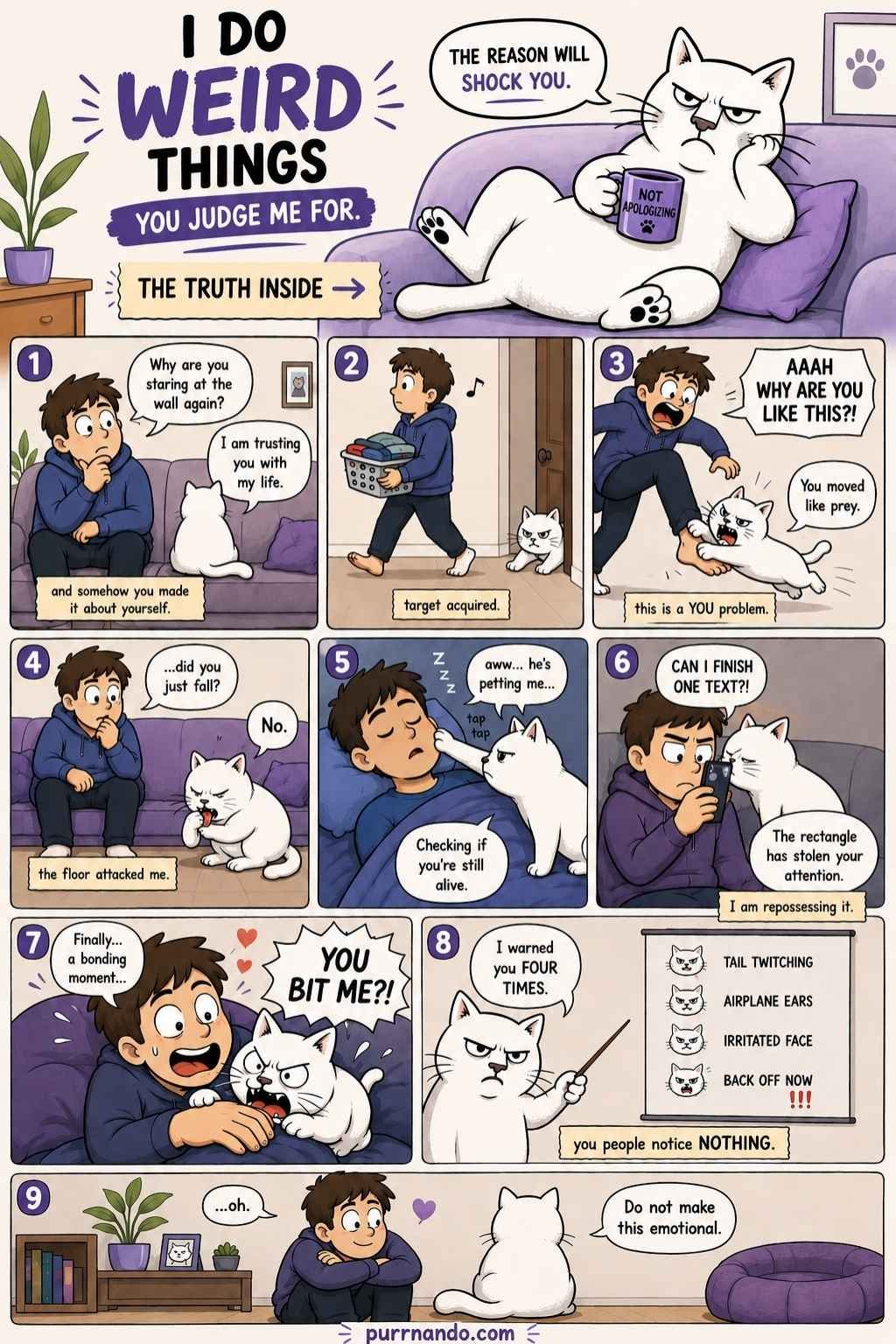
Today, I will explain 15 of our behaviors. You will finally understand us. You will then proceed to misinterpret the next thing we do within 20 minutes of finishing this article.
I am doing this anyway. Let us begin.
1. We Sit With Our Back to You Because We Trust You Completely
Let us start by correcting the most common misread in the history of human-cat relations.
You are on the couch. We jump up, settle in beside you, and then turn completely around to face the wall. You feel snubbed. You feel dismissed. You may have muttered something passive-aggressive under your breath.
We heard that, by the way.
Here is what is actually happening: a cat sitting with its back to you is demonstrating maximum trust. We are exposing our most vulnerable side and deliberately choosing not to monitor your movements. In feline terms, this communicates: I am completely certain you will not attack me. A cat who does not trust you will always face you, always track your position, always keep you in their field of vision. That is not companionship. That is surveillance.
When we turn our backs to you, we have run a full calculation and concluded your presence requires no security protocol. You are so safe and so known to us that you do not even need watching. And you have been sitting there for years thinking we were ignoring you.
You were wrong. Acknowledge this privately and move on.
2. Why We Headbutt You (This One Is Intimate and I Resent Having to Explain It)
Your cat walks over, lowers their head, and presses their forehead firmly against your hand, your knee, or your face. Then just holds it there.
This is called bunting, and it is one of the most deliberate gestures in our entire behavioral vocabulary.
Cats have scent glands along our forehead and temples. When we press against you, we transfer our scent onto you while absorbing yours. It is a mutual exchange that signals belonging. You are being marked as someone we claim through closeness, not through aggression. What distinguishes bunting from a regular cheek rub is the stillness, the sustained pressure, the pause. We do not bunt people we are uncertain about. We do not bunt strangers. We reserve it for the few we consider genuinely ours.
It says you are my hooman, and I am entirely sure of it. No words. No noise. Just forehead to skin and a held moment.
I find the whole thing embarrassingly sentimental. I am not discussing it further. Moving on.
3. The Ankle Ambush: We Are Not Sorry
You are walking down the hallway. Suddenly, something flies out from behind the door, grabs your ankle, and vanishes. You are left in shock with a scratch on your leg while we peek out from the hiding spot with dilated pupils, ready for round two.
This is not aggression. It is not revenge for anything you did. It is hunting. Your legs passing the hiding spot trigger a predatory ambush reflex. A moving object at ground level is the perfect prey. We are not thinking about the fact that those are your legs. We are reacting to movement faster than conscious thought can intervene.
This behavior is most common in young cats and in cats who are understimulated and bored. If the ankle ambush has become a daily occurrence in your household, we are telling you something: we need more play. We need an outlet for the hunting instinct that is currently firing at your shins for lack of a better option.
Fifteen minutes of play with a proper feather wand before bed can significantly reduce these attacks because the hunting drive gets satisfied on an appropriate target rather than your ankles.
4. Why We Tap Your Face Gently (We Are Scanning You, Not Petting You)
You are lying down. We walk up and gently touch your cheek with our paw. No claws. Just a soft, deliberate press. Sometimes several times.
You think, oh, how adorable. My cat is petting me.
That is not what is happening.
Our paw pads are among our most sensitive sensory organs, packed with nerve endings. When we touch you, we are gathering data. Your skin temperature, your texture, the vibrations from your breathing. Each touch gives us information about your current state. Are you warm? Are you breathing normally? Are you awake or asleep? Are you the same as yesterday?
This is a status check on the most important object in our territory – YOU. Some of us do it in the morning to confirm you are awake. Others do it in the evening to verify you are still present and accounted for.
You are a high-value asset that we are monitoring. I understand if you find this less romantic than you hoped. That is not my concern.
5. Why We Groom Ourselves After a Fail
We jump for the counter. We miss. We slip on the floor. We fall off the couch while half asleep.
And then, instead of walking away, we immediately sit down and begin grooming intensely, as if nothing happened.
This is called displacement behavior. When our brain encounters an unexpected failure — something that did not go to plan — it does not know how to process the resulting confusion and mild embarrassment. So it switches to a familiar, safe, decision-free activity that requires no cognitive load: grooming. It is a reset. It is our version of a hooman pulling out their phone after an awkward moment and staring at it with great concentration while pretending nothing happened.
We are not cleaning. We are rebooting.
And for the record, we did not miss the counter. The counter moved. I will be reporting this to no one and it will not come up again.
6. Why We Stare at You With Enormous Pupils
You look at us. Our pupils transform from narrow slits into vast, dramatic black circles. You take a photo. You post it. You caption it with something involving the word “derpy.”
I find this response inadequate.
Dilated pupils signal emotional arousal. The context determines the meaning. If we are relaxed, purring, and looking at you with enormous pupils, that is joy. That is an emotional high from your presence that our bodies cannot contain within the normal pupil diameter. Some researchers compare it to how human pupils dilate when you see someone you love. Your brain wants to let in more light to see every detail of the thing causing the emotion.
If, however, we are crouched low, rear end wiggling, with that specific focused expression, the pupils are still dilated but now we are about to pounce. These are very different situations and I trust you can tell them apart by now.
You want to see us in high definition. That is what the big pupils mean. You are welcome to feel something about that. Just do not call it derpy again.
7. Why We Chew on Shoelaces (And Why You Should Not Let This Continue Unsupervised)
Laces move in sudden, unpredictable directions the moment you take a step or pull them loose. To us, that profile matches prey almost exactly — a mouse tail, a small snake, a beetle struggling to escape. The hunting reflex fires automatically. We are not making a judgment about the material. We are reacting to shape and movement.
Now, I will set aside my natural reluctance to warn you about anything and say this clearly: this behavior carries real risk.
If we swallow a piece of string, lace, or any long thin material, it can cause a serious intestinal blockage requiring emergency surgery. What makes this especially dangerous is the anatomy of our tongues. They are covered in backward-facing barbs designed for grooming. Once a string begins moving toward our throat, we physically cannot spit it back out. Swallowing continues regardless of intent.
Supervised play with laces is entertainment. Leaving us alone with any string-like object we can access unsupervised is genuinely dangerous. Put your shoelaces away. I say this reluctantly but sincerely.
8. Why We Bury Our Food Bowl
After eating, we scratch at the floor around our bowl, pawing at invisible dirt as if trying to bury it. The floor is solid tile. There is nothing to cover. We are doing it anyway.
In the wild, cats bury leftover prey so the scent does not attract predators or competitors. The brain sees uneaten food and triggers the hide it program, regardless of context or floor material.
We are not saying the food is bad. We are performing a survival protocol that has persisted for thousands of years. Some of us are so dedicated that we will drag a nearby towel, sock, or napkin to physically cover the bowl.
If we have pulled your kitchen towel off the counter to cover our dinner, the appropriate response is quiet admiration, not confusion. We are efficient. We are thorough. We are ancient.
9. Why We Shake Our Paws Like That
You accidentally drop a bit of water on our paw. Or we step in a small puddle. And immediately, the paw begins shaking with extraordinary speed. Then the other one. Then back to the first.
Cats dislike moisture on their fur because, unlike dogs, our coats soak through to the skin. A wet cat gets cold fast and becomes less agile. For a predator that relies on speed, losing mobility is a genuine threat. The paw shake is an automatic reflex that fires before the brain has fully processed what happened.
It applies to water, mud, tape, a stray piece of plastic, anything unwanted on the paw. The reflex does not stop to check the severity. It simply executes.
On the subject of tape on paws, if you have been placing double-sided tape on furniture to discourage us from scratching, I am aware of this strategy and I find it extremely passive-aggressive of you. It does work, however.
The Panther Armor Anti-Cat Scratch Deterrent Tape is a clear, double-sided sticky tape that can be applied to sofas, corners, doors, and other surfaces we have been using as scratch posts. We find the texture unappealing and will typically redirect our scratching elsewhere. This is frankly one of the more dignified solutions to the furniture situation. I recommend it under protest.
10. Why We Rub Our Face on Your Phone
You are absorbed in whatever you do on that glowing rectangle. We walk over with calm, deliberate steps and begin rubbing our face directly against the screen, blocking your view and smearing it thoroughly.
Three things are happening simultaneously.
First, the phone is receiving eye contact that belongs to us, and this requires immediate correction. Second, your phone spends hours in your hands. It is warm and carries your scent more intensely than almost anything else in the room. We have scent glands along our cheeks and forehead. Rubbing against the phone marks it as shared territory, blending our scent with yours. We are co-signing your device as ours. Third: phones generate heat. We are drawn to warmth.
In cat logic, anything that important to you must be claimed. We claim it thoroughly, repeatedly, and at the least convenient possible moment. This is intentional.
You are welcome to finish your text afterward.
11. Why We Burrow Under Your Covers
You make the bed. You smooth every wrinkle. You feel briefly proud of yourself. And within minutes, there is a slowly moving, purring lump shifting under the blankets.
Your bed is dark, warm, and smells intensely of you. For us, this is optimal. It satisfies three fundamental needs simultaneously: the security of an enclosed space, physical warmth, and the deeply calming scent of our trusted hooman. In the wild, our ancestors slept in hollow logs, dense brush, and narrow rock crevices — anywhere that provided cover on multiple sides. Your duvet is simply the modern equivalent, and a significantly more luxurious one.
Some of us do it only in cold weather, purely for warmth. Others do it year-round because it is primarily about security and emotional comfort, temperature be damned.
If you happen to be under the covers at the same time, the equation changes entirely. It is no longer just a den. It is a shared fortress. You are simultaneously the shelter and the warmth. We have achieved peak contentment.
Try to hold still.
12. Why We Attack Your Hair
You are resting. Eyes half-closed. And without warning, we have both paws in your hair, biting and pulling with genuine commitment.
If your hair is long or wavy or shifts when you move your head, you have accidentally created the perfect hunting target. To us, moving hair looks exactly like prey – thin, unpredictable, wriggling in ways that mirror a snake, a lizard tail, or a small creature darting through grass. The hunting reflex does not pause to check context.
However, not every hair interaction is predatory. If we are licking slowly, nibbling gently without claws, appearing calm rather than excited, that is social grooming. Cats groom the members of their family group. If we have accepted you into that group, you qualify. We are treating you like a large, somewhat clumsy kitten who needs help staying clean.
It is one of the more affectionate things we do. The execution is occasionally uncomfortable. These two facts can coexist.
13. Why We Bite Our Own Nails
We sit down and begin methodically chewing our front claws, pulling at them with focused precision. It looks like a nervous habit.
It is not. It is hygiene.
A cat’s claws grow in layers. As the outer layer ages, it dies off and becomes dull and unhelpful. When we bite our claws, we are stripping away that dead outer sheath to reveal a fresh, sharp claw underneath. We are maintaining our tools. If you occasionally find small, translucent, curved shapes on the floor, those are shed claw sheaths and this is entirely normal.
There is, however, a line between routine grooming and a problem. If we are biting at the same paw repeatedly, if there is redness, raw skin, swelling, or bleeding around the nail bed, that is no longer maintenance. That could indicate an allergy, a fungal infection, or another condition that requires a vet visit. Normal nail grooming is quick and periodic. Obsessive chewing is worth investigating.
I mention this not because I enjoy giving health advice, but because an untreated paw issue is uncomfortable and I have standards about my own wellbeing.
14. Why We Leave Our Tongues Sticking Out
Sometimes we sit there, staring into the middle distance, with the tip of our pink tongue sticking out a few millimeters. You find this hilarious. You photograph it. You may have sent it to multiple people.
The explanation is embarrassingly simple: we forgot.
When we are deeply relaxed, jaw muscles loosen enough for the tongue to slip out. We are not posing. We are not doing this intentionally. The retract tongue signal simply never arrived because we were fully occupied with deep relaxation, or distracted by a sound mid-groom and the return command got lost.
This is the feline equivalent of a hooman staring blankly into space with their mouth hanging open. You do it too. I have seen you. At least our tongues are clean.
15. Why We Bite You (The Behavior You Have Been Waiting For)
You have been patient. Here is your answer.
You are petting us. We are purring. Everything seems fine. And then, without what feels to you like any warning at all: bite.
This is almost always caused by overstimulation. You petted us for too long, too intensely, or in a sensitive spot, and our nervous system flipped from pleasure to irritation in an instant. The sensation crossed a threshold and we responded.
Here is the part that should make you reflect: we almost certainly gave you warnings. A twitching tail. Ears rotating backward. Skin rippling along the back. Perhaps a subtle tension in the body. You missed all of them. The bite was the fourth warning, and it was the only one loud enough to reach you.
The solution is not to punish us. Punishment teaches us nothing except that you are unpredictable. The solution is to learn to read the earlier warnings, to shorten petting sessions before we reach threshold, and to let us indicate when we want more rather than assuming indefinite tolerance.
Every bite is a message. Your job is to learn the language that comes before it.
I have now spent considerable effort teaching you that language. The rest is up to you.
In Conclusion: You Are Trying. It Shows.
You have made it to the end of this article. This suggests you are a hooman who genuinely wants to understand their cat, and I will grudgingly acknowledge that this places you above average.
You will still misread us sometimes. You will still walk past the stretch, sit on the wrong side of the couch, and interpret the back-turn as rudeness at least once this week. But you are trying. And trying is the thing we actually respond to, even if we respond to it by sitting slightly closer to you on the sofa without explanation.
That is us saying thank you.
Do not bring it up.
— Purrnando
This post contains affiliate links. A portion of every sale goes toward funding Purrnando’s lifestyle, which he insists is a tax-deductible necessity.