Oh, You Found a Stray. How Remarkably Original.
Let me guess. It was small. It was outside. It looked at you with those enormous, pitiful eyes and your entire nervous system short-circuited. And somewhere in what I can only loosely call your decision-making process, a thought formed: “It’s just one cat.”

Sigh.
I have watched humans make this exact mistake for longer than I care to count. Today, I am going to explain — slowly, with numbers — precisely why “just one cat” is the most expensive sentence in the English language. Grab a chair. This will take a moment.
The Math Nobody Asked For (But Everyone Needs)
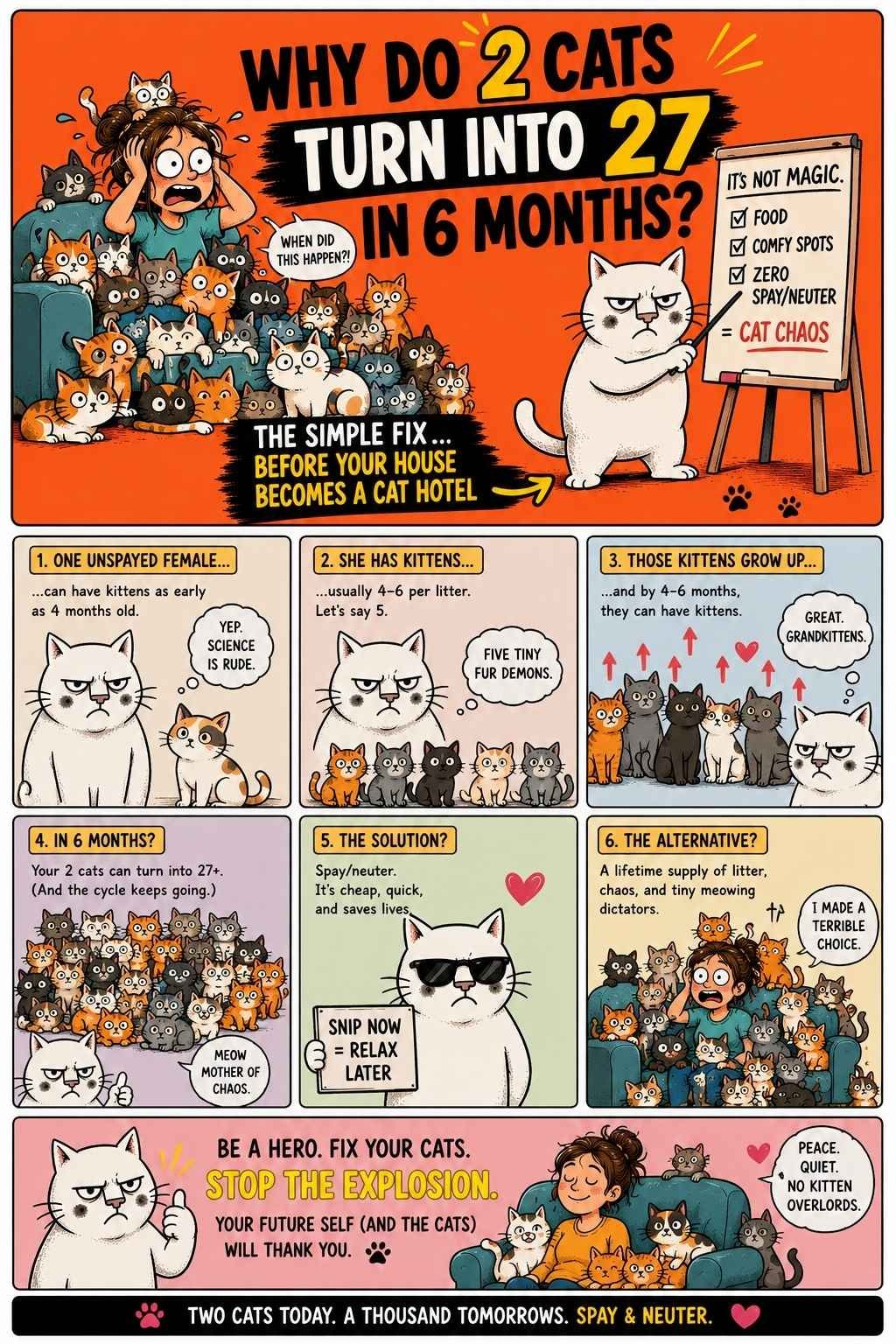
Here is something humans seem to forget: female cats reach sexual maturity at four months old. That is roughly the age at which a human is still largely confused by their own hands.
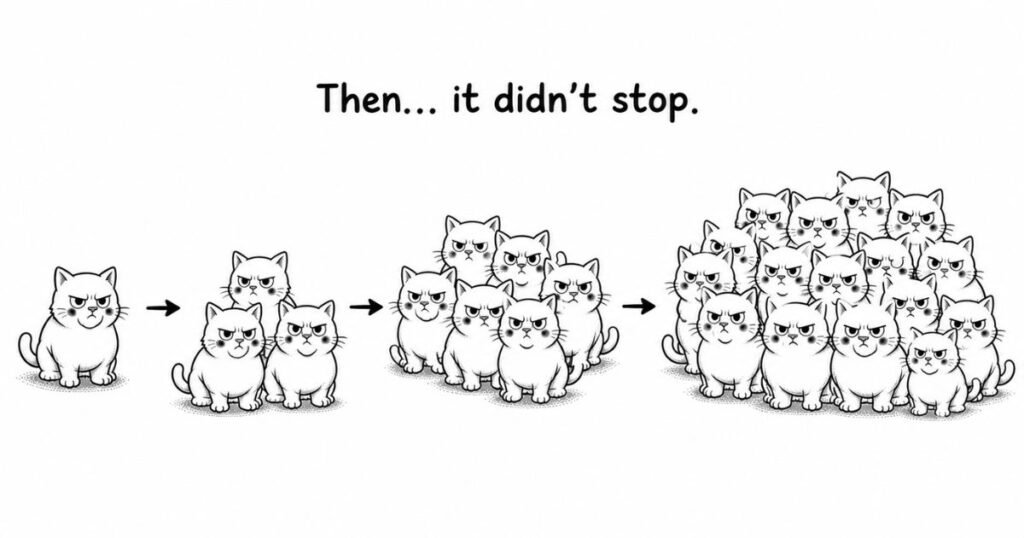
And yet, at that tender age, a female cat is fully prepared to begin producing up to five litters per year, with two to five kittens each. That is potentially 25 new cats annually from a single mother. Half of those kittens will be female. Those females will, in a matter of months, begin their own litters.
Purrnando’s Note: It is, frankly, an impressive biological achievement. I acknowledge this. I do not celebrate it. There is a difference.
This is not a metaphor. This is exponential growth — the same principle behind compound interest, viral spread, and every other thing humans claim to understand until it actually happens to them.
One Cat. Seven Years. Here Is What You Get.
Let’s be precise about this, since apparently that is necessary.
Year 1 — Modest Beginnings. Do Not Be Fooled.
Your original female has her first litter. Roughly three kittens. Cute. Manageable. Completely deceptive.
Year 2 — The Curve Begins.
Now the original cat and her offspring are reproducing. You are looking at approximately a dozen cats. Still feels fine. It is not fine.
Years 3–4 — Welcome to the Hundreds.
The exponential curve has kicked in. We are no longer talking about a handful of cats. We are talking about hundreds. You now have a constituency, not a pet.
Years 5–6 — Four Digits. Then Five.
Thousands of cats. Enough to constitute a small town — populated entirely by the descendants of that one kitten you picked up because it looked sad.
Year 7 — 420,000 Cats.
Nearly half a million. Enough to fill the population of Tulsa, Oklahoma. Or Oakland, California. Entirely with cats. From one animal.

Purrnando’s Note: Yes, this is the theoretical maximum. No, that does not make it better. Even a fraction of this figure overwhelms shelter systems. Millions of cats are euthanized every year simply because no one counted.
Reality Check — Before You Spiral
To be fair — and I am rarely fair, so appreciate this — the 420,000 figure assumes ideal reproductive conditions. In reality, disease, accidents, resource limits, and predation keep numbers lower than the theoretical maximum.
But here is the thing: even a small percentage of that potential, realized across millions of free-roaming unspayed cats worldwide, is a catastrophic overpopulation problem.
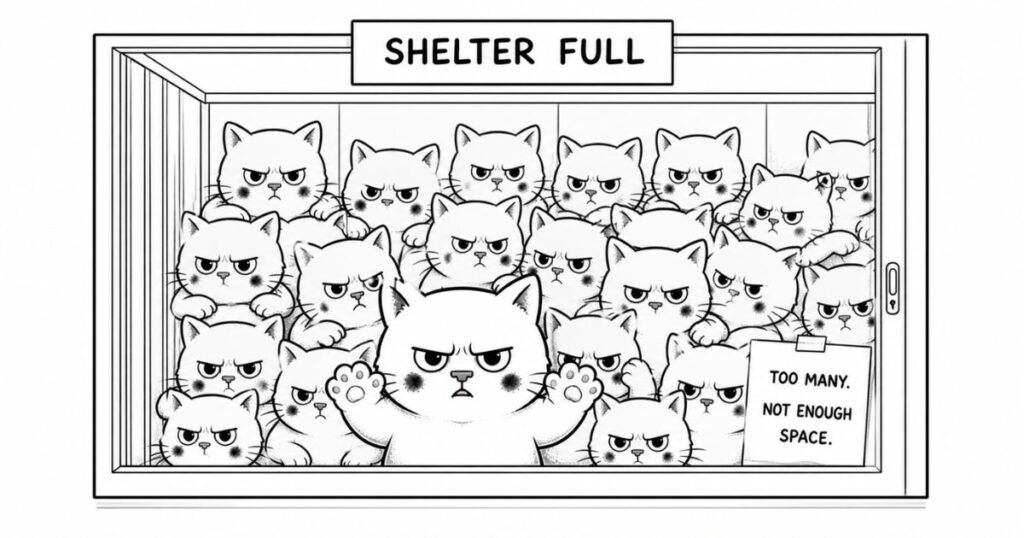
Animal shelters are already overwhelmed. Staff are already exhausted. Cats are already dying not because they are unwanted in principle, but because there simply are not enough homes.
The math does not need to reach 420,000 to be a crisis. It already is one.

The Solution Is Embarrassingly Simple
One procedure. Spaying or neutering. It converts an exponential growth curve into a flat line. That is the entire intervention. You have one job.

This is not about being a perfect pet owner — whatever that means. This is basic arithmetic. Every unspayed female cat you encounter is not one cat. She is the potential matriarch of a dynasty that would make historical empires feel modest.
Why It Matters Beyond Your Own Home
Even if you do not own cats, this affects you. Overpopulation strains local shelters, increases disease transmission in feral colonies, and places enormous pressure on animal welfare organizations and municipal resources. Spaying and neutering is not a personal preference. It is a community responsibility.
Low-Cost Options Exist
Many animal welfare organizations offer subsidized or free spay/neuter programs. There is no excuse that cost alone cannot address — if you look. Contact your local veterinarian or animal shelter and ask about available programs.
Purrnando’s Note: Spaying and neutering is, genuinely, one of the smarter things humans have managed to organize. I am saying this once. I will not repeat it.
Things to Buy If You Are Going to Do This Properly
Fine. Here are products. I have selected them based on usefulness, not sentimentality.
For Vet Care & Spay/Neuter Prep
1. Soft Recovery E-Collar (Cone) Your cat just had surgery. The least you can do is make recovery comfortable. A soft cone is less stressful than a rigid plastic one.
“You did this to them. Act accordingly.”
2. Soft-Sided, Airline-Approved Pet Carrier For vet visits, spay/neuter trips, and any situation requiring transport. A proper carrier. Not a cardboard box held together by optimism.
“A cardboard box is not a plan. It is a wish.”
3. Pet First Aid Kit For general health emergencies at home. Preparedness is not complicated. Look up the word.
“Have it before you need it. That is the whole point.”
For Responsible Cat Ownership
4. Handheld Microchip Scanner For identifying stray cats before you accidentally adopt your seventh cat of the year. Scan first. Name later.
“So you know whose cat you have accidentally collected. Again.”
5. Automatic Self-Cleaning Litter Box For multi-cat households. Removes the variable of human unreliability from the equation.
“You would forget to scoop. This is not an accusation. It is a statistical certainty.”
6. High-Quality Dry Cat Food (Large Bag) If you are feeding community or stray cats — which many of you are, whether you admit it or not — at least feed them properly.
“If you are going to do it, do it correctly.”
7. Humane Cat Trap (for TNR Programs) Trap-Neuter-Return programs are one of the most effective tools for managing feral cat colonies. This is actually useful. Do not make it weird.
“This is the part where you stop just feeding them and start actually helping.”
In Closing — You May Now Return to Your Lives
Cats may have nine lives, but their reproductive potential is, as we have thoroughly established, essentially limitless if left unchecked. That kitten with the pleading eyes is not just one cat. She is, mathematically, a city.
The good news — and I do not dispense good news lightly — is that this is entirely solvable. One decision. One appointment. One act of basic numerical responsibility. The same math that creates the problem is, when interrupted at the right moment, the math that prevents it.
Purrnando’s Final Word: Humans are, on balance, capable of better. I have seen evidence of this — occasionally. Spay and neuter your cats. Contact a local vet or animal welfare organization today. Do it not because I told you to. Do it because 420,000 is not a number anyone needs to reach. Not even cats.
Ready to act? Contact your local veterinarian or animal welfare organization to ask about low-cost spay and neuter programs in your area. Because when it comes to cat overpopulation, every single decision counts — mathematically speaking.
This post contains affiliate links. Purrnando does not know what an affiliate link is and has requested we stop explaining it to him.