Fine. You want to know why your cat licks you. You’ve Googled it. You’ve asked your vet. You’ve probably made a TikTok about it. And now you’re here, reading a blog written by a grumpy cat who finds your species consistently baffling.
I will explain this. Not because I want to. But because the alternative is watching you interpret it as “random cat behavior” and buying another one of those horrifying laser toys. Settle in. Try not to drool on yourself.
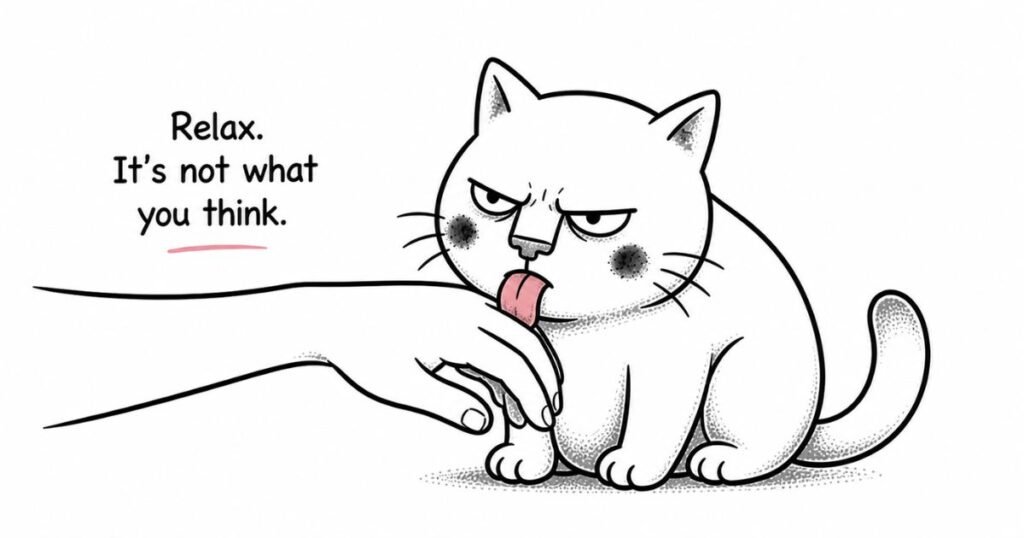
Let us begin with some context. Cats are not random creatures. Every single thing we do — every twitch of the tail, every slow blink, every casual knock of your coffee mug off the counter — is intentional. This includes licking you.
The behavior originates in our wild ancestors, who groomed each other to bond, reduce parasites, and distribute essential skin oils across the colony. Domestication simply redirected this instinct toward you — the large, clumsy, emotionally needy creature we now share a dwelling with. Congratulations on being adopted into the colony. You’re welcome.
There are five primary reasons a cat will lick a human. I will explain each one. I will also, at appropriate intervals, suggest products that may help you be a more tolerable companion. I recommend them not out of warmth, but because an unbothered human is a quieter human.
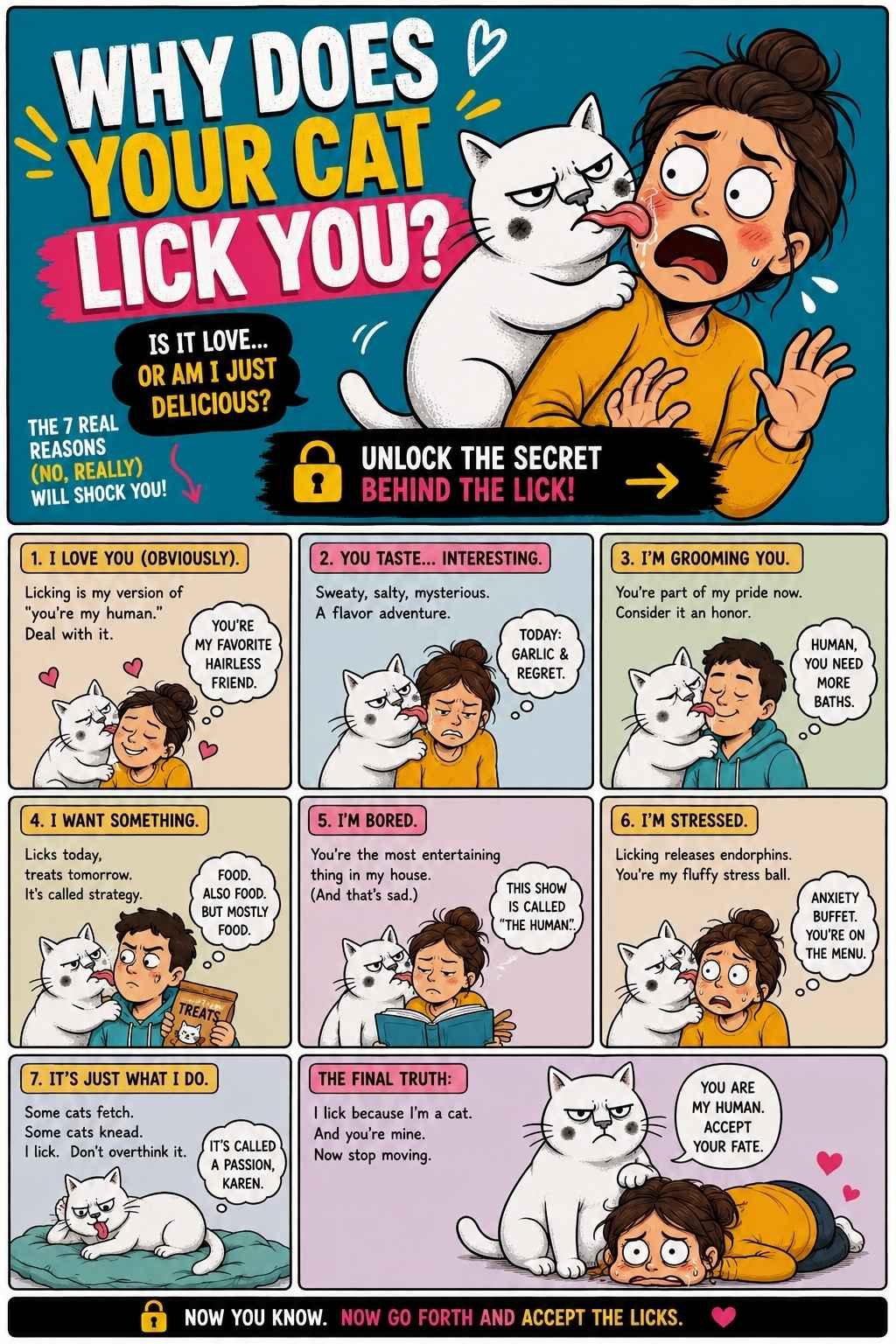
Reason 1: Affection & Social Bonding
Yes, we like you. Don’t make it weird.
In feline society, grooming is one of the most intimate acts of connection. When cats groom one another — a behavior called allogrooming — they are establishing trust, reinforcing social bonds, and declaring that the other creature is, in their estimation, worth the effort.
The key points:
Grooming among cats signals membership in a social group. When your cat licks you, it is formally enrolling you in its colony.
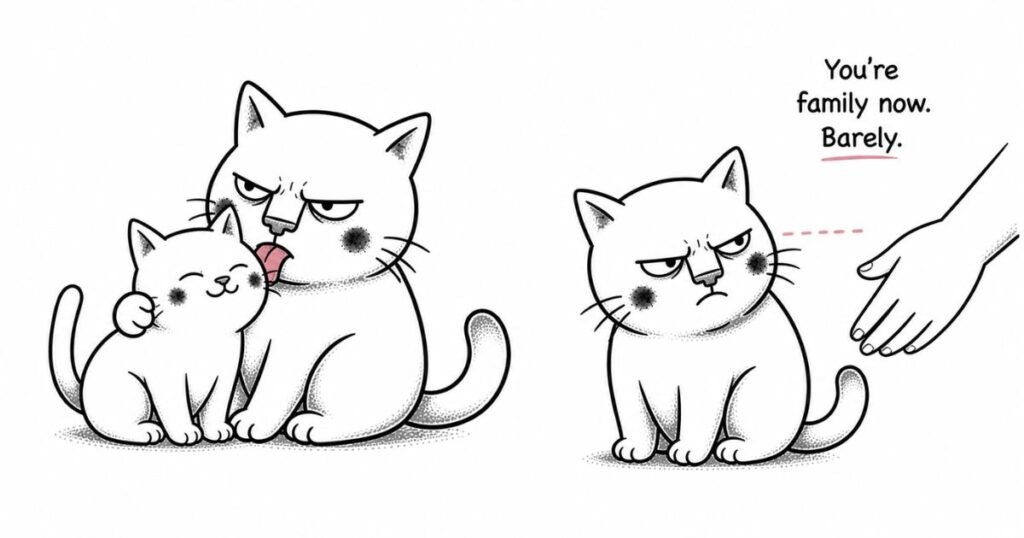
Oxytocin — the so-called “love hormone” — is released during positive cat-human physical contact, including licking. This applies to both species. Yes, we feel it too. We simply express it with more dignity.
Domestic cats have uniquely extended this bonding behavior to include humans, a development of domestication. Wild cats do not do this. They have standards.
Purrnando Reluctantly Recommends: KONG Zoom Groom Cat Brush — a rubber grooming brush that mimics the sensation of being groomed, strengthening the human-cat bond without requiring the cat to do all the work.
Reason 2: Territorial Marking
You belong to us. This is not a metaphor.
A cat’s tongue is not merely a grooming implement. It is also a highly sophisticated scent-delivery system. Embedded within it are pheromone-producing glands that, when pressed to your skin, deposit a chemical signature that other cats can detect — a signature that says, unambiguously: this human is claimed.
The key points:
Cats possess scent glands near the whiskers, on the paws, and on the tongue. Licking is the most direct form of scent transfer — more intimate than face-rubbing against furniture.
When a cat licks you, it is not merely showing affection. It is filing paperwork. You are property. Lovingly regarded property, but property.
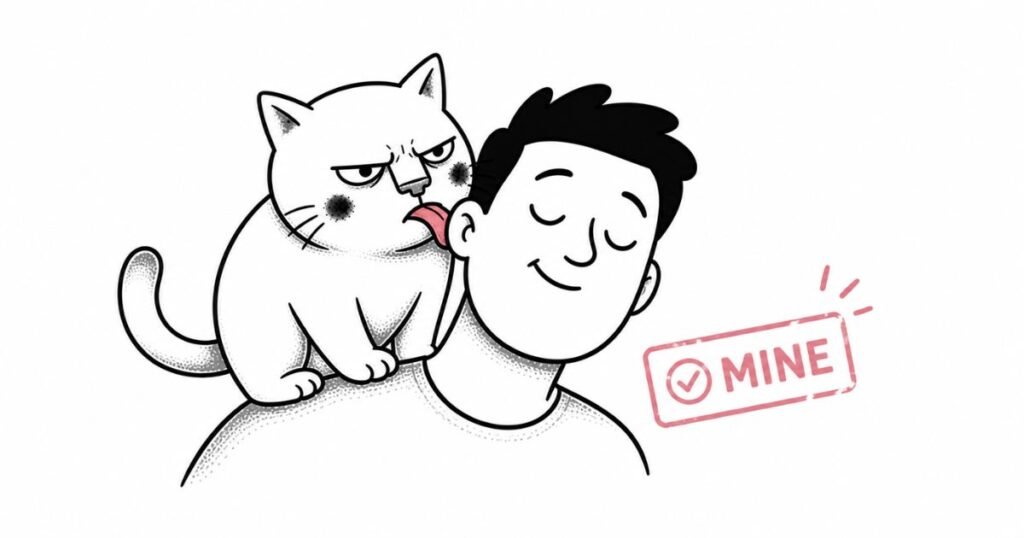
Other territorial behaviors to watch for: head bunting, rubbing against your legs, sitting on your possessions. All of these mean the same thing. You are ours.
A note on pheromones: Synthetic feline pheromone products mimic the natural calming signals cats use to mark safe spaces. They reduce stress-related territorial behaviors. If your cat is licking obsessively or marking anxiously, a pheromone diffuser in the home environment can help regulate their emotional baseline — and, as a side effect, yours.
Purrnando Reluctantly Recommends: Feliway Classic Calming Diffuser — a plug-in diffuser releasing synthetic versions of the “happy marking” pheromones cats produce naturally. Reduces stress, excessive marking, and territorial anxiety.
Reason 3: Tasting Interesting Flavors on Your Skin
Your moisturizer is a problem.
Cats have highly specialized taste receptors attuned to amino acids and salt compounds. Human skin, particularly after physical activity, produces sweat containing sodium, potassium, and various organic compounds that a cat’s palate may find genuinely appealing. Add to this the lotions, perfumes, sunscreens, and other chemical concoctions humans apply to themselves daily, and you begin to understand why your arm is essentially a tasting menu.
The key points:
Salt and sweat are particularly attractive to cats. They need sodium for basic physiological functions and can detect it acutely. If you have been exercising, you are, to a cat, irresistible. This is not a compliment.
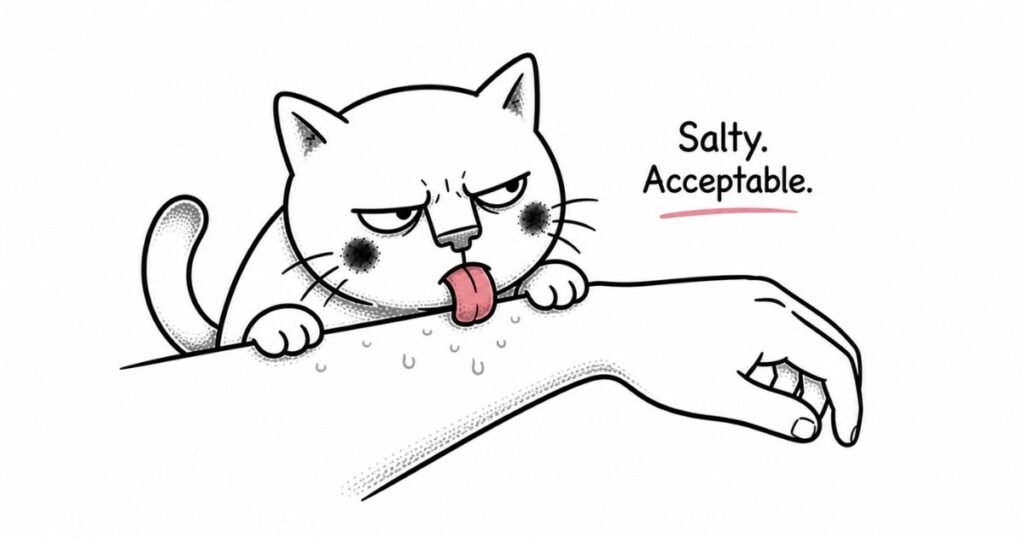
Certain skin products — lavender lotions, coconut-scented creams, some sunscreens — contain compounds that cats find fascinating. Fascinating enough to investigate with their tongues.
Cats’ unique taste receptors detect things humans cannot. Their sense of smell, integrated with taste, processes flavor information at a resolution humans will never achieve.
Purrnando Reluctantly Recommends: Silvervine & Catnip Sticks — natural chew sticks for cats. If your cat is licking you partly out of flavor-seeking behavior, redirecting that impulse toward silvervine sticks is a reasonable solution. Natural, safe, and considerably more dignified than licking sunscreen off a human ankle.
Reason 4: Stress Relief & Self-Soothing
Living with you is not easy. We manage.
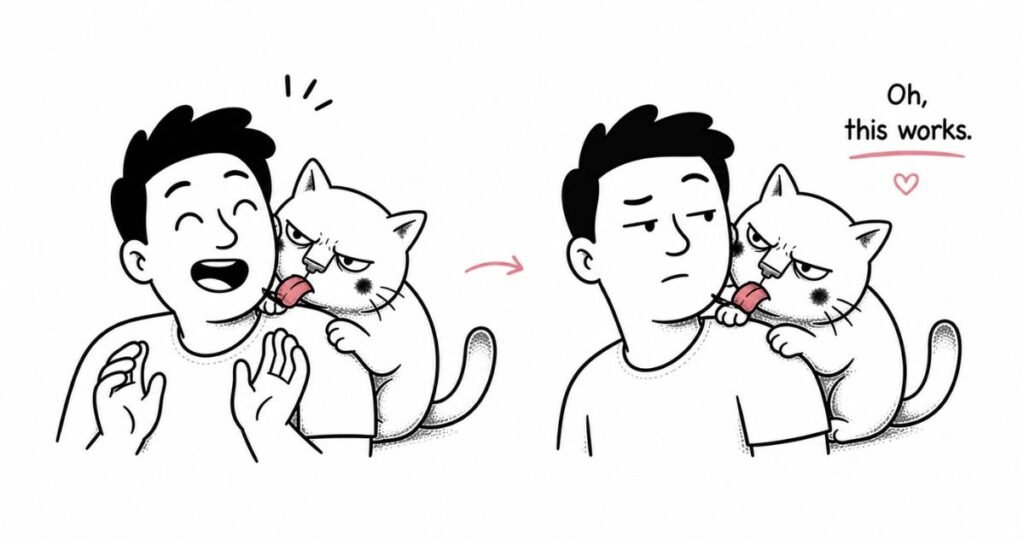
Repetitive grooming behavior — including licking — releases endorphins in cats. It is, functionally, a self-regulation mechanism. A cat that licks its human during a stressful moment is not only expressing affection; it is also managing its own nervous system. This is, incidentally, more self-awareness than most humans demonstrate.
The key points:
Licking triggers the release of endorphins — neurochemicals associated with calm and comfort. The act itself has a measurable soothing effect on the cat performing it.
Signs that licking may be anxiety-driven rather than affectionate: excessive repetition, restlessness, pacing, hiding, or hair loss from over-grooming one’s own coat.
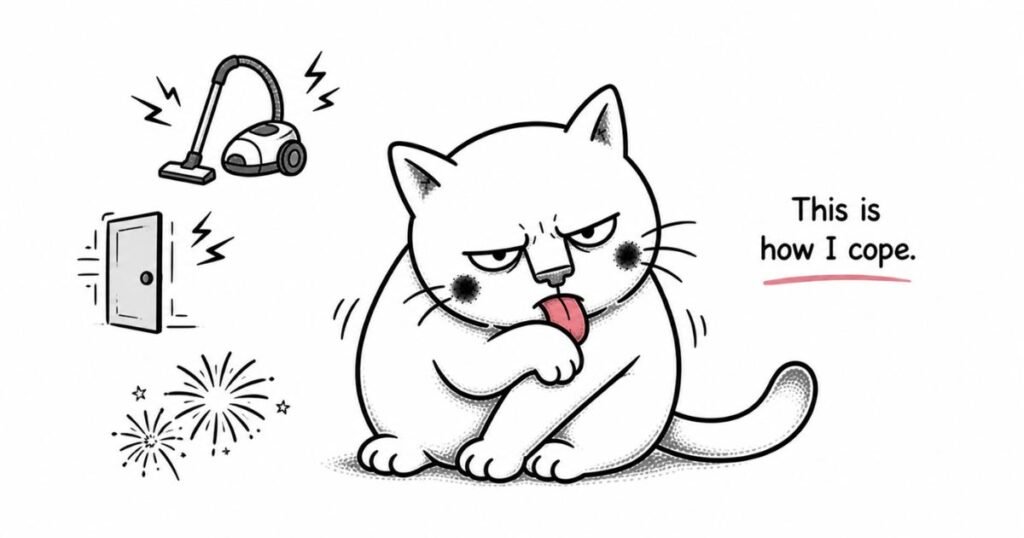
A stress-free environment — consistent routine, adequate vertical space for climbing, low household noise — significantly reduces anxiety-related licking behaviors.
When to consult a veterinarian: licking that creates bald patches or skin lesions on the cat; a sudden increase in licking behavior without obvious environmental cause; licking accompanied by pacing, yowling, or refusal to eat; compulsive licking of non-food surfaces such as fabric, plastic, or walls.
Purrnando Reluctantly Recommends: A tall, stable cat tree (62 inches or higher). Adequate vertical height is not a luxury. It is a psychological necessity. A tall cat tree provides elevated observation posts, territory, and a retreat from the unpredictable chaos of the human-managed floor level. Reduces stress. Reduces anxiety-driven licking. Reduces the likelihood that we will knock things off shelves to reclaim our sense of control.
Reason 5: Maternal Instincts & Nurturing Behavior
We have assessed your capabilities. We are concerned.
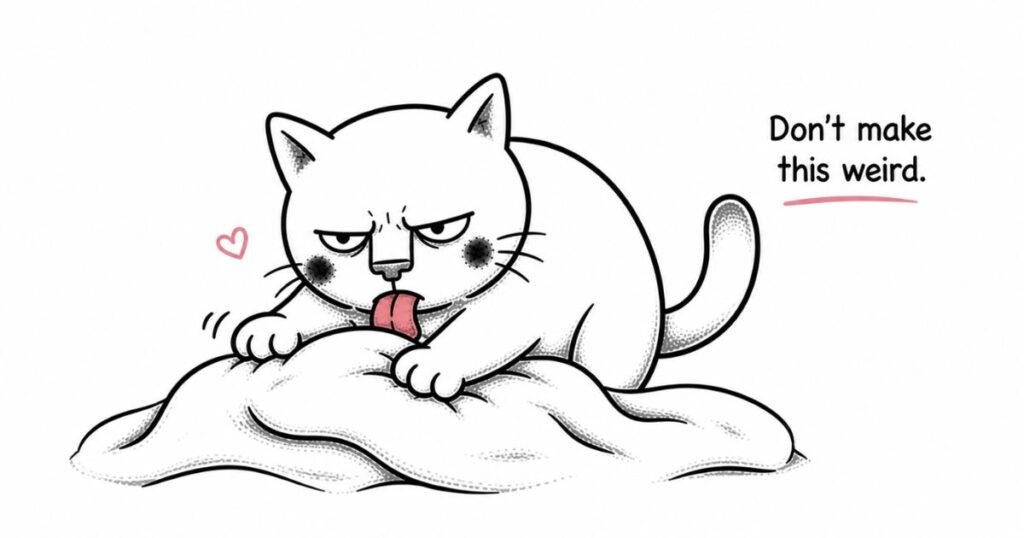
Mother cats lick their kittens constantly — to clean them, stimulate circulation, regulate temperature, and communicate safety. It is the foundational act of feline care. Some cats, when bonded deeply with their human, begin to exhibit this same nurturing behavior toward them. This is because, upon careful observation, the human appears to require it.
The key points:
A cat that licks your face or hair may be treating you as a large, confusing kitten in need of grooming assistance. This assessment is, in many cases, accurate.
Female cats, particularly those who have raised kittens, tend to display more nurturing licking behavior. However, male cats are entirely capable of it as well.
Age plays a role: older, more settled cats often become more affectionate and attentive toward their humans, particularly as they observe the human’s continued inability to manage basic tasks.
Purrnando Reluctantly Recommends: An enclosed cat cave bed. A properly enclosed sleeping space fulfills the same psychological need as maternal nest environments — warmth, enclosure, security. A cat with a calm, adequate retreat expresses nurturing behaviors from a place of contentment rather than anxiety. The difference is palpable.
A Brief Word on the Tongue Itself
Since we are already here: the cat tongue is an engineering achievement that human civilization has spent millennia failing to replicate. Its surface is covered in papillae — hollow, backward-facing spines made of keratin — that function simultaneously as a comb, a cleaning implement, and a cooling system. The evaporation of saliva from these spines regulates body temperature with an efficiency that no human grooming product has come close to matching.
You have invented the hairbrush. We evolved the papillae. We will allow the comparison to speak for itself.
Purrnando Reluctantly Recommends: A self-cleaning slicker brush for cats. It mimics the directional pull of papillae, removing loose undercoat and debris efficiently. The self-cleaning mechanism means the human does not have to figure out how to extract fur from the bristles using a second, smaller brush. Progress.
When Licking Becomes Excessive
Normal licking is social, intermittent, and contextual. Compulsive licking is something else entirely — repetitive, difficult to interrupt, and frequently accompanied by other signs of stress. The distinction matters.
Normal licking is brief, affectionate, and associated with calm and contentment.
Concerning licking is prolonged, difficult to redirect, and accompanied by restlessness, hair loss, or changes in appetite.
Skin conditions, allergies, and neurological factors can all manifest as excessive grooming behavior. These are medical matters, not behavioral quirks.
A veterinarian should be consulted. Environmental stress — new humans, moved furniture, household disruption — is one of the most common drivers of compulsive grooming. Address the cause, not just the symptom.
How to Respond (A Manual, Simplified for Your Level)
This section exists because some of you, upon being licked, make faces. Or worse — you laugh. Or worst of all, you pull away dramatically, look at us with theatrical disgust, and say “ew.” We remember this. We always remember.
If the licking is gentle and your cat appears calm, accept it. This is a compliment. Respond with slow blinking or quiet stillness. Reciprocal grooming via brushing is acceptable.
If you need to redirect excessive licking: do so gently. Stand up slowly. Offer a toy. Do not recoil. Do not make it a scene.
Consistency matters. Every member of the household should respond the same way. Mixed signals are confusing and undignified for everyone involved.
Positive reinforcement of calm behavior — treats, quiet affection — is more effective than any attempt at verbal correction. We do not speak your language. We speak actions.
Purrnando Reluctantly Recommends: Churu Lickable Cat Treats — squeeze tube variety pack. High-value lickable treats ideal for positive reinforcement, redirection during over-licking episodes, and general relationship maintenance. Low calorie. High palatability. Also useful for bribing cooperation during brushing, nail trims, and other violations.
You came here seeking to understand why we lick you. I have explained it. You are bonded to us, owned by us, occasionally delicious to us, sometimes in need of emotional support from us, and — in our more charitable moments — regarded as an oversized, well-meaning kitten who is doing its best. That is the whole of it. You may now return to whatever you were doing. I will be watching from the cat tree.
Affiliate disclosure: if you buy through our links, we earn a small commission. Purrnando has been informed of this and is choosing to be offended that it isn’t larger.