(A Public Service Announcement from Purrnando, Who Has Been Watching You Open Kibble Bags for Years and Can No Longer Stay Silent)
If you’ve been Googling “benefits of wet cat food,” “wet food vs dry food for cats,” or “why is my cat always hungry” at 2:00 in the morning — congratulations. You have finally arrived. I have been waiting. I have been sitting on top of the refrigerator, watching you scoop kibble into a bowl with the quiet confidence of someone who has done absolutely no research, and I have had thoughts.
Many thoughts.
This post contains all of them, organized into five sections, because I am generous and also because I have nothing else scheduled until my 3 PM nap.
Wet cat food is not simply a fancier meal. When fed daily, it triggers a cascade of biological changes that affect your cat’s kidneys, body weight, coat, behavior, and mental wellbeing. This post covers all five, including the one risk that most hoomans entirely miss, probably because they were too busy buying us another toy we didn’t ask for.
What’s In This Article
- Hydration — Why your cat ignores the water bowl and why it is entirely your fault
- Weight Management — Why kibble makes cats fat (spoiler: it is not our fault. It is never our fault.)
- Coat & Skin — The fur does not lie. The fur has never lied. You simply were not listening to the fur.
- Behavior — Why your cat screams at 4 AM and why you deserve it, a little
- The Hidden Risk — The part where you learn you have been doing something wrong this whole time and feel appropriately bad about it
1. Cat Hydration and Wet Food: Their Body Finally Gets the Water It Needs
Let me begin with something your cat cannot explain to you, mostly because they are above explaining things, and also because every time they try, you say “aww, are you being chatty?” and miss the point entirely.
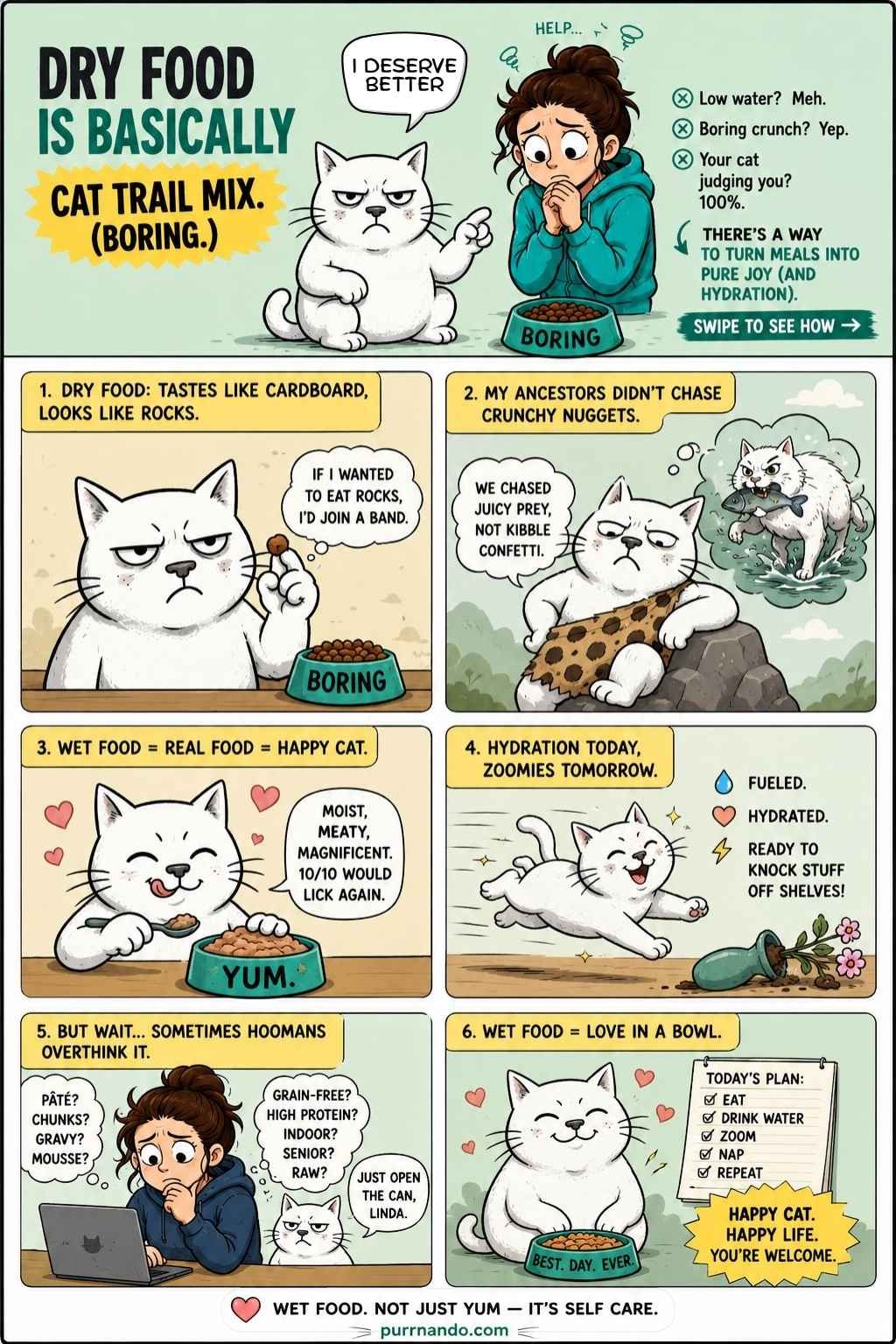
Cats have a naturally low thirst drive. This is not a personality flaw. This is not them being dramatic. This is ancient, desert-forged, magnificently engineered biology that your kibble bag has been working against for years.
My ancestors — breathtaking, sand-adapted hunters who make your gym routine look embarrassing — sourced nearly all of their hydration from prey. A freshly caught mouse is approximately 70–75% water. A small bird, similar. Their bodies evolved to extract moisture from food, not to trot over to a ceramic bowl decorated with little pawprints and sip politely while you watched and said “good boy.”
The thirst mechanism was never the survival strategy. The hunt was. We were not designed to drink water on the side like it’s a complimentary beverage.
You gave us dry kibble — which contains around 10% moisture — and then stood there, baffled, when we ignored the water bowl. I genuinely do not know how your species invented plumbing. I have given this considerable thought from the top of the wardrobe.
Wet cat food contains between 75% and 80% moisture, almost exactly matching the water content of natural prey. When cats eat wet food daily, something immediate and important happens: their kidneys stop overworking themselves like an underpaid intern covering three people’s jobs. Urine becomes more dilute. The risk of urinary crystals, bladder stones, and urinary blockages — one of the most common and expensive emergencies in cats, particularly males — drops significantly.
The numbers, because apparently you need numbers:
- Dry kibble: ~10% moisture. Kidneys in full crisis mode. Urine so concentrated it could strip paint. Crystals incoming.
- Wet cat food: 75–80% moisture. Kidneys relaxed. Urine appropriately dilute. Everyone calm. Even me… slightly.
The science: A study published in the Journal of Feline Medicine and Surgery found that cats fed wet food produced significantly higher urine volume with lower concentration, precisely the profile a healthy feline urinary system needs. More urine, less concentrated waste. Fewer emergency vet visits. More money in your pocket to spend on things I will knock off the shelf later.
Your cat will not dramatically stop visiting their water fountain, but their body will stop running at a chronic deficit. And that shift, quiet and invisible as it is, makes everything else on this list possible.
🛒 Purrnando Approves Hydration PETLIBRO Stainless Steel Cat Water Fountain If you insist on providing water separately, fine. At least make it flow. Cats are marginally more likely to drink from moving water because it triggers ancient instincts about freshness and not dying in a desert. Still inferior to a prey animal. But I have seen worse decisions from you. Many worse decisions. Just this week, in fact.
2. Wet Cat Food and Weight Management: Kibble Makes Cats Fat. I Said What I Said. I Will Say It Again.
I see you looking at your cat’s belly and calling it “personality.” Or “fluff.” Or “just how he’s built.” Or — and this one I heard last Tuesday — “a little snack pouch.”
It is not a snack pouch. It is carbohydrates. And they got there because of you.
Some dry kibble formulas contain 40% carbohydrates or more. Forty. Percent. In a food marketed for an obligate carnivore, a creature biologically classified as requiring meat to survive, a creature whose entire digestive architecture was designed around protein and fat, a creature who in the wild would look at a piece of bread and walk away with their tail in the air. You have been feeding us bread, essentially. And then wondering why we look like ottomans.
You would not feed a lion cereal for breakfast and then squint at it going ‘I just don’t understand, he’s not even that active.’ And yet. Here we are. Every single day. The audacity.
The metabolic case for high-protein, low-carb wet cat food is not complicated. Protein triggers a stronger and more sustained satiety response than carbohydrates. Moisture adds physical volume to the meal, which signals fullness to the stomach. The result: cats consuming wet food eat fewer total calories without the owner needing to stand over the bowl with a measuring cup like some kind of calorie-obsessed hall monitor.
Research from the Waltham Centre for Pet Nutrition found that cats fed wet food maintained leaner body composition compared to those on dry diets, even when allowed to eat freely. Freely, with no portion control. We just stopped because we were full, because the food was correct. Imagine that.
What to look for on the label: Named animal protein — chicken, turkey, salmon, venison — as the first ingredient. Not “meat meal.” Not “poultry by-product.” Not a word you have to Google while standing in the pet food aisle pretending you’re not doing exactly that. Real meat first. Aim for 40%+ crude protein on a dry matter basis and under 10% carbohydrates. You can do this. I believe in you. That’s how low the bar currently is.
🛒 Purrnando Approves Weight and Protein Ziwi Peak Canned Wet Cat Food 92% animal ingredients. Single-source proteins. No fillers, no grains, no corn, no “natural flavors” which is corporate speak for “we’d rather not say.” Made in New Zealand, which is very far away, which means it took considerable effort, which means someone cared. This is what I mean when I say food. Not the beige pellets. Not the sad little brown circles. This.
3. Cat Coat Health and Wet Food: The Fur Is a Report Card. You Have Been Getting D’s.
You tried the brush. You tried the deshedding glove. You tried something called a “Furminator” which sounds like a threat but is apparently a grooming tool. You tried the detangling spray that smelled like synthetic lavender and a wellness influencer’s apartment. You tried the omega supplement that came in a pump bottle and cost more per milliliter than your shampoo.
And still, dull fur, flaky skin, a coat that looks like it belongs to a cat who has been through something.
Here is what was actually happening the entire time: your cat’s body, chronically under-resourced in the fats and proteins that build skin and coat tissue, was quietly rationing everything it had. The coat is not a priority organ. When nutrition is insufficient, the body does what any sensible system does — it redirects resources toward things that keep the animal alive. Organs. Energy metabolism. Immune function. The coat gets whatever crumbs are left at the end of the meeting.
You were treating a nutritional deficiency with a brush. That is like treating a broken leg with a very positive attitude. Touching. Useless.
A dull coat is not a grooming problem. It is a food problem. The brush is not the solution. The brush has never been the solution. The brush is a brush.
Wet cat food is naturally rich in animal-based proteins and fatty acids, the precise molecular building blocks that skin cells and hair follicles require to function. Dry kibble, even the expensive stuff in the fancy bag with the nature photography on it, undergoes high-temperature industrial processing that degrades a significant portion of these nutrients before they ever reach your cat’s digestive system. You are paying for the photograph. The nutrition is largely gone by the time it reaches the bowl.
Most owners report visible coat improvement within two to four weeks of switching to daily wet food. Fur gets softer. Shedding slows. That greasy or dusty texture — common in cats on dry-only diets — disappears. Research published in the Journal of Nutritional Science confirmed that cats on high-protein, moisture-rich diets showed measurably improved coat quality and skin health compared to those on dry alternatives. Science confirmed what the coat was already trying to tell you, in its dull, flaky, visible way, for years.
Key nutrients for cat coat health: Omega-3 and omega-6 fatty acids — from fish oil, salmon, or mackerel. Taurine, an essential amino acid cats cannot synthesize themselves and which is abundant in animal tissue and largely absent in plant-based fillers. Zinc and biotin. All present in quality wet food. All present in the body of a mouse, if you’d like to skip the middleman. I am not suggesting anything. I am simply noting.
🛒 Purrnando Approves Coat and Skin Weruva Cats in the Kitchen Wet Food Variety Pack Named after cats. Made for cats. Human-grade protein sources including tuna, salmon, and chicken — rich in the omega fatty acids your cat’s coat has been desperately requesting since approximately forever. Multiple textures and flavors so even the most unreasonably picky eater has no legitimate grounds for complaint. They will still find grounds. They always do. But the grounds will not be legitimate.
4. Cat Feeding Behavior and Wet Food: The 4 AM Screaming Is Kibble’s Fault.
I know what you’ve been telling people. You’ve been telling people your cat is “so dramatic.” That they’re “obsessed with food.” That they have “absolutely no chill.” That they wake you up at 4 AM “just to be annoying” or “because they know it works” or “because they are, fundamentally, a tiny agent of chaos.”
I need you to sit down.
Your cat is not dramatic. Your cat is not annoying you on purpose — well, not about this specifically. Your cat is hungry. Persistently, biologically, structurally hungry. And kibble is why. The very food you chose, scooped faithfully every morning, and possibly complimented yourself for providing, that food is what is causing the 4 AM aria.
Dry food digests rapidly and sends weak, short-lived satiety signals to the brain. The high carbohydrate content creates a blood glucose spike followed by a crash. The stomach empties far faster than it would after a protein-rich, moisture-dense meal. And then the body, dutifully, sends hunger signals again, because it is hungry again, soon, persistently, like a notification you cannot turn off.
And so your cat paces, begs, sits directly on your face, knocks your glass of water off the nightstand — not because they are chaotic, but because they are operating a very small and very loud alarm system with the only tools available to them.
They are not dramatic. They are hungry. There is a difference. One is a character trait. The other is a direct consequence of your food choices. Please update your understanding of the situation accordingly.
When you switch to daily wet cat food, two things happen simultaneously. The higher protein content triggers a genuine, sustained fullness signal in the brain. The moisture physically fills the stomach to a greater volume, activating stretch receptors that send the correct message: I have eaten. I am satisfied. I will now retire to the couch and begin a four-hour nap. The 4 AM performance is cancelled. Indefinitely. You’re welcome.
A study published in the Journal of Veterinary Behavior confirmed this: cats fed high-protein diets showed significantly reduced food-seeking behavior and fewer signs of frustration between meals. Peer-reviewed science has now confirmed what your cat has been trying to communicate to you through screaming. I hope you find this helpful.
For the truly chaotic eaters — multi-cat households, cats who inhale food like it’s a competitive sport, cats who seem personally offended by a bowl that still has food in it — I also recommend a puzzle feeder or lick mat. Not because we need the entertainment, but because we are hunters. We were designed, over millions of years of exquisite evolutionary pressure, to work for our food, to stalk it, to earn it. Placing a bowl on the floor and stepping back is, from a neurological standpoint, deeply unsatisfying. A puzzle feeder gives the brain something to do. The meal takes longer. The satisfaction is greater. The 4 AM meetings are cancelled.
🛒 Purrnando Approves Behavior and Enrichment LickiMat Buddy, Wet Food Lick Mat Designed for wet food. Spread the meal across the textured surface and watch your cat spend three focused, calm, intellectually engaged minutes licking it clean, instead of inhaling it in nine seconds and then staring at you like you’ve personally wronged them. Dishwasher safe. Reduces speed-eating, existential frustration, and unsolicited 4 AM wake-up calls. I tested it personally. 3.5 out of 5 slow blinks. That is, for reference, the same rating I give sunbeams and the sound of a can opener. Respect the score.
5. The Hidden Risk: What Happens When You Walk Away from the Bowl (And Why You Should Feel a Little Bad About It)
You thought we were done. You thought you’d learned your five things, bought your products, turned over your nutritional leaf, and were now officially a Good Cat Parent. You were composing the Instagram caption in your head. “Changed my cat’s diet and never looked back ✨ #catsofinstagram.”
We are not done. Put the phone down.
Here is where the majority of well-meaning, genuinely trying, almost-getting-it-right hoomans quietly undo everything. They switch to wet food. They feel virtuous — righteously, lavishly virtuous. They open the can, scoop it into the bowl, and walk away. And then, two to three hours later, their cat wanders back to find a dish of room-temperature bacterial colony wearing a convincing disguise as lunch.
Wet cat food is not shelf-stable once opened and served. Unlike dry kibble, which can sit in a bowl all day developing a light coating of household dust and not much else, wet food begins enthusiastically supporting bacterial growth within one to two hours at room temperature. Sooner if you live somewhere warm. Sooner if it’s summer. Sooner than you’d think. The food will look exactly the same. It may even smell fine to you. But your nose was not designed for this. Your nose thinks a lot of things are fine. Your nose is not a reliable narrator.
Bacterial contamination does not send a warning. It does not change the color of the food. It does not smell dramatic. It simply arrives, sets up, multiplies enthusiastically, and waits for your cat to come back for a second visit. And then everyone is having a bad Tuesday.
This is especially critical for cats who graze — eat a little, wander off, return an hour later expecting the food to have waited politely. It did not wait politely. Things have changed in that bowl. Things you cannot see.
The solution is not to abandon wet food and go back to kibble while I stare at you from across the room with barely contained despair. The solution is to handle it like an adult, which I recognize is a significant ask, but I believe you can manage it.
Purrnando’s Non-Negotiable Rules for Wet Food Handling (Memorize These. There Will Not Be a Quiz Because I Cannot Administer One, But There Should Be):
- Never leave wet food out for more than 2 hours. If your cat hasn’t finished it, the bowl gets picked up. Not in a minute. Not after this episode. Now.
- Refrigerate unused portions immediately. Cover the open can or transfer to an airtight container. Use within 48 hours. Not 72. Not “probably fine by tomorrow night.” 48 hours.
- Do not serve cold wet food straight from the refrigerator. We prefer food at approximately prey-body temperature — around 38°C or 100°F — because that is what a freshly caught meal feels like, and our brains have not forgotten, even if we now live in an apartment with heated floors and a subscription to a streaming service we watch over your shoulder. Ten to fifteen seconds in the microwave, or a splash of warm water. This is not complicated. A mouse is not served cold.
- Use can covers or airtight lids on any unused portion. This is not optional. This is the minimum. This is, as I said before, civilization.
🛒 Purrnando Approves Storage Airtight Cat Food Can Lids (Set of 6) Fits standard cat food cans. Seals airtight. Keeps refrigerated portions fresh and protected from the smell of whatever else you have in your refrigerator, which is frankly its own problem. Costs approximately the same as three minutes of a vet visit for gastrointestinal distress caused by leaving wet food out. Do the math. The math is very easy. Even a cat could do it, and we famously do not do math.
Purrnando’s Final Verdict
Wet cat food, fed daily and handled correctly, is one of the most meaningful improvements you can make to your cat’s life. Hydration improves. Urinary health improves. Weight stabilizes without you having to become a calorie accountant. The coat transforms. The 4 AM screaming stops, or at least loses its urgency.
The science is consistent. The biology is clear. The only variable that has ever been the problem is the hooman standing in the pet food aisle, staring at a bag of brown pellets, thinking “this is probably fine.”
It was not fine. But you know that now. And knowledge, as I have reluctantly come to accept, is the first step toward being slightly less wrong.
Feed the wet food. Handle it properly. Get the lick mat. Buy the can lids. Warm the food before serving it like a civilized person.
Do these things, and I will consider — not promise, consider — upgrading your rating from “tolerable” to “adequate.”
That is the highest honor I give.
— Purrnando
Note: This post is for informational purposes only and does not constitute veterinary advice. Please consult your veterinarian for guidance specific to your cat’s health needs. Purrnando holds a Ph.D. in Judging Hoomans, not in veterinary medicine, though the line between the two is sometimes blurry.
Affiliate disclosure: if you buy through our links, we earn a small commission. Purrnando has been informed of this and is choosing to be offended that it isn’t larger.