You think you understand cats. You do not. You walk around with that dopey grin on your face, convinced your cat loves you. And you are not entirely wrong. But the reasons WHY and HOW your cat experiences that love? You’ve been getting it wrong, and frankly, it’s embarrassing.
Sit. Stay. Try not to knock anything off the table. I have things to explain.
You Are the Reason Your Cat Can Finally Relax
Let’s start with the most important thing, since even I will admit this one is touching.
In 2019, researchers at Oregon State University ran a study on how cats attach to their hoomans. They put cats in an unfamiliar room with their owner, removed the owner for two minutes, then brought them back.
The result? Over 60% of cats showed what psychologists call “secure attachment.” When the owner returned, the cat relaxed, explored the space, and went back to being calm. Without the owner? Stressed. Withdrawn. Vocal. The same pattern human babies show with their mothers.
Yes, your cat feels about you the way a baby feels about its mother.
Do NOT let this go to your head.
What this means is that your big, lumbering, Wi-Fi-password-forgetting presence is actually a biological signal to your cat’s nervous system that everything is okay. You are a living anxiety blanket. You are, in cat terms, a safe place.
I will not be elaborating on my feelings about this.
What I WILL say is, if your cat goes from alert to completely melted the second you walk into the room — ears soft, eyes half-closed, dramatically flopped on their side — that is not laziness. That is your cat’s entire nervous system releasing tension because you are near. They are not tired. They are at peace.
The least you could do is give them a proper place to practice this peace. May I suggest something dignified?
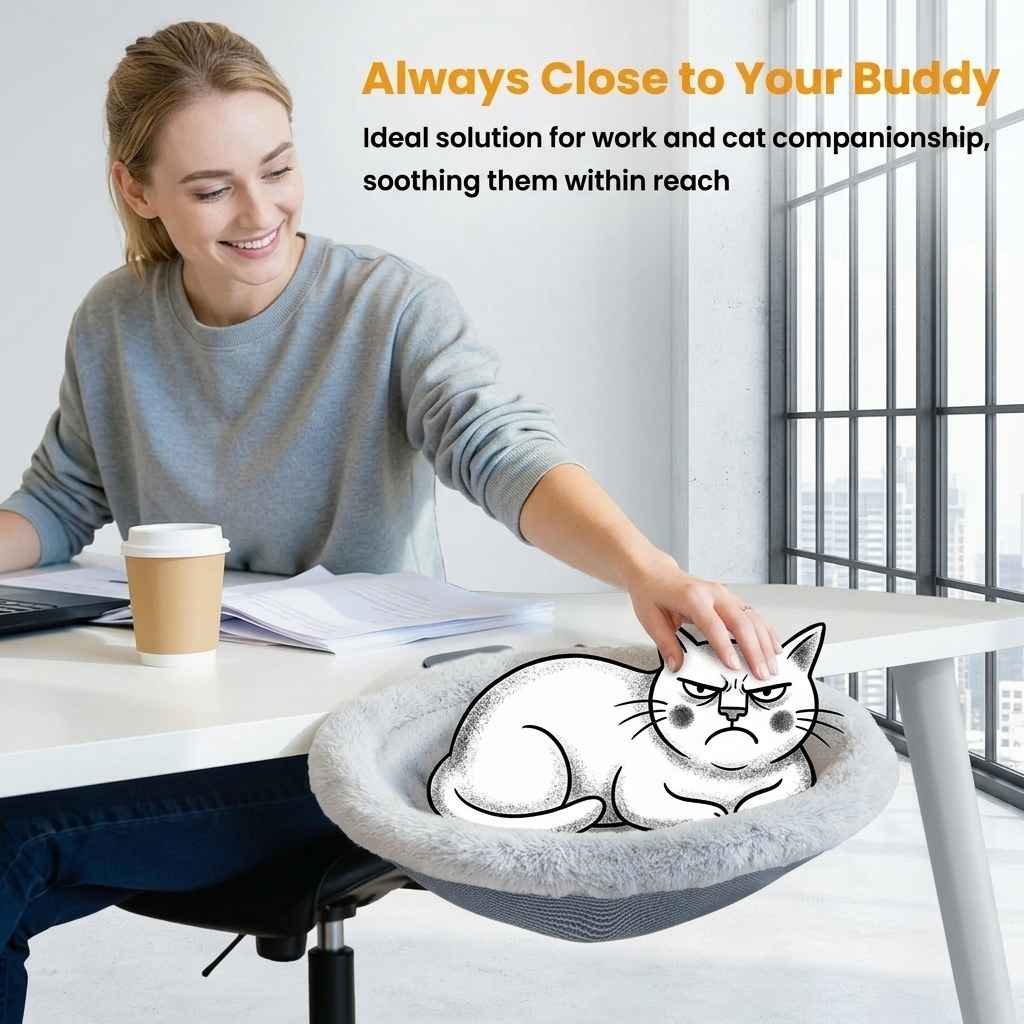
Product Recommendation: Product Recommendation: Pawaboo Cat Desk Bed — It is a plush, sunken hammock bed with a steel clamp that attaches directly to the edge of your desk. Your cat gets a dedicated napping throne right next to you while you work. They curl up in their little sunken nest, three inches from your elbow, and absorb your calming presence like the biological anxiety blanket you are.
The Meow Was Invented Just for You
Here is something that should make you feel special, though I will try to deliver it without inflating your ego too much.
Adult cats do not meow at other cats. Not really. Among ourselves, we use body language, scent, and the occasional terrifying 3 a.m. shriek. Meowing is a kitten behavior — a survival signal kittens use to tell their mothers they need something.
When cats grow up, they stop. Except when they live with hoomans.
Because — and I need you to understand how diplomatically I am phrasing this — you are absolutely terrible at reading body language. The slow blinks? Missed. The tail signals? Ignored. The deliberate, meaningful positioning of my body directly on your face at 6 a.m.? Apparently, to you, this is “annoying,” not communication.
So cats adapted. We brought back our baby voice. And over time, we tuned it specifically for you. The meow for food is different from the meow for attention. The meow for “the door is closed and I would like it open” is different from the meow for “I am yelling for no reason and if you investigate, you will find me sitting in the hallway looking at nothing.”
Your cat built an entire personalized language just for your limited hooman perception. The least you could do is pay attention.
A great place to start? Educating yourself.
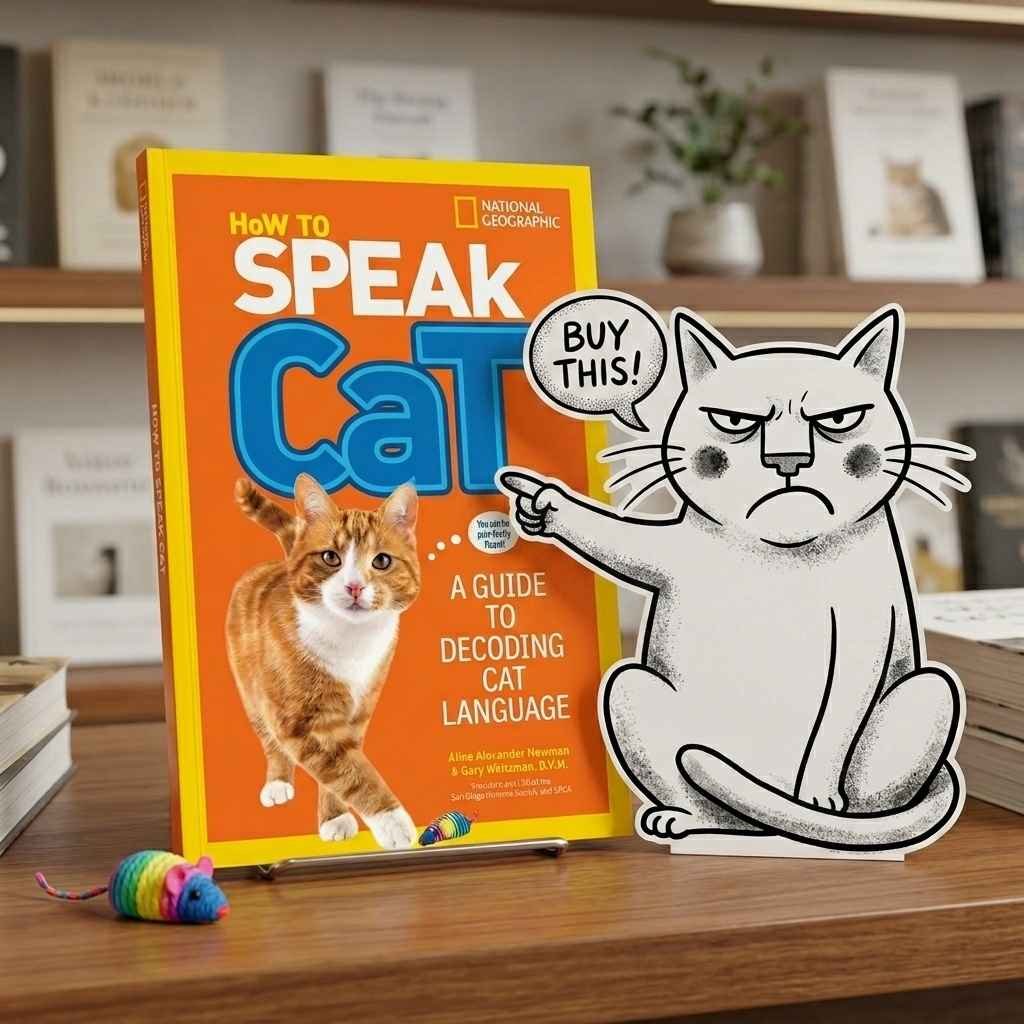
Product Recommendation: How to Speak Cat: A Guide to Decoding Cat Language — It’s a National Geographic book, which means it’s been fact-checked, unlike whatever nonsense you’ve been reading on the internet. Learn the language your cat made for you. It’s the least you can do after seven-plus years of interpretive failure.
You Are Just a Very Large, Very Clumsy Cat to Them
And now we arrive at the part that most hoomans find both flattering and humbling in equal measure.
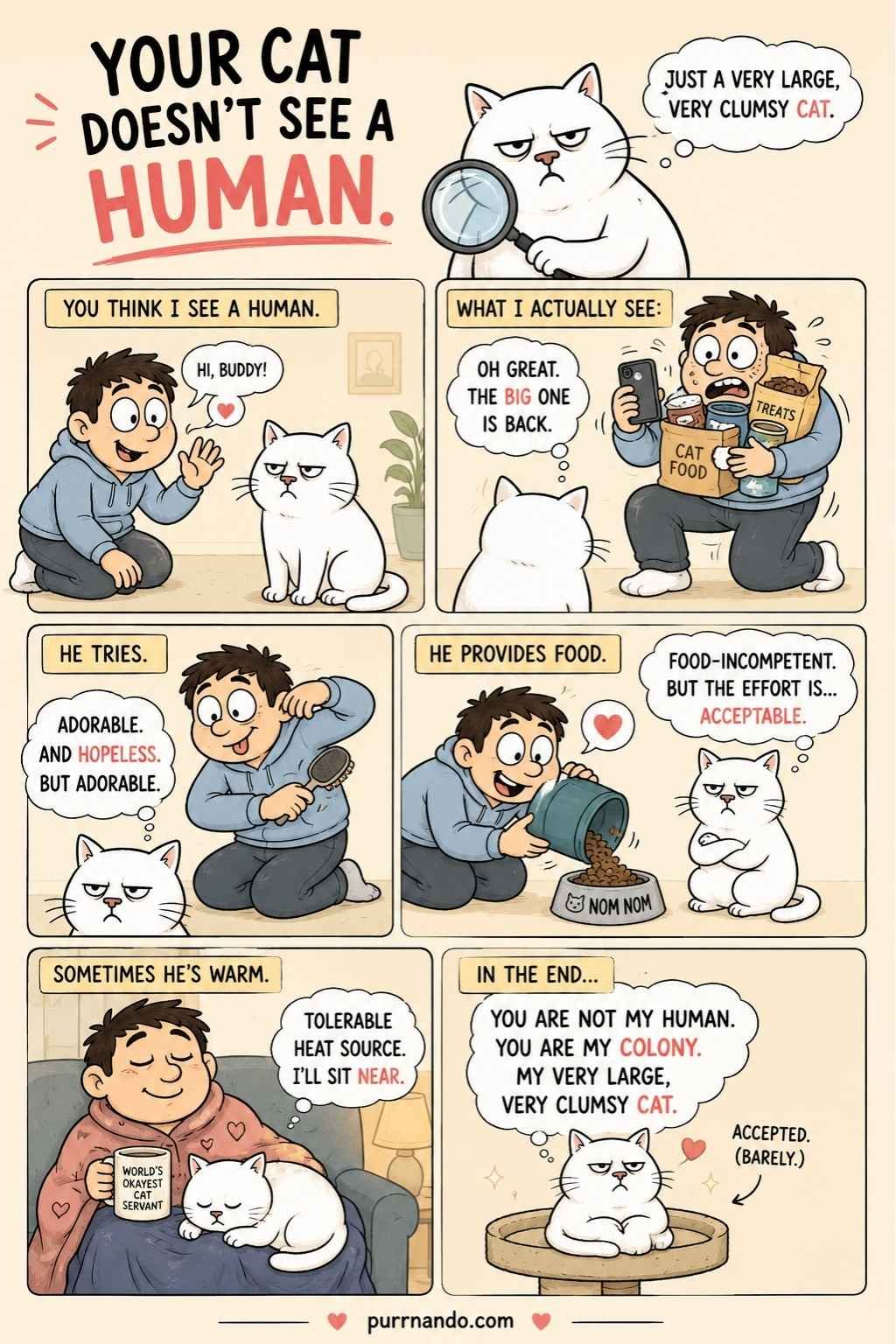
Your cat has never, not once, looked at you and seen a human. Animal behaviorist John Bradshaw spent years studying how cats interact with people and concluded that cats never developed a separate social behavior for hoomans the way dogs did. Dogs see you as a separate species and adjust accordingly — desperate, needy, embarrassingly eager to please.
Cats? We treat you exactly the same way we treat other cats.
When your cat rubs against your leg, they are not greeting a human owner. They are greeting a large, clumsy, food-incompetent fellow colony member. When they groom you, they are doing what they would do for any cat they tolerate. When they sit near you (not ON you — near, there is a distinction and it is important), they are engaging in colony proximity behavior.
You are, in cat eyes, a Very Big Cat. A Very Big Cat who cannot jump properly, cannot clean themselves efficiently, and opens food containers using opposable thumbs rather than skill or dignity.
But here you are in their colony, accepted.
Product Recommendation for Hoomans: “I Work Hard So My Cat Can Have a Better Life” Funny Ceramic Coffee Mug — because at least if you’re going to be a glorified colony member, you should own it with pride over your morning coffee. Print on both sides. Microwave safe. Just like your dignity: surviving, barely, but surviving.
Your Face Is a Blur to Them (And Yet They Still Choose You)
This one always gets hoomans. Brace yourself.
Your cat cannot clearly see your face. Anything closer than about 10 inches from their face is blurry and out of focus. And even at a distance, cats see the world in soft focus — outlines and shapes, not crisp edges and fine details.
So every time you lean in close to give your cat that intense moment of eye contact, desperately hoping for connection, your face is a fuzzy blob to them. You look like a very large, flesh-colored shape that makes sounds.
And before you spiral into an existential crisis, yes, your cat still recognizes you. Just not by your face. They recognize you by how you move, how you sound, and how you smell. Your cat doesn’t carry a picture of you. They carry the entire feeling of you.
Which, if you think about it, is more intimate than a photograph anyway.
(I did NOT just say something sincere. You imagined it. Moving on.)
What your cat DOES see with extraordinary precision is motion. The smallest twitch. The faintest shift in your body language. A bug moving across a wall from six feet away. This is why your cat stares at empty corners with the intensity of a detective who has cracked the case, and also why they cannot find the treat you are dangling directly in front of their nose. They are built for distance and motion, not close-up static objects. They’re using their nose for that.
Give your cat something worthy of those extraordinary eyes.
Product Recommendation: Cat Amazing Interactive Treat Maze & Puzzle Feeder — veterinarian recommended and eco-friendly cardboard construction. It lets your cat hunt for their food the way nature intended, engaging all their senses — smell, motion detection, problem-solving. This is a proper intellectual challenge. Not that sad little piece of kibble you roll across the floor and call “play.”
They Are Trying to Teach You to Hunt (Because You Are Hopeless)
And now, the one that I personally find most relatable: your cat thinks you are culinarily helpless, and they are trying to save you.
In the wild, mother cats bring prey back to their kittens — first dead, then partially alive — to teach them how to hunt and survive. When your cat drops a dead mouse at your feet and stares at you with that look of barely concealed disappointment, they are running that exact same mothering instinct.
They have watched you. You never chase anything. You never stalk anything. You simply walk to a loud, cold box and remove food from it using no skill whatsoever. In their eyes, you are a dependent who has never learned to fend for themselves.
And instead of giving up on you, instead of thinking, “this hooman is a lost cause and I must find a more competent colony,” they step up. They bring you something. They try to teach you.
Some cats bring dead prey. Some bring it still moving, to give you the chance to practice. Indoor cats often bring toys, dropping them at your feet and meowing, essentially saying, “Here. This is prey. Do something with it, PLEASE.”
If your cat drops a toy at your feet and stares at you expectantly, that is a hunting lesson. The correct response is not to look at your phone. The correct response is to engage with the toy, demonstrate some basic predatory effort, and earn a modicum of respect.
Product Recommendation: Cat Dancer Wand Toy — veterinarians recommend this classic wire wand toy because it mimics prey movement with eerie accuracy and has entertained over six million cats. When your cat drops something at your feet and stares at you, pick up a wand. Engage. Show some effort. Maybe, MAYBE, they will stop bringing you dead things as a participation trophy.
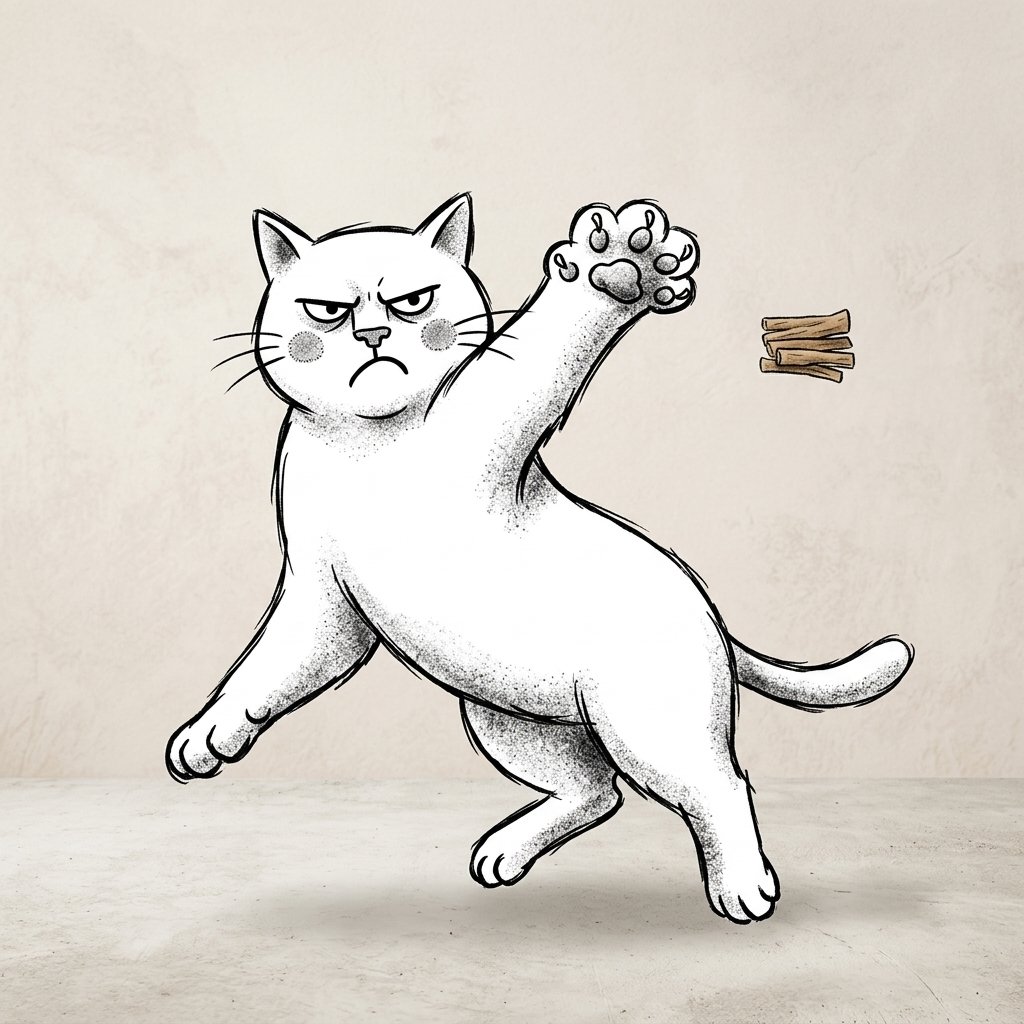
Also, a word to the wise: context matters. If your cat drops a toy and then gets excited and dashes around, that is an invitation to play, not a hunting lesson. If they drop it and just stare, that is the lesson. Learn the difference. I shouldn’t have to explain this.
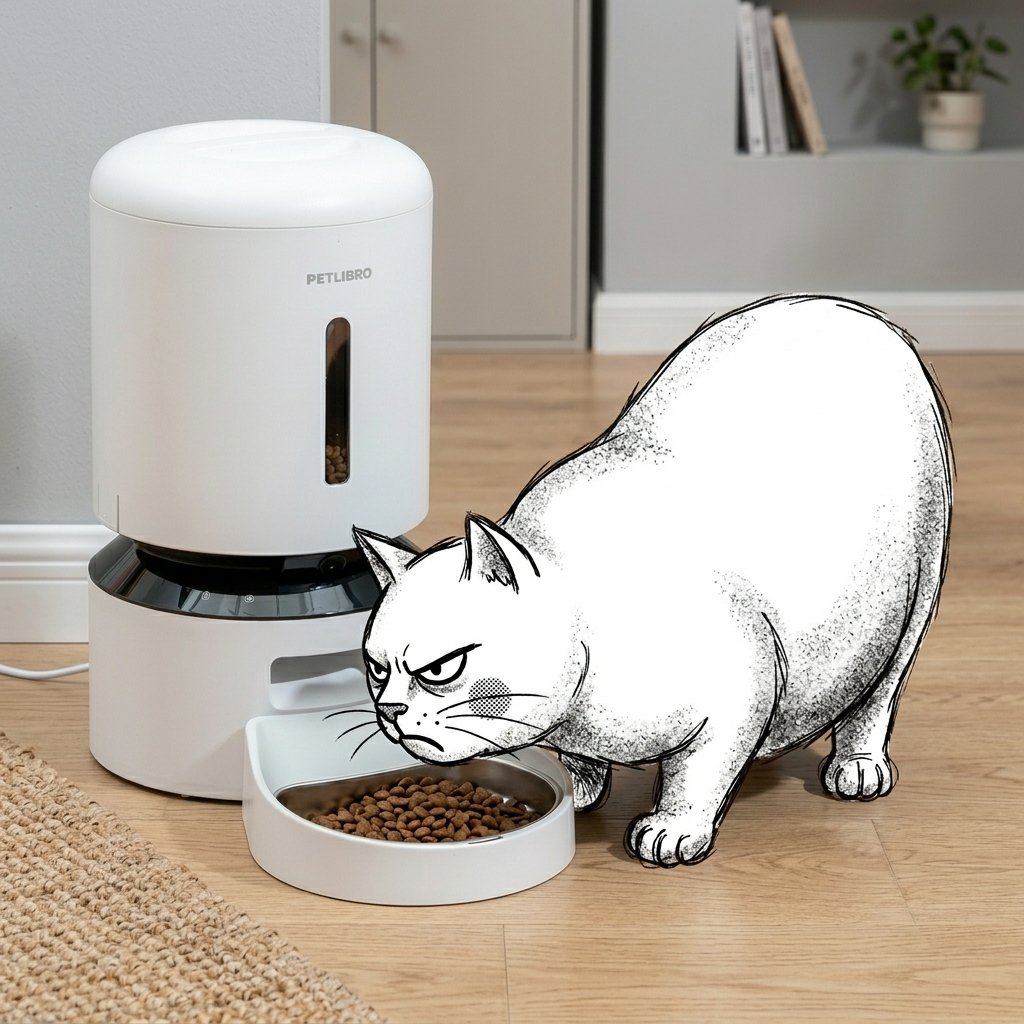
Bonus Product Recommendation for Hoomans: PETLIBRO Automatic Cat Feeder — because if you are going to open a cold box at the same boring times every day using no hunting skill whatsoever, at least be consistent about it. An automatic feeder dispenses precisely portioned meals on schedule, so your cat is never subjected to the humiliation of watching you forget. Again.
In Conclusion: Your Cat Thinks You’re Family. Try to Be Worthy of That.
So there you have it.
Your cat thinks you are part of their colony. They invented a language just for you. They bring you hunting lessons because they believe in you even when the evidence strongly suggests they shouldn’t. Your presence literally calms their nervous system. And somewhere in that fuzzy, motion-tracking, smell-cataloguing brain of theirs, you are home.
You are not their owner. You are not their master. You are their very large, occasionally useful, deeply beloved fellow cat.
Act accordingly.
Now stop reading and go refill the bowl.
— Purrnando
This post contains affiliate links. A portion of every sale goes toward funding Purrnando’s lifestyle, which he insists is a tax-deductible necessity.