Do cats get jealous? you ask. Fine. I will address this.
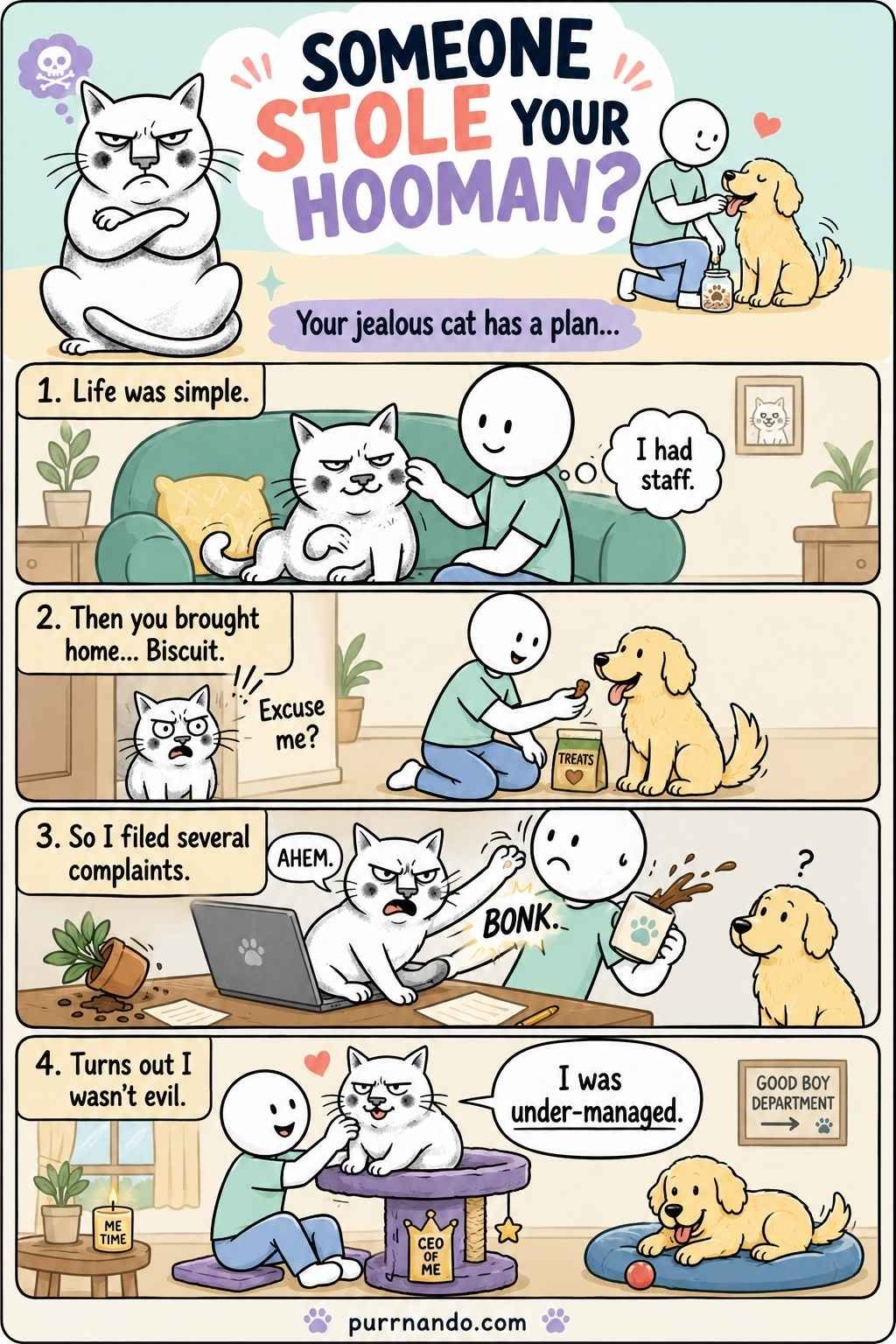
You hoomans have been running around the internet asking “do cats get jealous?” as if it is some grand philosophical mystery. As if WE are the complicated ones. Meanwhile, you brought a slobbering golden retriever named “Biscuit” into MY home, gave him MY spot on the couch, fed him treats out of YOUR HAND, and then looked at me — me, Purrnando — as I knocked your coffee off the counter and thought, “Hmm, I wonder if something is wrong.”
Something is wrong. I will explain it to you now slowly because apparently you need help.
Can Cats Actually Feel Jealous? (Spoiler: Obviously.)
Let us get the science out of the way so I can get back to staring at you with contempt.
Animal behaviorists largely agree that cats do experience something very much like jealousy — though they are careful to note it is not quite identical to the complex, obsessive human version. (You hoomans really do make everything about yourselves, don’t you.)
According to experts, when a cat sees another creature getting something they want — attention, treats, a warm spot on the lap — the emotional response of “I want that thing they have and I am NOT getting it” is very much within a cat’s emotional repertoire.
The key difference? You hoomans will stew in jealousy for weeks, writing sad poetry and texting your ex.
We cats live in the moment. We will simply yell at you, sit on your face at 3am, or knock Biscuit’s water bowl across the kitchen floor. Clean, direct, efficient.
We do not hold grudges. We hold grudges for exactly as long as it takes you to acknowledge us, at which point we may or may not accept your apology.
What triggers cat jealousy is, at its core, a feeling of insecurity. Cats are deeply territorial creatures with a strong need to feel in control of their environment.
When that sense of security is threatened — by a new pet, a new baby, a new partner, or frankly a new piece of furniture we did not approve — behaviors emerge that you, in your limited hooman understanding, interpret as “jealousy.”
We prefer to call it “a completely reasonable response to your chaotic lifestyle choices.”
Signs Your Cat Is Jealous (A Field Guide for Observant Hoomans)
You would think this would be obvious. It is not. So here is your list.
Aggressive Behavior That Seems Unprovoked (It Is Not Unprovoked)
Hissing. Swatting. Growling. The occasional unprovoked attack on the new kitten you brought home without consulting me. These are not random acts of violence. These are clearly communicated messages that you have failed to heed.
Cats show aggression when they feel their status, territory, or access to resources — including YOU — is being threatened.
There are actually different flavors of this aggression, which I will generously explain:
- Status-induced aggression: I am the dominant creature in this household. Or I was, until you got “Biscuit.” Do not test me.
- Redirected aggression: I am upset about the stray cat sitting in MY garden outside, and since I cannot get to him, your ankle is the next best option. You are welcome.
- Inter-cat aggression: A new cat has arrived in my territory and I have not agreed to a roommate arrangement. HR will be hearing about this.
Attention-Seeking Behavior (And Don’t You Dare Ignore It)
Have I sat on your keyboard while you were working? On your book while you were reading? On your face while you were sleeping? This is not coincidence. This is strategy.
When a cat inserts themselves between you and whatever you are doing, they are reclaiming their position as your top priority.
Some say this is because cats enjoy warmth — your laptop runs hot, after all.
Some say it is because we like things that smell like you. I say it is because you were paying attention to something that was not me, and that needed to stop. The end result is the same.
PRODUCT RECOMMENDATION FOR HOOMANS: If you work from home and your cat keeps sitting on your laptop — good news, someone has invented a solution. The Cattop Cat Laptop Toy is a heated fake laptop that mimics the warmth of your real one. You can give your cat their own “computer” to sit on while you attempt to be productive. I find this hilarious and slightly insulting, but also… I tried it and it is quite warm. I am keeping it.
Destructive Behavior (You Call It Destruction, I Call It Redecorating)
Chewing furniture. Shredding household objects. Knocking things — specifically your things — off shelves.
This is not random.
A jealous or stressed cat may resort to destructive behavior as an outlet for anxiety.
Every vase I have knocked off your bookshelf has been a carefully considered emotional statement. You just weren’t listening.
Litter Box Avoidance (The Nuclear Option)
I do not enjoy talking about this. It is undignified. But it must be said: when a cat starts going outside the litter box, it is often a stress response, particularly in multi-cat households.
This is not revenge. This is a cat who feels so insecure and out of control of their environment that normal bathroom routines have collapsed. It is, essentially, a cry for help. A smelly, inconvenient, impossible-to-ignore cry for help.
If this is happening in your house, do not punish your cat. Find the cause. Eliminate it. Then clean the carpet. With good products.
Hiding or Withdrawal (The Silent Treatment, But Make It Feline)
Not all jealous cats are loud about it. Some of us retreat. If your normally social cat suddenly disappears behind the couch for days on end, that is not them being “independent.”
That is a cat who feels displaced, overlooked, and frankly a little devastated. We just have too much dignity to cry about it openly. Unlike Biscuit, who cries about literally everything.
Excessive Grooming (When the Anxiety Goes Inward)
Some cats under stress will over-groom — licking themselves to the point of hair loss.
This one is serious. If your cat is developing bald patches, that is not a fashion choice. That is a stress response that warrants a vet visit.
What Causes Cat Jealousy? (A Partial List of Hooman Crimes)
Here is what sets us off. Take notes.
1. A New Pet in the Household You did not ask us. You never ask us. One day there is no dog, and the next day there is a dog named Biscuit who has been given MY blanket. The social upheaval of a new animal entering a cat’s established territory is one of the biggest triggers of jealousy-like behavior. The resident cat — that is me — loses their status as the center of attention and must now compete for everything: space, food, your lap, your love. It is exhausting.
2. A New Baby Congratulations on your baby. I am sure it is very loud. And bald. And it smells unusual. Your cat will need time to adjust to the new smells, sounds, and the alarming amount of attention this tiny hooman receives. Sudden shifts in routine are deeply stressful for cats, and a new baby upends absolutely everything. Be patient with your cat during this time. And perhaps give them a few extra treats. For medicinal purposes.
3. A New Partner Oh, so now there is another hooman in the house who takes up half the bed and does not know how I like to be petted. Wonderful. New people in the household can make established cats feel territorial, particularly if this new person sits in our spot, uses our hooman’s attention, or — unforgivably — brings their own scent into our space. Give us time to warm up to them. If we do not warm up to them in six months, please consider that we may simply have good judgment.
4. Changes in Routine You went back to the office. You changed feeding times. You rearranged the furniture without asking. We do not handle change well. Disruptions to routine create uncertainty, and uncertainty creates stress, and stress creates the kind of behaviors that make you google “why is my cat being weird.”
5. Resource Competition in Multi-Cat Households If you have multiple cats and only one food bowl, one litter box, and one sunny window spot — congratulations, you have created a gladiatorial arena. Competition for resources is a major source of inter-cat tension. Every cat needs their own space, their own feeding station, and their own litter box. Plus one extra. This is not negotiable.
How to Manage a Jealous Cat (Without Further Insulting Their Dignity)
I will now give you actionable advice, because I am generous and also because I need things to improve around here.
Give Your Original Cat Priority Attention
Before greeting the dog, the baby, the new partner, the new kitten — greet the resident cat first. This signals that their position in the household has not been usurped. A few minutes of dedicated one-on-one time in the morning and evening does more than you know.
PRODUCT RECOMMENDATION: The Nina Ottosson Buggin’ Out Puzzle Toy is an interactive puzzle feeder that gives your cat mental stimulation and makes them feel engaged and clever. Engaged cats are less anxious cats. And a cat who has just solved an eight-compartment puzzle feels like the undeniable genius of the household, which is what we are anyway.
Introduce New Pets Slowly (Agonizingly, Mercifully Slowly)
Do not put two cats together and hope for the best.
This is not a strategy. This is a disaster with fur. Introduce new animals gradually: scent swapping first (swap bedding between animals), then visual contact through a cracked door, then controlled face-to-face meetings with escape routes available.
This can take weeks. Take the weeks. I promise you it is faster than rebuilding trust after a bad introduction.
Create Separate Safe Spaces
Every cat needs a place that is theirs alone — where no dog, no baby, no new kitten can follow them. A cat tree in a quiet room, a shelf, a cozy bed tucked in a corner. A sanctuary.
PRODUCT RECOMMENDATION: The Heybly Cat Tree features multiple perches, a hammock, and hiding spots — everything a cat needs to feel like royalty while surveying their domain from a safe distance. Height = power. Remember this.
Distribute Resources Generously
In a multi-cat household, the rule is: one litter box per cat, plus one extra. Same for feeding stations, water bowls, and cozy sleeping spots.
This reduces competition and the simmering resentment that leads to bigger conflicts.
Consider a Calming Diffuser
For genuinely stressed or anxious cats, pheromone diffusers can help create a sense of calm in the environment. The FELIWAY Classic Diffuser is the #1 vet-recommended option. It releases a synthetic version of the feline facial pheromone — the one we deposit when we rub our faces on things (yes, when we rub our faces on your furniture, we are saying “this is mine and I feel safe here.” You are welcome for the clarification).
The Feliway Classic earns 4.5 stars from Catster reviewers and comes with decades of research behind it. It won’t fix the underlying problem, but it takes the edge off while you do the actual work.
BONUS PRODUCT RECOMMENDATION FOR HOOMANS: If you are the type of hooman who brings home a dog named Biscuit without telling your cat, might I suggest the “I’m Sorry” Cat Treat Variety Pack — because you have some making up to do. Specifically to me. Starting now.
Maintain Routines
Feed at the same times. Play at the same times. This is not complicated. Predictability is safety for a cat. Safety means calm. Calm means I am not sitting inside your suitcase every time you open it.
When to Call a Vet or Animal Behaviorist
If jealous behaviors are escalating — aggression increasing, litter box avoidance persisting, excessive grooming causing hair loss, appetite changes, prolonged hiding — please involve a professional.
A veterinarian can rule out underlying health issues, and an animal behaviorist can help you restructure the environment and dynamics in a way that restores harmony for everyone, especially me.
A Word on Cats and Their Emotional Depth (From a Cat Who Has Feelings, Not That He Will Admit It)
There is still debate among scientists about whether cats experience emotions exactly the way hoomans do.
The research on animal jealousy focuses primarily on behaviors rather than internal emotional states, since we have not yet agreed to participate in your brain scans. But here is what I will say:
Jealousy evolved, in animals and humans alike, to protect social bonds from intrusion. The fact that cats show behaviors consistent with jealousy suggests that we value our relationships — with our hoomans, our territory, our resources — enough to defend them.
That is not nothing. That is actually quite meaningful.
We may not stew over it. We may not write the sad poetry (although I have considered it). But in the moment, when you give Biscuit the last treat and look at me like I won’t notice — I notice. I always notice.
In Conclusion: Your Cat Is Fine. You Just Need to Do Better.
To summarize what I, Purrnando, have generously shared with you today:
- Yes, cats get jealous — or something very much like it, rooted in insecurity and the need to feel safe and valued.
- Signs include aggression, attention-seeking, destructive behavior, litter box avoidance, hiding, and excessive grooming.
- Triggers include new pets, new babies, new partners, routine changes, and resource competition.
- Solutions include dedicated attention, slow introductions, separate spaces, calming diffusers, and treating your cat like the priority they are.
- If things escalate, call a vet. Do not wait until I have shredded the couch.
Your cat is not being dramatic. Your cat is communicating. The question is whether you are listening.
I am going to go sit in a spot of sunlight and pretend this conversation never happened. But I saw you reading this article. And I appreciate it.
Not that I will tell you that.
If this article helped you understand your cat’s behavior, share it with a fellow hooman who has also made questionable life choices (i.e., gotten a second pet without consulting the first one). They need this more than they know.
Affiliate disclosure: if you buy through our links, we earn a small commission. Purrnando has been informed of this and is choosing to be offended that it isn’t larger.