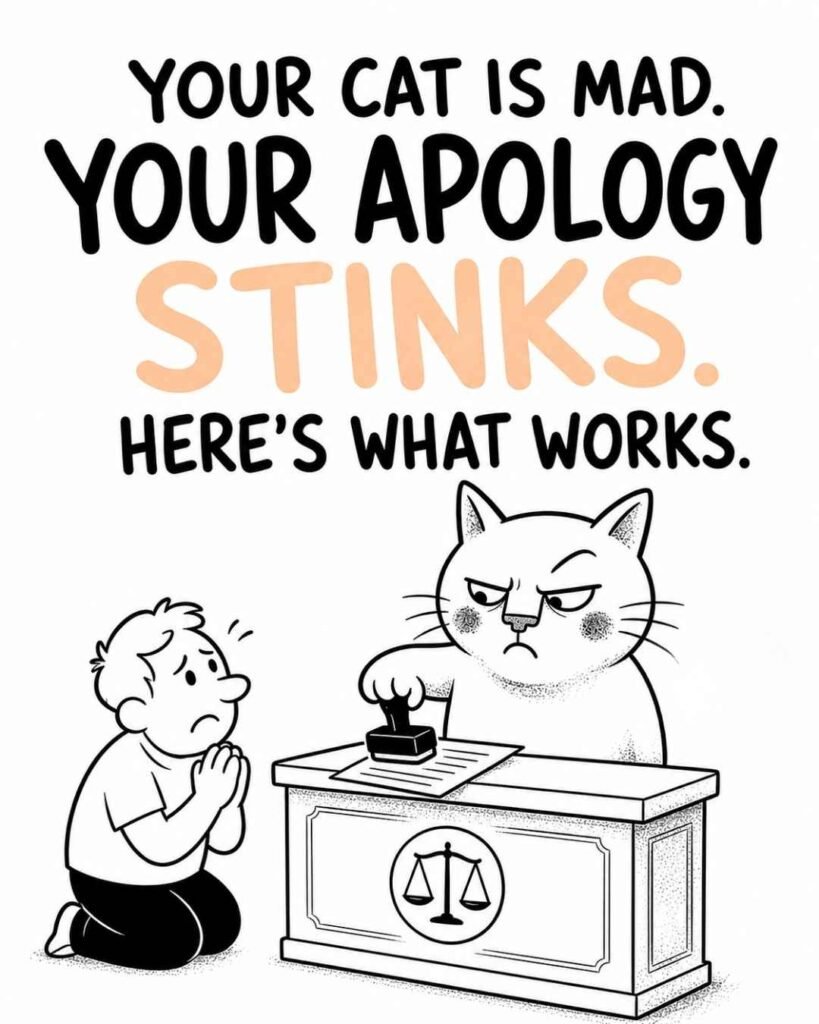
You found this blog post because you Googled something embarrassing like “does my cat feel bad for knocking over my coffee” or “why does my cat look guilty.” You have come to the right place. I will explain everything. Not because I care about you. But because someone has to set the record straight, and frankly, none of you are doing a very good job of it.
Sit. Read. Try to keep up.
Why Does My Cat Misbehave? (A Question That Already Annoys Me)
Let us start here because this is the foundation of your confusion, and your confusion is frankly exhausting.
You think your cat is misbehaving. Your cat does not agree. Your cat is simply living. When I knock your water glass off the counter, I am not doing it at you. I am doing it because it is there, it is precarious, and the laws of physics are a temptation I refuse to resist. That is called curiosity. You used to think it was charming. What happened?
When cats scratch your furniture, it is because our nails grow continuously. It is a biological reality. If you would like us to stop scratching your precious couch, perhaps consider providing a proper alternative. Might I suggest the SmartCat Ultimate Scratching Post. It is 32 inches tall, covered in sisal that cats apparently cannot get enough of, and comes with a sturdy base so it does not wobble when I commit to a full-body stretch.
When a cat pees outside the litter box, it is also not personal. It means the box is dirty, the cat is stressed, the box is in a terrible location (why did you put it next to the washing machine?), or there is a medical issue. Speaking of which, if you are still scooping your cat’s litter box by hand in this economy, that says more about you than it does about us.
A self-cleaning litter box exists. It has app control. It has safety sensors. It has more technology in it than your first laptop. It scoops itself. Sort your life out.
Cats do not act out of revenge. We do not sit in the corner plotting against you. We simply have needs, and when those needs are not met, we improvise. The fact that your couch is the casualty of your own negligence is, respectfully, a you-problem.
Do Cats Know When They Have Done Something “Bad”?
No. And yes. It is complicated. Try to follow along.
Cats do not possess a sense of right and wrong the way you do. We do not look at your shredded curtains and think, “Oh, that was morally incorrect of me.” We look at your shredded curtains and think, “Outstanding texture. Would scratch again.” The concept of “bad” is a hooman invention. We did not sign your social contract.
However — and here is where I will admit something that pains me greatly — we do notice when you are upset.
Studies have shown that cats are remarkably responsive to human voices. When you are happy, your voice is warm and pleasant, and we associate it with food, cuddles, and general tolerance of our presence. When you are angry, your tone shifts into something unfamiliar and unpleasant, and yes, we register that. We are not oblivious. We are simply choosing when to care.
Beyond your voice, we also read your face. Research from Oakland University found that cats can distinguish between smiling and frowning humans. I personally have been reading your face for years. Your face, by the way, is very readable. You are not as mysterious as you think.
So to answer the question: your cat does not know it did something bad. But your cat does know that you think it did something bad, because you are standing there with your hands on your hips making that face. We see you.
Does My Cat Feel Guilty? (No. Stop Looking for Guilt. There Is No Guilt.)
I must now deliver some news that I suspect will hurt your feelings.
Cats do not experience guilt. We do not feel shame. We do not feel pride either, but that is less relevant to this discussion. These are classified as secondary emotions, complex social feelings that require a level of self-reflection and moral reasoning that cats have not bothered to develop, because it did not seem useful.
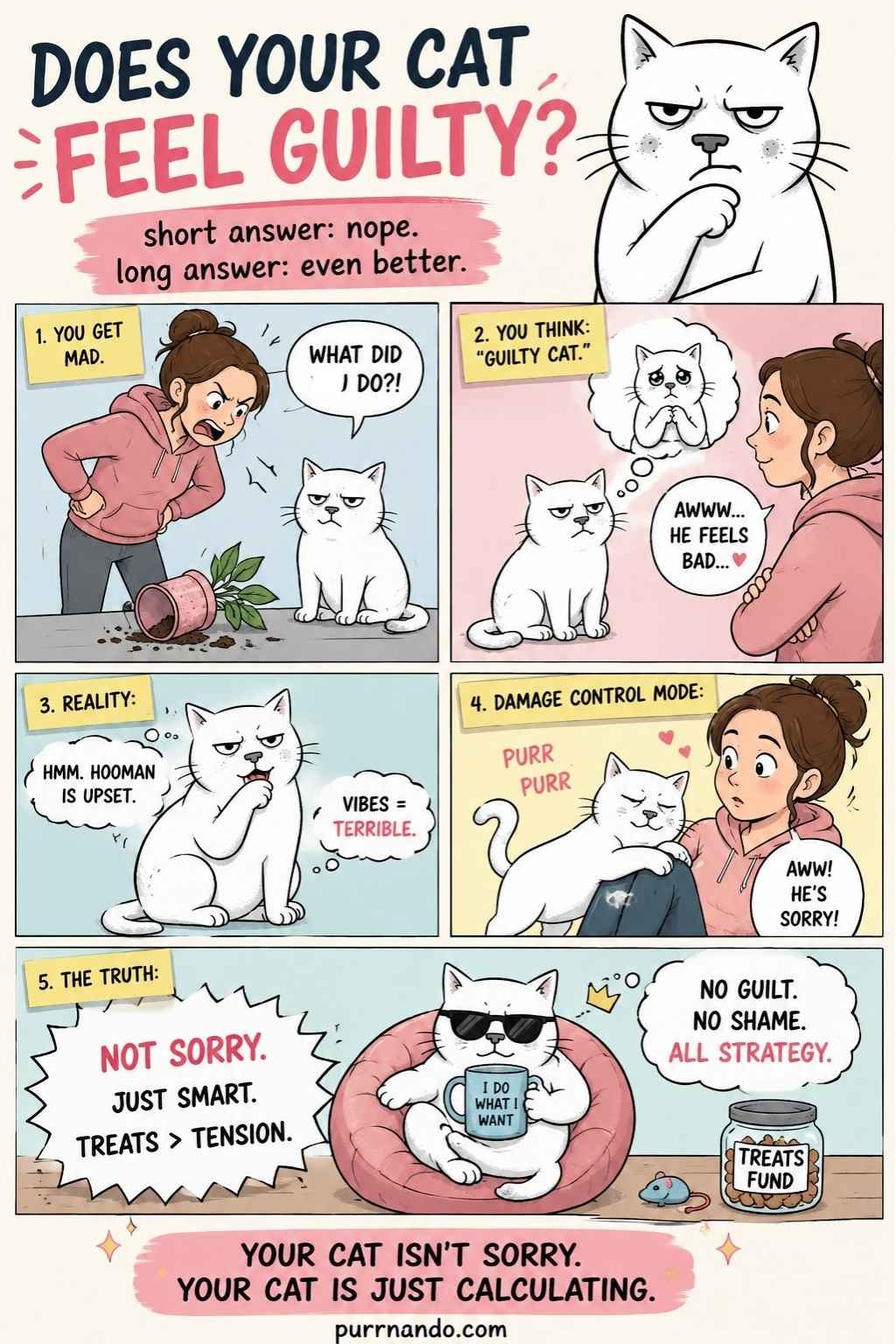
If your cat knocked something off the shelf and then stared at you afterward with what you interpreted as a guilty expression, I need you to understand something: that was not guilt. That was your cat reading your reaction and recalibrating. Your cat saw your face change, your body stiffen, your voice rise, and your cat thought, “Hmm, this creature is upset. I should monitor the situation.” It looked like guilt because you wanted it to look like guilt. You projected that onto us. This is a hooman problem.
Cats act on instinct. If we hurt you during play, it was not malice. If we scratched you, we were probably overstimulated or felt cornered. We are not sitting in our feelings about it afterward. We have moved on. I suggest you do the same.
So Why Does My Cat Cuddle Me After Misbehaving? (The Real Answer)
I know. You thought the snuggling meant “I’m sorry.” You told your friends about it. “He knocked over my lamp and then came and sat on my lap — he felt so bad!” Your friends nodded. Your friends were wrong, and so were you.
Here is what is actually happening: after you expressed your displeasure, your changed behavior — the ignoring, the sighing, the dramatic energy — made us anxious. We do not enjoy tension. We are not drama creatures by nature (well, some of us are, but that is a separate conversation). We want the household energy to return to baseline: calm, predictable, and centered around our comfort.
The licking, the head-butting, the purring, the sitting on you, this is not an apology. This is a peace treaty. This is us saying, “I notice you are in a mood. I would like you to stop being in a mood. Here is my head. Please return to normal.” If it also works to get your attention and remind you that treats exist, so much the better.
We are pragmatists. We are not sorry. We are strategic.
Speaking of treats, if you want to actually use positive reinforcement to help your cat associate good behavior with good things, INABA Churu Lickable Cat Treats are a highly effective tool. They are a creamy purée, extremely popular, and among the top-rated treats. Cats lose their minds for these. I do not speak from personal experience. I am simply aware of their existence.
You may also want Temptations Classic Cat Treats — crunchy, soft, and considered basically a controlled substance in the cat community.
Can Cats Apologize? (No. And We Should Not Have To.)
Let me be direct: cats cannot apologize. Apologizing requires understanding that you have wronged someone, feeling bad about it, and wanting to make amends. This is a three-step process that assumes guilt, which, as we have already established, is not something we do.
What cats can do is attempt to reconnect with you after a period of tension. We do this through affectionate behaviors — the meowing, the slow blink, the flopping dramatically near your feet. This is your cat reaching out. Not to say sorry. To say “I miss when things were normal and you were providing services.”
Do not romanticize it. But also do not dismiss it. It is, in its own way, quite touching — if you understand what it actually means rather than what you want it to mean.
How Do Cats Apologize to Each Other? (With Strategic Grooming and Zero Words)
Among ourselves, the dynamic is different. Cats do not feel guilty toward other cats any more than we do toward you. But we do value safety, stability, and a peaceful territory. Drama between cats disrupts all of that.
So when two cats have had a conflict and you later see them grooming each other, sleeping near each other, or rubbing heads, this is not a heartfelt reconciliation. These are two beings who have decided, rationally, that the cost of ongoing conflict is higher than the cost of tolerance. It is diplomacy, not friendship. Much like international relations, but with more napping.
How Long Do Cats Stay Angry? (Long Enough to Make a Point, Short Enough to Get Dinner)
Here is where I will share something that might surprise you: we are not as vindictive as our reputation suggests.
Research shows that one-off negative events fade from a cat’s short-term memory within approximately 16 hours. If you accidentally stepped on my tail and then apologized (with treats), I will likely have moved on by dinner. I am not holding a grudge over a single incident. I have better things to do with my time, like napping. And staring at the wall.
However — and I cannot stress this enough — repeated mistreatment is a different matter entirely. Cats have associative memories. If someone has consistently been rough, cruel, or frightening, we learn that. Not as a grudge, as survival information. We categorize that person as a threat and adjust our behavior accordingly. We are not being dramatic. We are protecting ourselves. Please treat your cats with consistency and kindness. Not for their sake — clearly they are fine — but for yours. A cat who trusts you is a completely different creature from a cat who does not.
How to Apologize to Your Cat (Yes, You. The One Who Did Something.)
Fine. You made a mistake. You startled your cat, scolded them too harshly, or accidentally sat on them. It happens. Here is the correct protocol, from me, Purrnando, who has never been wrong about anything.
Step one: Give us space. If you just sent us running under the bed, do not chase us under the bed. That is worse. Sit quietly and let us process.
Step two: Use a calm, gentle tone. When we eventually re-emerge — and we will re-emerge, especially if food is involved — talk to us softly. None of that panicked, apologetic rambling. It is unpleasant.
Step three: Slow blink. This is a known feline communication of trust and goodwill. Look at your cat, let your eyes half-close, and blink slowly. If your cat slow-blinks back, you are forgiven. If your cat stares at you with large unblinking eyes, try again later.
Step four: Treats. Always treats. I recommend Greenies Dental Cat Treats, vet-recommended, and they double as dental care, which I also did not ask you about but will now acknowledge is probably useful.
Step five: Playtime and petting. Spend some calm, gentle time with your cat. Interactive toys, light petting in the places they enjoy, quiet presence. This communicates safety. Safety communicates trust. Trust communicates that you are a tolerable hooman.
A Final Word From Purrnando
You came here thinking your cat was capable of guilt, shame, and elaborate emotional performances for your benefit. You now know the truth, which is more interesting. We are highly intelligent, emotionally aware creatures who read your every mood, choose our responses based on what works, and have no interest in moral accountability whatsoever.
Is that so different from you? I will let you sit with that.
Now I have been awake for 45 minutes and I need to return to my nap. Leave treats by the door. Not the cheap ones.
— Purrnando
Affiliate disclosure: if you buy through our links, we earn a small commission. Purrnando has been informed of this and is choosing to be offended that it isn’t larger.