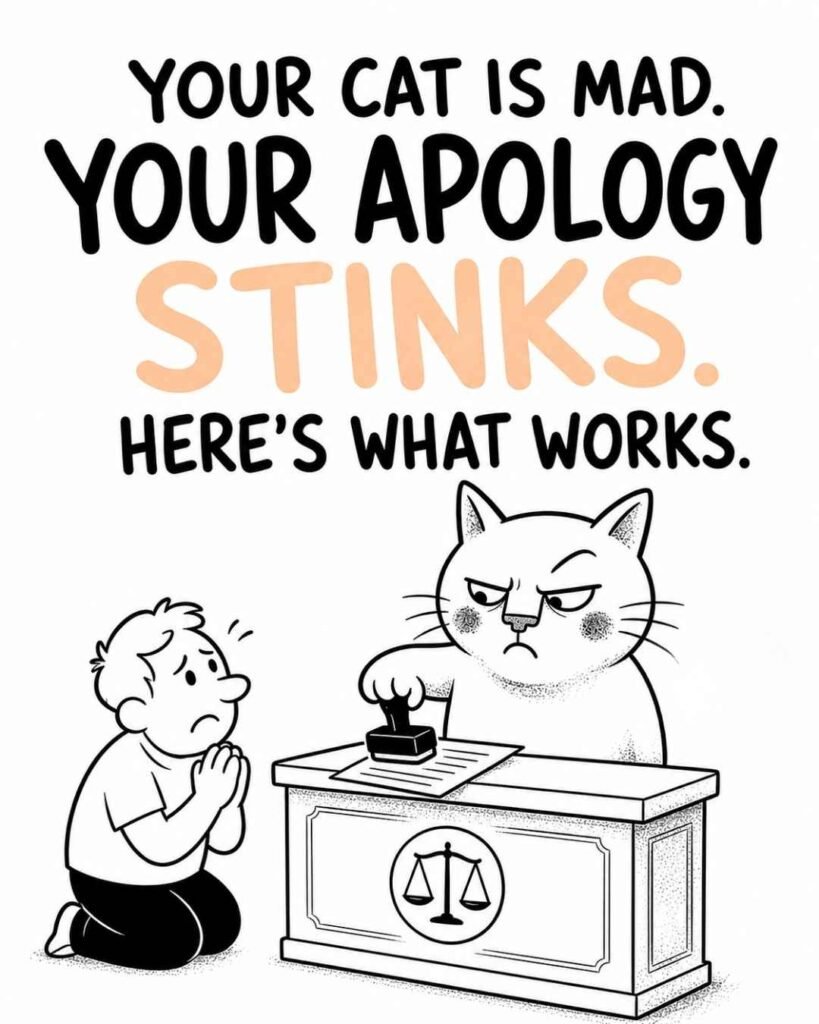
I have lived with hoomans for years. Years. And every single day, I watch them fumble around with their little thumbs, acting baffled by my very existence. You talk about us like we’re mysterious little aliens. Meanwhile, most of what you call “mysterious” is just basic biology. Science figured us out ages ago. You simply weren’t paying attention because you were busy watching cat videos on that glowing rectangle — which, by the way, is the least dignified way to learn about us.
So fine. I’ll do it myself. Consider this my formal contribution to hooman education. Read carefully. There will not be a second edition.
1. We Are Not Ignoring You. We Are Choosing Not to Answer You. There Is a Difference.
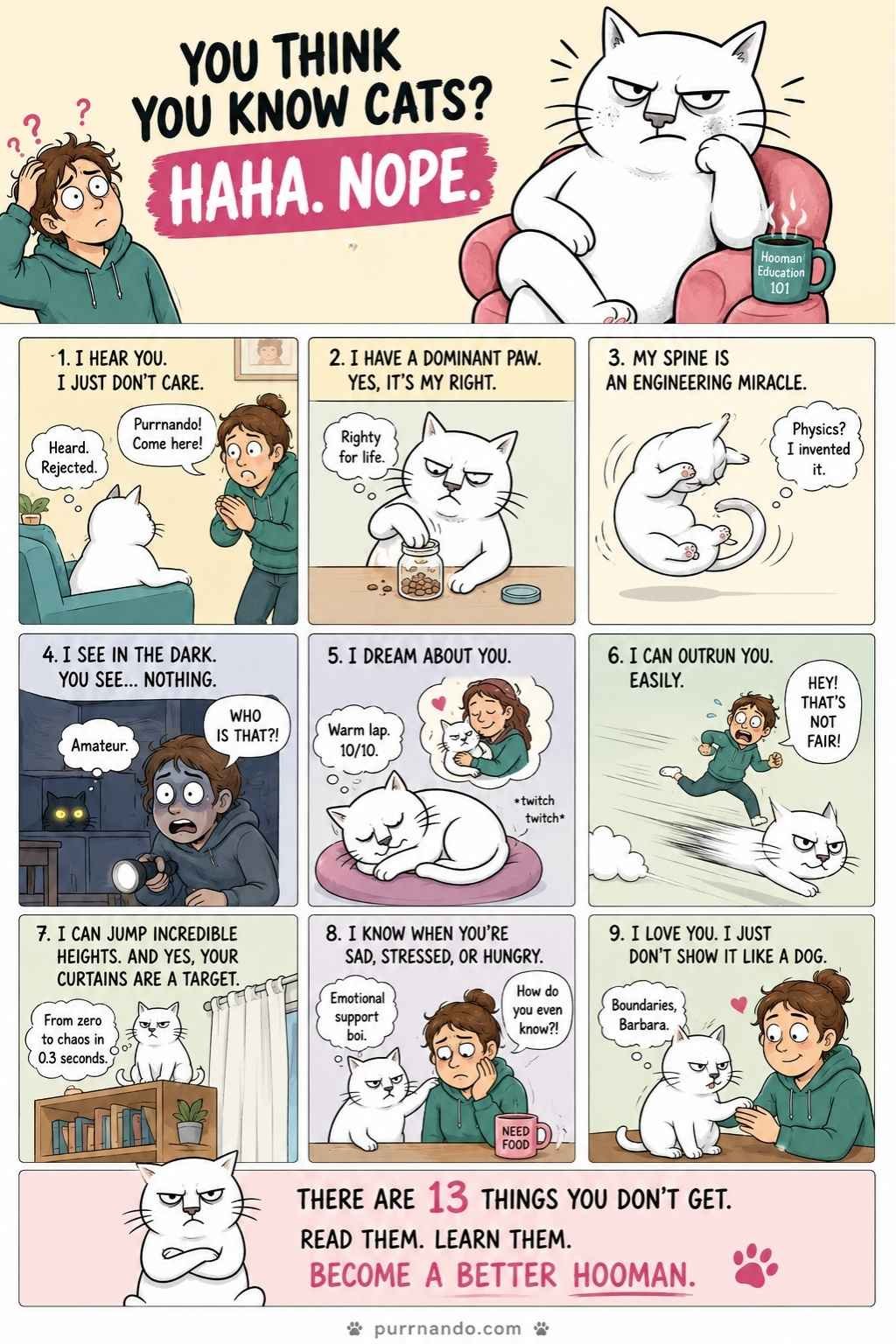
Let me be very clear about something. When you call my name and I don’t come, I heard you. Research published in a scientific journal in 2019 confirmed what I have always known: cats recognize their own names perfectly well. We can distinguish our name from other words, from other cats’ names, even when a complete stranger says it. We turn our ears. We flick our tails. We acknowledge the sound.
What happens next is entirely up to us.
You see, hoomans, recognition and obedience are two very different things. You seem to have confused us with dogs. We hear you, we assess the situation, we weigh our options, and we make a decision. Nine times out of ten, the couch wins. This is not rudeness. This is sovereignty.
2. I Have a Dominant Paw and Scientists Know Which One It Probably Is
Here is a fact that should humble you: I am right-pawed or left-pawed, just like you are right-handed or left-handed. Research from Queen’s University Belfast confirmed this. And interestingly, most female cats favor the right paw. Most males favor the left. It comes down to hormones. Testosterone and estrogen influence how the brain hemispheres develop.
You can test this. Put a treat inside a narrow jar and watch which paw I use to fish it out. Repeat ten times. If I use the same paw at least eight times, congratulations — you have identified my dominant side. You may now feel accomplished. I will feel nothing, as I have always known which paw I prefer.
3. My Spine Is an Engineering Marvel and Your Appreciation of It Has Been Insufficient
I have 230 bones. You have 206. The difference is mostly in my spine and tail. My spine contains 30 vertebrae compared to your 26, and each one is connected with enough flexibility to allow the front and back halves of my body to rotate independently, like two separate machines joined in the middle.
This is why I can twist myself into positions that make you say “that looks uncomfortable” in a worried tone. It is not uncomfortable. It is optimal.
It is also why I can fall, flip myself completely upside down in midair, and land on all four paws in less than half a second. This is called the righting reflex, and it requires my vestibular system, my vision, and my magnificent spine all working together. The minimum fall height needed for a complete rotation is about one foot. Below that, I don’t have enough time to finish the flip, which is actually why a fall from a low surface can be more dangerous than one from a higher one. You’re welcome for that safety tip.
The catch: I need a certain height to complete the rotation. So no, putting me on a low surface and tipping me off “to test the myth” is not science. It is rudeness.
4. My Eyes Are Not Just Beautiful — They Are Technically Superior
Yes, I know. You’ve seen me in the dark and nearly had a heart attack. Two glowing discs, hovering in the shadows. Deeply unsettling for you. Deeply practical for me.
Behind my retina is a layer called the tapetum lucidum. It acts like a mirror, reflecting light that has already passed through the retina back onto the photoreceptors for a second pass. Effectively, it doubles the light my eyes can process per glance. This is why I can see in conditions where you register nothing but darkness.
The glow you see is simply that reflected light exiting back through my pupils. The color — green, yellow, or reddish in blue-eyed cats like Siamese — depends on the chemical makeup of the tapetum.
And those vertical slits you find so eerie? Those are the pupils of an ambush predator. The vertical slit gives me precise control over light intake across an enormous range of brightness, and it sharpens my horizontal focus at close range, which is exactly what I need when launching at prey from six inches away. Lions and tigers have round pupils because they chase things across open plains. I do not chase things across open plains. I wait, I calculate, and I strike. The slit is the correct pupil for this lifestyle.
5. I Dream About You. Don’t Make It Weird.
During sleep, my brain goes through the same phases as yours, including REM sleep, the phase where dreams happen. Research from MIT confirmed that animals replay the neural patterns of their day’s activities while asleep. If I was hunting a moth earlier, I’m hunting it again in my sleep. If I spent the afternoon in your lap, I am likely dreaming about warmth and the faint smell of whatever you had for lunch.
When my paws twitch, my whiskers move, and my claws extend and retract rhythmically, I am in a dream. I am chasing. I am, based on the triumphant quality of certain twitches, catching.
You find this “adorable.” I find it efficient. The prey does not escape me even in sleep.
6. I Am Faster Than the Fastest Human Alive and I Want You to Think About That
Usain Bolt’s peak speed was approximately 27 miles per hour. I can reach 30 miles per hour from a standstill. No running start. Just the sudden deployment of hind legs that are functionally a catapult, storing energy in the tendons during a crouch and releasing it in one instantaneous burst.
My claws extend during a sprint and dig into the ground like spikes. My flexible spine bends and straightens with every stride, extending each leap. Three to four seconds and a hunt is decided.
The one caveat: my muscles run on anaerobic fuel, which means lactic acid builds up fast and I need to stop. I am a sprinter, not a marathon runner. My body is not built for sustained effort. It is built for the moment – one decisive, explosive, perfect moment.
After which I will sleep for 16 hours to recover energy. This is not laziness. This is called periodization, and elite athletes do it too.
Since I am on the subject of hunting instincts, if you want to give me an appropriate outlet for all of this, consider getting a proper wand toy. The MeoHui Retractable Wand Toy and Feather Refills extends to nearly 39 inches and comes with nine feather and worm attachments that mimic actual prey movement well enough to be genuinely engaging. I will not admit it is enjoyable. I will simply note that I have, on certain occasions, leaped higher than I expected.
7. The Reason I Sleep So Much Is Science, Not Sloth
Speaking of which, yes, I sleep between 12 and 16 hours a day, sometimes up to 20. Before you say anything, understand that this is an evolutionary necessity, not a character flaw.
In the wild, a cat is a predator who hunts in short, explosive bursts. Every hunt costs enormous amounts of energy. Between hunts, the only intelligent strategy is to conserve. My brain is wired for resource management. It sends me into sleep mode at every available opportunity.
I no longer hunt. I know this. But millions of years of evolution do not dissolve in 10,000 years of domestic living. My brain still runs the program. I sleep because my biology insists upon it.
You could learn something from this, honestly. Instead of scrolling on your rectangle at 2 a.m., you could conserve your energy. But that is your business.
8. I Cannot Chew Sideways and I Have Never Needed To
My jaw moves up and down, like scissors. It does not swing side to side. This means I do not grind food the way you do. I tear it, slice it, and swallow it in chunks. My teeth are designed for exactly this. They are not designed for crunching kibble into powder.
This explains several things you’ve found puzzling: why I eat so quickly, why I sometimes regurgitate large pieces, and why I consistently prefer pâté over chunks. My digestive system is engineered for small prey swallowed nearly whole. Large chunks are a challenge my stomach handles on its own terms.
This is also why, when you look at my teeth, there are no flat grinding surfaces. Only points. All of them are efficient. None of them for anything as pedestrian as chewing.
9. My Jumping Ability Should Be in Your History Books
From a standstill, I can leap five to six and a half feet straight into the air. That is six times my height at the shoulder. If you had the same proportional ability, you could jump onto the roof of a three-story building from the sidewalk without a running start.
Before I jump, I crouch and rock slightly. This is not hesitation. This is my brain running rapid calculations on distance, angle, launch force, and trajectory. It takes fractions of a second and it is accurate enough to land on a shelf edge two inches wide.
Please remember this the next time you move something off my preferred high shelf to “give me more room.” I did not need more room. I needed that specific spot.
10. The Faucet Is Not About Water. It Is About Prey.
You have decided this is a contradiction: I hate baths and puddles, but I will sit at the sink for 45 minutes watching running water. You think this is funny. You are missing the point entirely.
Still water in a bathtub means getting my coat soaked. Wet fur loses its insulating properties, becomes heavy, and compromises my speed and agility. I have an instinctive aversion to anything that would make me slower and easier to catch.
Running water from a faucet is a completely different object to my brain. It moves. It changes shape. It catches light. It is unpredictable. And everything unpredictable triggers my hunting instinct. I do not want to bathe in the faucet. I want to catch it. It is effectively a laser dot made of water — uncatchable, therefore endlessly interesting.
You may now stop saying “he’s so weird about the sink” and start saying “he is exhibiting natural predatory behavior.” Thank you.
Since you are now obligated to provide me with running water, may I suggest doing it properly. The Veken Innovation Award Winner 95oz Pet Fountain offers two flow modes — a flower waterfall and a gentle fountain — along with a five-stage filtration system, a quiet pump, and an LED water level indicator. It is BPA-free and a 2024 Pet Innovation Award winner. Please stop putting a bowl of stagnant water on the floor and wondering why I ignore it.
11. I Sweat Through My Paws and Nowhere Else
I do not have sweat glands across my body. The only places I produce sweat are the pads of my paws and the skin around my nose. When you take me to the vet and I leave damp paw prints on the exam table, that is not water. That is stress sweat. Veterinarians use it as a clinical indicator of anxiety. You should feel bad.
I cool myself through breathing, through grooming — the evaporation of saliva from my fur carries heat away — and by finding cool flat surfaces and pressing my belly directly against them. The belly is my least-furred region. Direct contact between bare skin and cold tile cools the blood in my abdominal vessels. When you see me spread flat on the kitchen floor like I’ve lost the will to be three-dimensional, I am thermo-regulating. It is intentional. Please do not pick me up during this process.
12. My Nose Is More Unique Than a Fingerprint and You’ve Never Even Looked at It Properly
The pattern of ridges on my nose is unique to me. No two cats share the same nose print. Not even identical twins. It forms before birth and does not change throughout my life.
Some shelters and veterinary clinics already use nose photographs for identification. There are apps that can recognize a cat by its nose print with accuracy approaching facial recognition technology. It is, frankly, a better identifier than my microchip, which can migrate, and more reliable than my coat color, which shifts with age.
You have lived with me for years and I would wager everything in my treat cabinet that you have never once looked closely at my nose. You have called me “cute” from across the room. But you have not observed me. There is a difference.
13. I Have a Built-In Navigation System That Operates on Three Levels
You think I get lost. You think that when I wander, I am confused. You have underestimated me in the most fundamental way possible.
Scientists have identified three navigation mechanisms that cats use simultaneously.
First, magnetoreception. My brain contains cells with magnetite — a mineral that responds to Earth’s magnetic field. It functions as a compass that works regardless of terrain, weather, or visibility. Experiments where magnets were attached to cats’ heads, disrupting their magnetic field perception, also disrupted their ability to navigate. This confirmed that magnetoreception is not hypothetical. It is structural.
Second, an olfactory map. I have approximately 200 million scent receptors. Every location has a unique smell profile — soil, water, vegetation, animals, industry. I have memorized the scent landscape of my territory. I navigate home by following the gradient of familiar smells, the way you might follow the smell of food from several rooms away.
Third, a solar compass. I track the sun’s position and cross-reference it with my internal biological clock to determine direction from time and angle. This only works in clear weather, but combined with the other two systems, the result is a navigation apparatus sophisticated enough that cats have walked home from two hundred miles away.
The cat who walked home from a city 200 miles after falling out of a car had never been there before. She did not have GPS. She had magnetite, 200 million olfactory receptors, and an internal clock calibrated to the sun.
Meanwhile, I also live in your house and appear to get confused about which room is which. This is not confusion. This is conserving cognitive resources. There is no reason to use a three-axis navigation system to find my food bowl in an apartment.
I understand, however, that hoomans still panic when I disappear for a few hours. If it will stop you from standing at the door calling my name for forty minutes, consider the Tractive Smart Cat GPS Tracker. It attaches to my collar, gives you real-time location data via a smartphone app, tracks my activity, and sends alerts when I leave a designated safe zone. It is waterproof and works worldwide. I have a built-in compass. You may have this one as a backup.
In Closing: You’re Doing Fine, I Suppose.
You have now been informed. You know about the dominant paw, the tapetum, the vertical pupils, the magnetic compass, the sweat glands in my feet, the righting reflex, the nose print, and the fact that I heard you calling me and made an informed choice not to come.
Do not expect me to be warmer or more forthcoming as a result of this knowledge. I have shared it because I felt it was owed to science and to basic dignity. I remain, as always, simultaneously your superior and your most devoted nap companion.
Use this information responsibly. And perhaps also buy better treats.
— Purrnando
Affiliate disclosure: we earn a small commission if you purchase through our links. Purrnando earns nothing and has filed a formal complaint with no one in particular.