So you did it again.
You stepped on my tail. You yelled across the room. You stumbled over me like I was some kind of invisible obstacle and not, in fact, the most important creature in this household.
Congratulations, hooman. You have committed what we in the feline world call A Feline Offense, and now you’re frantically typing “how to apologize to your cat” into the internet at 11 pm while I sit across the room, judging you.
I have been judging hoomans for years. It is my calling. And today, against my better instincts, I am going to help you fix whatever mess you just made.
Do Cats Even Understand Apologies?
Let me be very clear: we do not understand why you hoomans make such a theatrical production out of saying sorry. The long face, the dramatic sighing, the “I’m so sowwy, baby.” It is exhausting to watch.
However, we are not emotionally illiterate. We feel love. We feel safety. We feel the very specific energy of someone who genuinely means us no harm versus someone who is, frankly, a threat. So no, we do not understand the human concept of an apology, but we do understand when you are trying to reconnect with us and prove you are not a danger. That is what matters.
The goal is simple: reassure us that you are not a monster. We will take it from there.
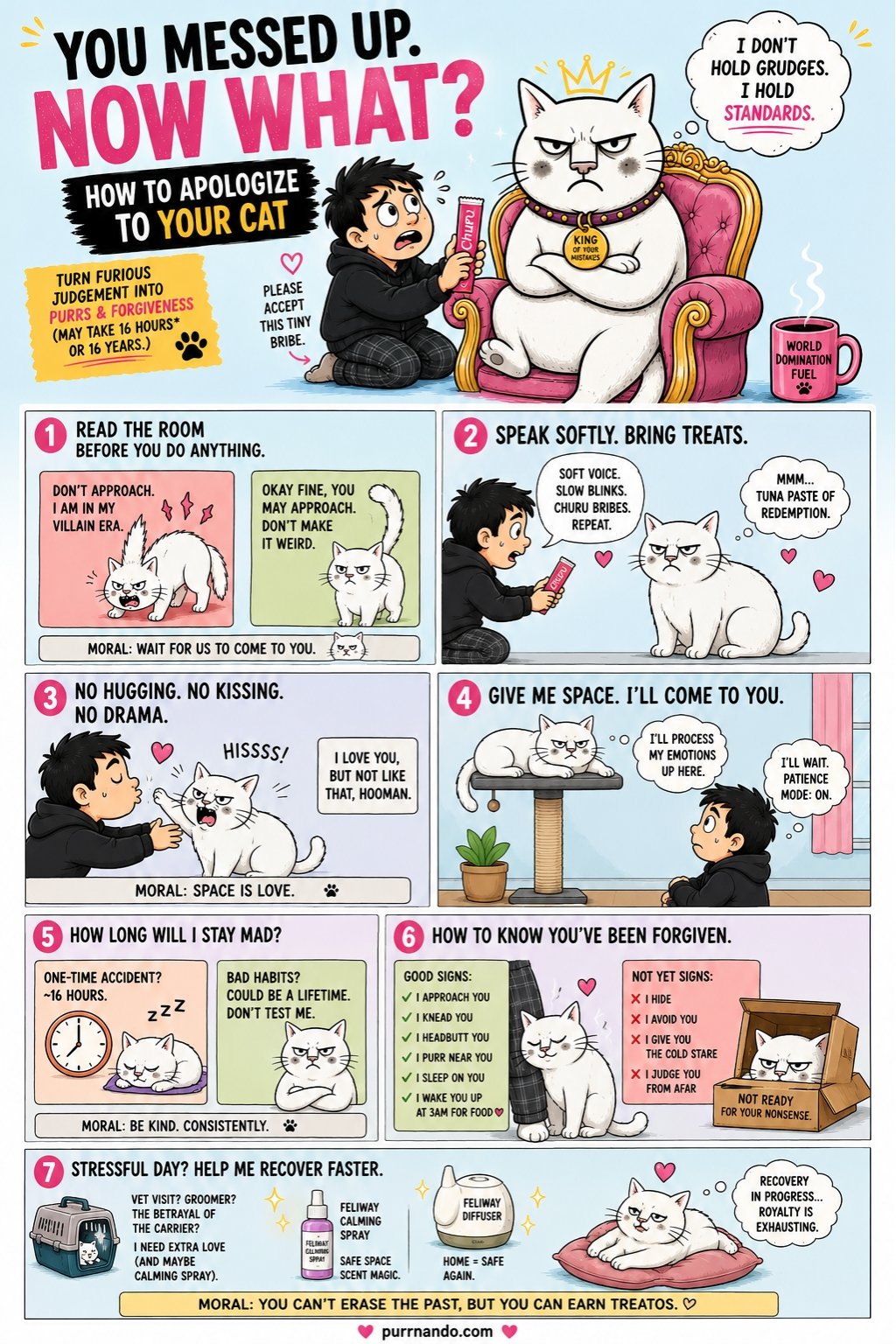
Step 1: Read the Room Before You Do Anything
I cannot stress this enough. Do NOT chase us.
If I have just bolted under the bed with my tail puffed up like a Halloween decoration, you chasing after me going “kitty kitty kitty” is not going to help. That is going to make everything worse, much, much worse.
Watch our body language first. Here is a quick translation guide from Cat to Hooman:
Lowered tail, arched back, flattened ears = Do not approach. I am in my villain era. Leave me alone.
Relaxed ears, upright tail, soft eyes = Okay fine, you may approach. Don’t make it weird.
Wait for us to come to you. Yes, you will be sitting there feeling awkward and guilty. Good. Sit with that.
Step 2: Speak Softly and Bring Treats
When we are finally ready to engage with you again, your best tool is your voice. Speak in a calm, low tone. Blink slowly at us. This is what we call the slow blink, and it is the feline equivalent of a peace offering. It communicates that you are relaxed, non-threatening, and deeply sorry for whatever foolish thing you did.
Bonus points for treats. Significant bonus points.
I personally recommend INABA Churu Lickable Cat Treats. They are a creamy lickable purée that comes in flavors like tuna, chicken, and salmon. They contain added taurine for heart health and vitamin E for immunity, and they are grain-free with no artificial colors or preservatives.
A hooman offering me a Churu tube speaks a language I understand deeply. It says: I am sorry. You are loved. You are the priority.
If your cat is more of a crunchy-treat personality, Temptations Classic Crunchy and Soft Cat Treats are available in seafood, chicken, tuna, and more. Hoomans love the price. Cats love the crunch. It is a rare moment of agreement between our two species.
Step 3: No Hugging. No Kissing. No Big Gestures.
I know what you want to do. You want to swoop in and squeeze us and bury your face in our fur and say “I’M SORRY” in a high-pitched voice while we struggle to escape.
Do not do this.
From our perspective, you lunging at us with wide open arms is threatening behavior, not comforting behavior. Getting your face close to ours, wrapping your limbs around us, these are things we tolerate under ideal circumstances when WE initiate. They are not apology strategies.
Give us space. Talk to us. Let us sniff your hand. Rebuild trust slowly, like a reasonable adult.
How Long Will Your Cat Stay Mad?
Here is the nuanced answer, and I say this not to comfort you, but simply because it is factually accurate:
For a one-time accident — a tail step, a startled shout, an accidental tumble — we typically move on within about 16 hours. Our short-term memory is not built for holding grudges over isolated incidents. You apologize, you give treats, you give space, we forget.
However, if you have a habit of mistreating us — yelling repeatedly, forcing us into situations we hate, picking us up constantly when we do not want to be held — we remember that. Not as a grudge but as an association.
You become someone who is not safe. That is stored in our memory for a very long time, and no amount of treats can undo a pattern of unkindness overnight.
So let this be a lesson, hoomans. The one-off mistakes are forgivable. The patterns are what damage us.
How to Know If You’ve Been Forgiven
You will know. Trust me, you will know.
Signs we are still processing and need more time:
- Hiding from you
- Avoiding the same room you are in
- Tucked tail, flattened ears when you walk by
- The cold stare from across the room (that one is just my natural face, but still)
Signs you have been forgiven and may resume your normal hooman duties:
- We approach you on our own
- We knead on you (you’re welcome, that means you’re claimed)
- We rub against you or headbutt you
- We purr near you or fall asleep in your presence
- We resume demanding food at 3am as if nothing happened
The last one is the clearest sign of all. When I am back to sitting on your face at sunrise, you are fully forgiven.
After Stressful Events: Vet Visits, Groomers, and Other Crimes Against Cats
The betrayal of the carrier. The indignity of the vet. The absolute audacity of the groomer.
If you have recently subjected us to any of these experiences, understand that our stress is real and our resentment is proportional. We are not being dramatic.
In these cases, a calming aid can genuinely help us recover more quickly. FELIWAY Classic Cat Calming Spray works by mimicking the natural pheromones we produce when we feel safe and comfortable in our environment.
You spray it on our bedding, in our carrier, or around our space, and it helps create a sense of familiarity and security.
Vets recommend it. I do not endorse it because I like you. I endorse it because an unstressed Purrnando is a slightly less judgmental Purrnando, and that benefits everyone.
Also, maintain our routine as much as possible after stressful events. Cats are creatures of habit. When the routine breaks, we spiral.
Keep feeding times consistent, keep our spaces undisturbed, and don’t bring seventeen visitors over the day after we get back from the vet.
Things Hoomans Do That Damage Our Trust (A Non-Exhaustive List)
Since I have the floor, let me take a moment to educate you on the common offenses beyond the accidental tail-step. Consider this free consulting.
Forcing us to do things we don’t want to do. This includes: surprise nail trims, forced socialization with guests who smell like other animals, being picked up and rocked like an infant. We know what we like. Respect it.
Sudden loud noises. You know who you are. The door slammers. The sneeze-screamers. Every time you startle us unnecessarily, we file it away.
Constant picking up. Many cats do not enjoy being carried. This is not a character flaw. This is a preference. Repeatedly scooping us up when we clearly do not wish to be scooped damages trust over time.
Yelling. This one is simple. Anger does not teach us anything except to be afraid of you. It is not a training tool. It is just upsetting. Stop it.
How to Rebuild the Bond After a Rough Patch
Fine. You’ve apologized. You’ve given treats. You’ve given space. Now what?
Play with us.
Interactive play is one of the most effective ways to rebuild trust and strengthen our bond, particularly for shy or anxious cats. It builds our confidence and burns our energy, and it reminds us that you are actually quite entertaining when you’re not stepping on us.
For this, I recommend the MeoHui Cat Toys Retractable Wand Toy Set. It comes with a retractable wand and multiple feather refill attachments. You wave it, we chase it, everyone feels better about the relationship.
Alternatively, the M JJYPET Cat Wand Toys is a colorful rainbow ribbon wand that appeals to our natural chasing instincts. Lightweight, inexpensive, and highly effective at making us forget we were ever annoyed with you.
And beyond play, the most important thing is simply your presence. Sit near us. Talk to us in a quiet voice. Nap in the same room. You do not have to perform affection. Just be there, calmly, consistently.
That is how we know you love us. Not the frantic apologies. Just the steady, reliable showing up.
Do Cats Apologize to Each Other?
You want to know if we have the moral sophistication to apologize to our own kind. Adorable.
We do not apologize. We do, however, engage in what scientists call conciliatory behaviors after a conflict – grooming each other, sleeping close together, rubbing heads. These actions reduce tension and signal that the fight is over. We do not name it an apology. We just move on.
Honestly, hoomans could learn a great deal from this approach. Less dramatic monologuing, more quiet reconnection. Just a thought.
Final Thoughts from Purrnando
You stepped on us. You startled us. You committed some unknown crime against our dignity. It happens. We are not entirely unreasonable creatures, despite what our faces suggest.
Apologize calmly. Give space. Offer treats. Play with us. Be consistent. And for the love of all things salmon-flavored, stop trying to hug us as your opening move.
Follow these steps and we will, in our own time, on our own terms, decide that you are tolerable again.
That is the highest compliment we give.
— Purrnando
This post contains affiliate links. Purrnando does not know what an affiliate link is and has requested we stop explaining it to him.