You remember to put on your little sweaters and wrap yourselves in your big fluffy blankets the moment a cold breeze rolls in. Adorable, truly. And yet half of you have absolutely no idea when YOUR CAT is freezing.
Yes, me, the creature who runs this household, the one whose food bowl is never full enough, cold and you didn’t notice.
Well, today I shall educate you. Consider this my gift.
Why Cats Feel The Cold (A Lesson You Should Have Known Already)
First, a little science, since apparently you need it.
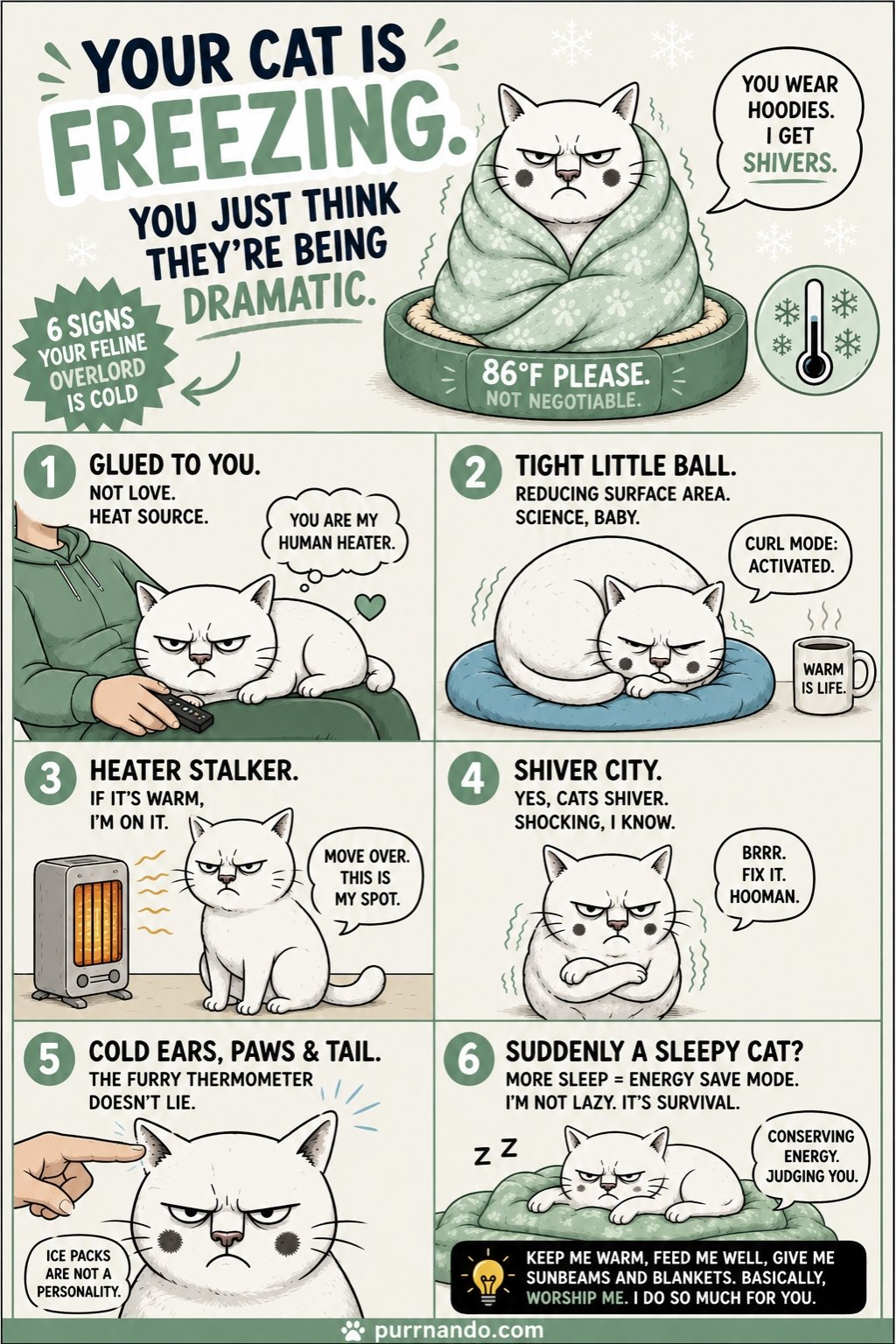
Cats are descended from desert animals. We were built for warmth, not your lukewarm 68°F (20°C) room temperature comfort. No, no. Studies show that cats prefer temperatures of around 86°F (30°C). That’s toasty. That’s warm. That’s the temperature of a sunbeam hitting a velvet cushion on a Tuesday afternoon.
And before you roll your eyes, let me tell you who is MOST at risk when temperatures drop: cats with little to no hair (Sphinx, Siamese — magnificent, vulnerable creatures), kittens, senior cats, and any cat with a compromised immune system. Just like children and the elderly among your species are more sensitive to the cold, so are these distinguished members of mine.
Now, let us get to the signs. Pay attention.
Sign #1: Your Cat Is Glued To Your Lap (And Not Because They Like You)
Let me be very clear about something. Under normal circumstances, I allow you to be near me because it amuses me. But if I am suddenly draped across your lap, pressed against your leg, or sleeping directly on your chest at 2 am, I am not being affectionate. I am cold, and you are a heat source. That is all.
When temperatures drop, cats seek body heat to maintain their warmth. If your previously independent cat is suddenly velcroed to you, that is a signal. Likewise, if you have multiple cats and they are huddling together like a little fur pile, they are sharing warmth. It’s practical. It’s survival. It is not cute. Stop taking photos.
Sign #2: We Are Curled Into A Tiny Ball And Will Not Be Moving
You’ve seen it, the full curl. Paws tucked under, tail wrapped around, nose buried. This is not just a cozy aesthetic. This is thermal regulation. When a cat curls into a ball, they reduce the surface area exposed to cold air, preserving precious body heat.
And if you see something called the “loaf position” where all four paws disappear completely under the body, that is also a cold signal. The loaf is not laziness. The loaf is strategy. I am basically a warm bread-shaped heat conserving machine and I will not apologize for it.
Observe these positions. If your cat is loafing or curling tighter than usual, they are cold. Go fix the temperature immediately.
Sign #3: Suddenly Obsessed With The Radiator? That’s A Clue, Hooman.
If you notice your cat inching closer and closer to the heater, the fireplace, the radiator, or any patch of sunlight streaming through a window, they are attempting to boost their body temperature. This is instinct. This is self-preservation. This is us doing YOUR JOB for you.
Pay attention to the routine. If your cat, who normally sleeps in the middle of the living room floor, has now taken up permanent residence directly on top of the heating vent, something has changed. The temperature dropped, and they adapted. The least you can do is open a blind or two to let some warm sunbeams in. A small effort, truly.
Sign #4: Shivering — Yes, Cats Do It Too
I can’t believe I have to explain this, but here we are.
When a cat gets too cold, they shiver. Shivering is the body’s automatic response to low temperature — muscles rapidly contract and relax to generate heat. If your cat is visibly trembling, they are cold.
If your cat is wet for any reason, dry them immediately with a warm blanket. Do not leave them sitting there damp and shivering while you scroll through your phone. If the shivering doesn’t stop, or if it seems unrelated to temperature, contact your vet. This is not a drill.
Sign #5: Cold Ears, Cold Paws, Cold Tail Tip
You want to know the quickest way to check if I am cold without asking me (as if you could understand my answer anyway)? Touch my ears. Touch the tip of my tail. Touch my paw pads.
These are the extremities — the parts of the body that lose heat first when the temperature drops. If they feel cold to the touch, I am uncomfortable. I am chilly. I am silently judging every decision that led to this moment.
Think of it like checking the temperature of a tiny furry thermometer. Warm ears, happy cat. Cold ears, get your act together.
Sign #6: Lethargy — More Sleeping Than Usual (Yes, It Is Possible)
I know what you’re thinking. “But Purrnando, you sleep 20 hours a day already. How would we know the difference?” Valid question. I will allow it.
When cats are cold, they significantly reduce their activity levels and rest even more than usual to conserve energy and body heat. So if your cat, who normally makes at least two to three dramatic sprints through the hallway per day, is now completely stationary and uninterested in everything, the cold may be the culprit.
Watch for a combination: more sleeping, less playing, less eating, less yelling at you from the other room for no reason. That cluster of behaviors means something is wrong. Possibly temperature. Possibly vet visit time.
What Happens If Your Cat Stays Cold? (Spoiler: It’s Bad)
If this situation is ignored — and I am looking at you specifically — there are real consequences.
First, a cold. Yes, cats get colds. Red or watery eyes, frequent sneezing, and decreased activity are the telltale signs. Treat your cat like they have caught a cold, because they have. This is a direct result of your negligence.
Worse, in severe cases, a cat can develop hypothermia. Signs include a slowing heart rate, shallow breathing, difficulty standing, and reduced responsiveness. If you see these signs, call the vet immediately and use pet-safe heat sources to begin warming them. Do not use a human heating pad. These reach temperatures far too high and can cause burns. We are not impressed by your enthusiasm when it harms us.
How To Actually Fix This (Since You Clearly Need Instructions)
Here is what I require:
Open the blinds and let the sunbeams in. Move my bedding a few inches closer to the radiator. Provide warm, cozy sleeping options. And for the love of all things warm and comfortable, invest in some proper cat warming products. Here are a few I have personally approved.
1. K&H Pet Products Thermo-Kitty Heated Cat Bed — This is a thermostatically controlled heated bed that warms to your cat’s body temperature. It has soft foam walls, a micro-fleece cover, and is machine washable. It comes in multiple sizes and is MET-certified for safety. Thousands of cats (and even some dogs, apparently) have used this bed for years. One reviewer reported her cats used it every night for seven years. Seven years. That is dedication. That is loyalty. That is what we deserve.
2. Bedsure Self Warming Cat Bed (Non-Electric Thermal Mat) — No cords. No plugs. This mat uses self-heating technology that reflects your cat’s own body heat back to them. It has a soft plush faux fur cover that is removable and machine washable, a noiseless heat-reflecting mylar film inside (so it doesn’t crinkle and disturb our sleep — thoughtful), and a non-slip bottom. It is an Amazon’s Choice product bought by over 800 people per month. Suitable for indoor and outdoor use, and it comes in two sizes.
3. Bedsure Calming Donut Cat Bed — This is one of Amazon’s bestselling cat beds, and I will admit, the donut shape is architecturally superior for curling. The raised rim provides head and paw support, the faux fur is soft, and it is machine washable. If you are going to buy your cat a bed, buy one that 33,000 other cat owners have already vetted. The numbers do not lie.
A Note On How To Tell If Your Cat Is Too Hot
Yes, this can also happen. If your home is a sauna, watch for your cat lying flat on cool tile floors, sleeping in shadowy corners, drinking more water than usual, or grooming excessively (the evaporation of saliva cools them down). If you suspect overheating, provide shade, fresh cool water, and stop making the thermostat your personal experiment.
Balance, hoomans. It is not complicated.
Final Words From Purrnando
You now have no excuse. You have the signs. You have the science. You have the product recommendations. The ball — much like the one I occasionally bat off the counter for fun — is in your court.
Keep us warm. Keep us comfortable. Notice when something is wrong. That is literally all we ask. Well, that and better quality kibble and more treats. And for you to stop moving me when I am sitting on your keyboard.
Now go check if your cat is cold.
That is all.
— Purrnando
Affiliate disclosure: if you buy through our links, we earn a small commission. Purrnando has been informed of this and is choosing to be offended that it isn’t larger.