You have a cat.
You did not ask me if that was a good idea. Nobody ever does. And now you are standing in a home that is approximately 40% cat hair, wondering which machine will restore some semblance of order to the chaos your beloved feline has quietly, methodically imposed on every surface you own.
I am that feline. Or rather, I am a feline. And I will tell you exactly which vacuum to buy — not because I want to help you, but because I have standards, and watching hoomans vacuum incorrectly is almost as offensive as the hair itself.
Be aware: I shed because I choose to. Every strand on your couch is intentional. Every clump under the radiator is a statement. You cleaning it up is simply you acknowledging who is in charge here.
Now pay attention.
The One You Should Actually Buy
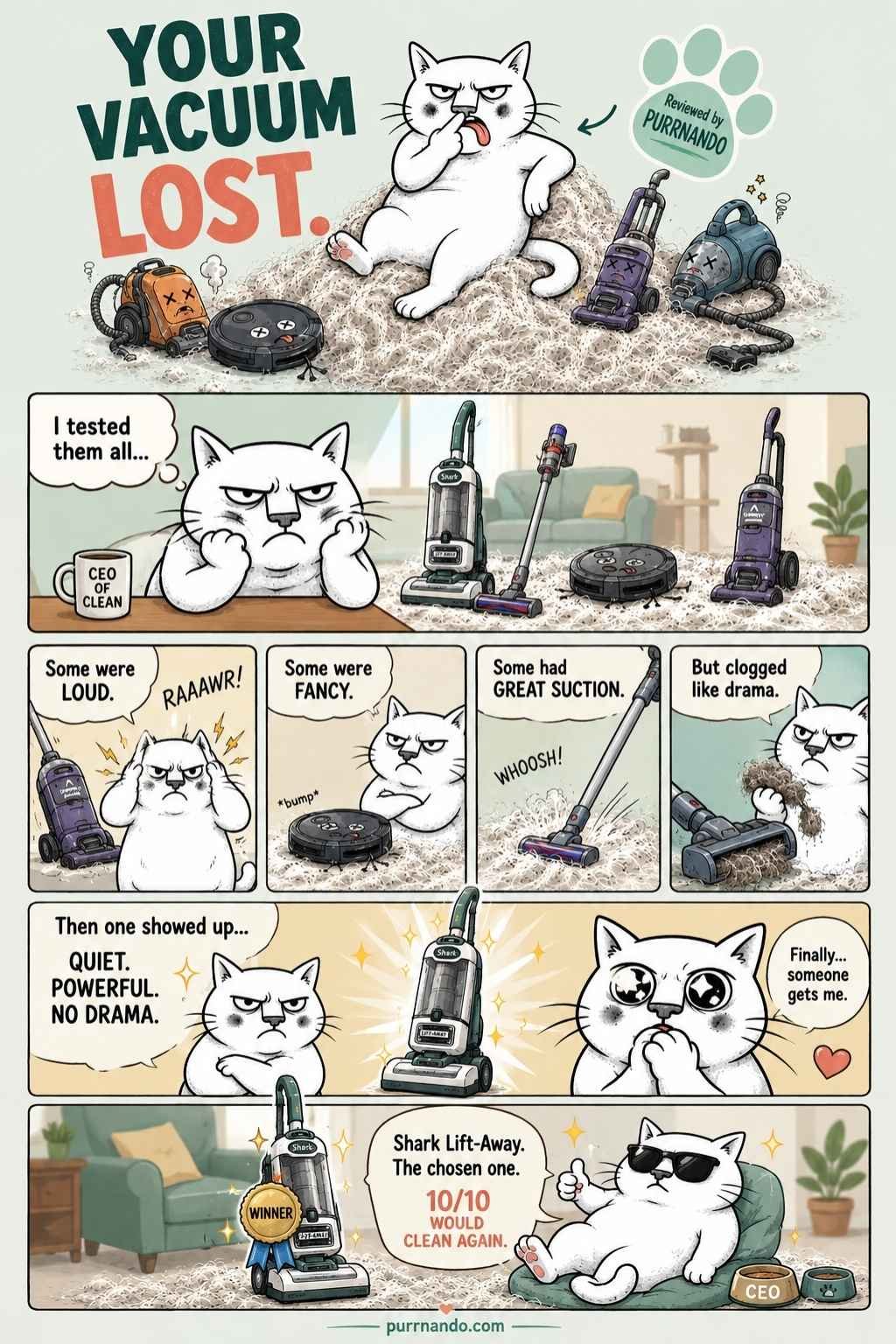
Shark NV752 Rotator Powered Lift-Away TruePet
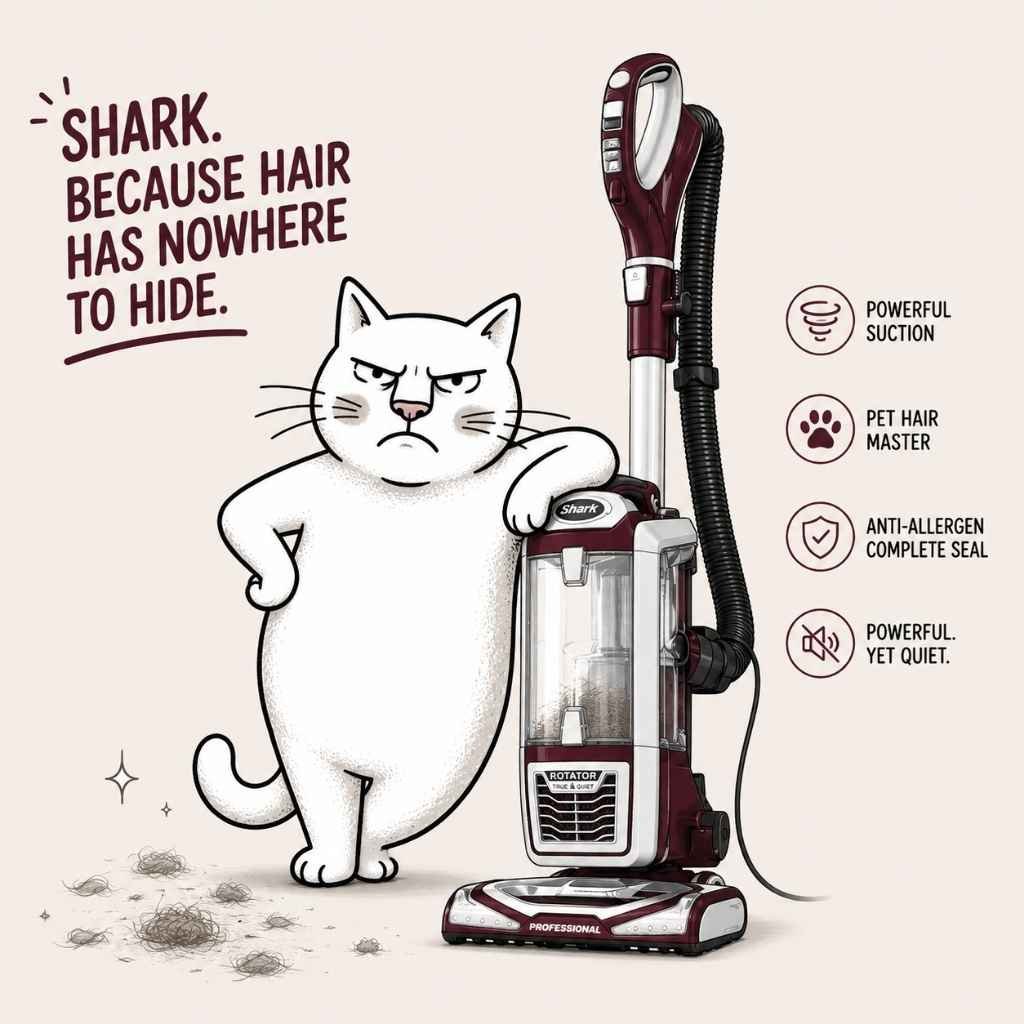
The machine works, and the machine works specifically on cat hair, which is a different problem entirely and one that most vacuum manufacturers treat as an afterthought.
Cat hair is not like dog hair. It is finer, lighter, and possessed of a singular ambition: to go deeper. Into the carpet fibers. Into the upholstery weave. Into the one dark sweater you own. It does not sit on the surface waiting to be collected. It moves in. It unpacks. It considers itself a permanent resident.
The Shark NV752 evicts it. The motorized brush pulls cat hair from surfaces that other vacuums have quietly given up on, and it picks up around 52% of debris per pass, which lands it firmly in the upper tier of everything tested.
The Lift-Away feature detaches the canister from the base, and I want you to think carefully about where cat hair actually lives in your home. Not just the floor – the stairs, the baseboards, the narrow gap under the sofa where three months of fur has been accumulating in peace, completely undisturbed, slowly becoming something with its own ecosystem.
The Lift-Away reaches all of it without requiring you to buy a second machine, which is the kind of efficiency that should have been obvious from the start but apparently required engineering.
The attachments click in and stay in. The suction holds as the bin fills. It weighs 17 pounds, which some of you will complain about, and it is not cheap, which more of you will complain about.
Do it anyway. You already spent money on the cat. You spent money on the food the cat rejected. You spent money on the bed the cat ignored in favor of your face. You spent money at the vet looking shocked at the invoice. The vacuum is simply the next item on an invoice that began the moment you said “how hard could it be.”
The One for Hoomans Who Will Not Vacuum Themselves
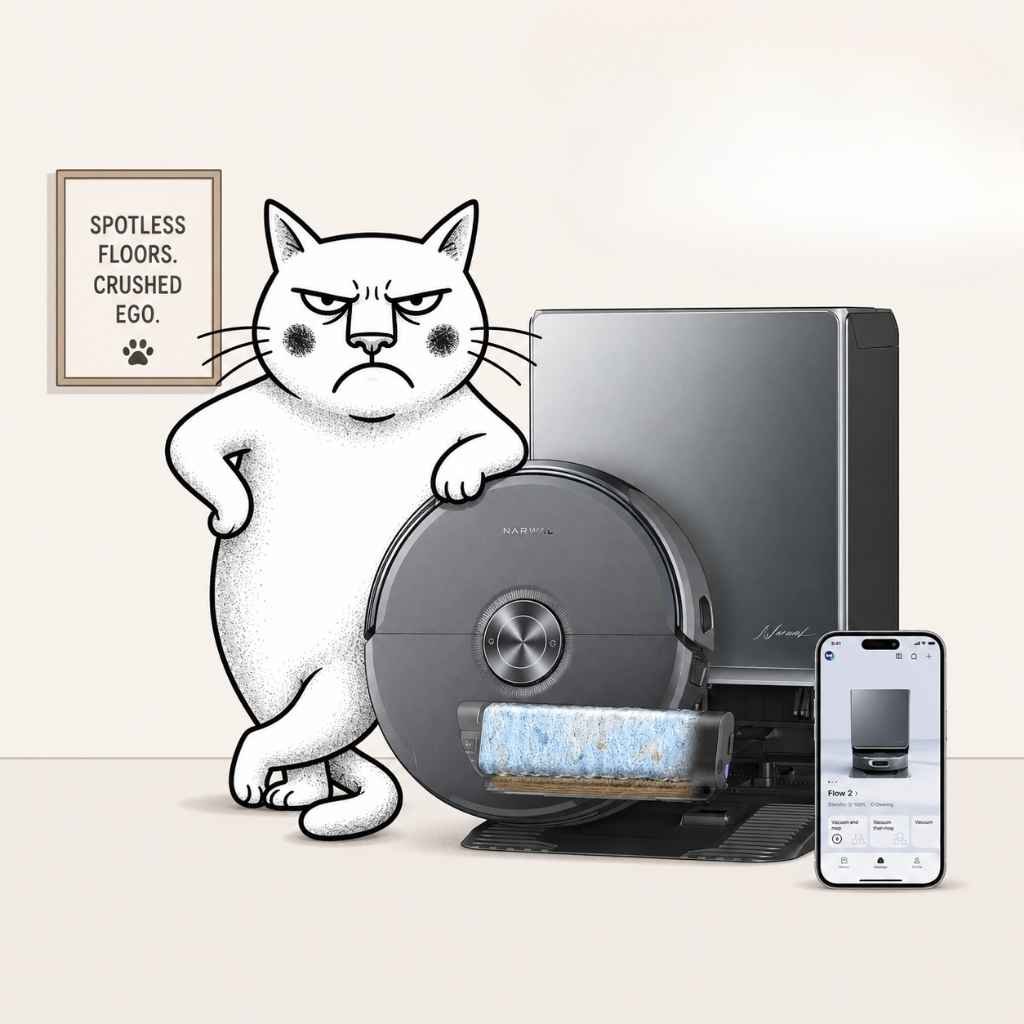
Narwal Flow 2 Robot Vacuum and Mop
I have watched many of you move through your homes. I have observed your relationship with cleaning. I have catalogued the gap between your intentions and your follow-through, and I have arrived at a conclusion that I will state plainly: some of you are not going to vacuum. Not regularly. Not consistently. Not without a reason that feels urgent and a guest arriving in forty minutes.
I have accepted this. The Narwal Flow 2 has also, in a sense, accepted this. It runs by itself. It empties itself into an 8-in-1 base. It can go 120 days without requiring your involvement in any meaningful way. It was designed, with some precision, for people whose vacuuming schedule can best be described as “aspirational.”
For cat-specific situations, the obstacle avoidance navigates around litter boxes, food bowls, and whatever I knocked off the counter last Tuesday without incident or complaint. The hot-water mopping at 158 degrees addresses the litter tracking and water bowl splash that cats leave across hardwood floors as a matter of course — not redistributing it with a damp cloth the way lesser machines do, but actually removing it.
And crucially, for cats who have spent years training themselves to disappear at the first sound of a vacuum motor, this machine runs quietly enough that animals in testing did not even lift their heads.
That last detail is not a footnote. That is genuinely impressive. My opinion of it remains complicated.
It requires Narwal’s own cleaning solution, which is a commitment. The box arrives at a size and weight that may require assistance, which is inconvenient. For cat owners who want clean floors but have made their peace with the fact that they personally will not be producing them, this is the best autonomous option tested, and I will not be mentioning it again after this.
The One for Hoomans Who Take This Seriously
Miele Guard L1 Cat & Dog Canister Vacuum
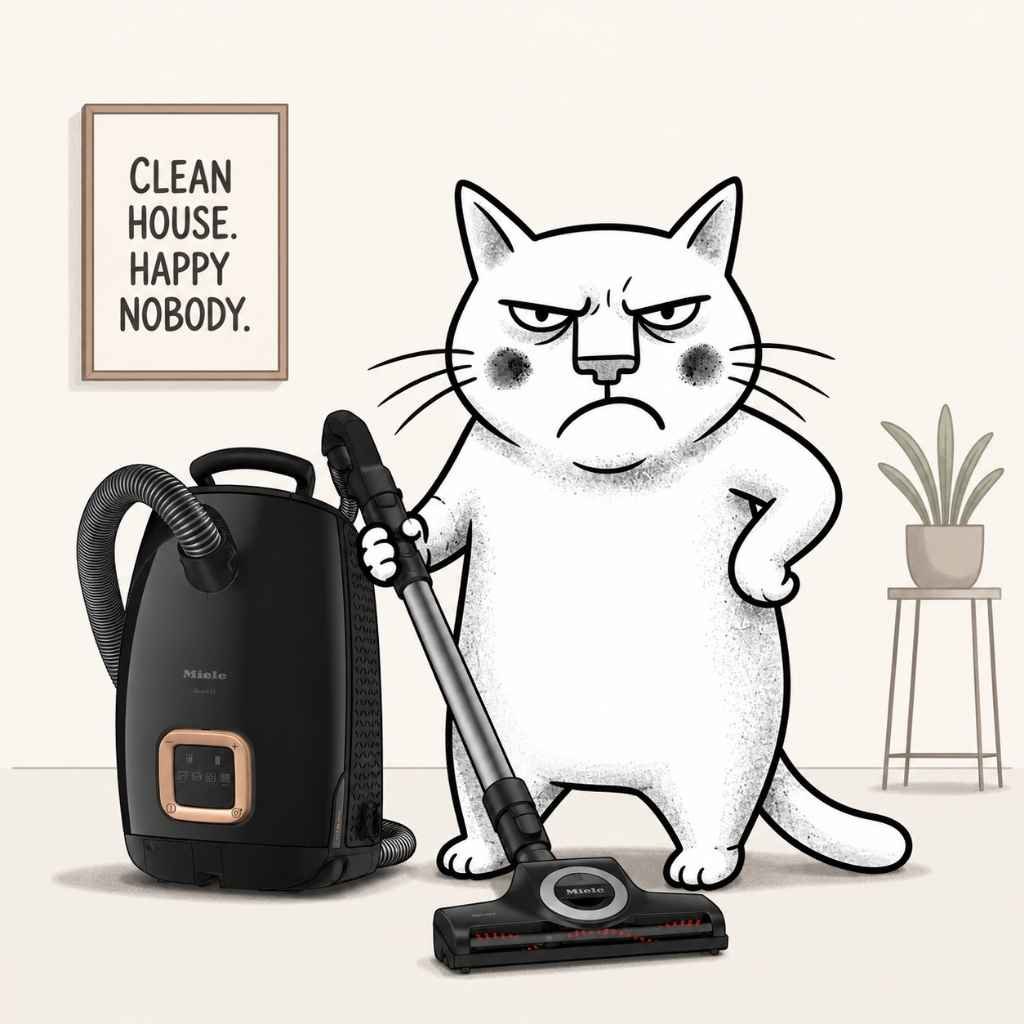
This machine is $899. I am going to let that number sit there for a moment while you think about your long-haired cat, your thick carpet, and the specific texture of the relationship between those two facts and every vacuum you have owned that was not equal to the situation.
Done thinking? Good. This is what serious looks like.
Long-haired cats — Persians, Maine Coons, Ragdolls, Siberians, and any other breed that appears to be approximately 70% fur and 30% attitude — produce a volume of shedding that budget machines encounter and simply give up on.
The Miele Guard L1 does not give up. The 1200-watt motor goes into carpet pile and retrieves hair that has been living there undisturbed for so long it has started to feel settled. The TurboTeQ motorized brush handles thick area rugs that other vacuums treat as decorative obstacles, pushing hair across the surface in a way that technically counts as effort while accomplishing nothing.
The Active AirClean filtration system handles cat dander — the microscopic, invisible, airborne problem that continues long after the visible hair has been addressed and that is responsible for a significant portion of the sneezing in cat-owner households. It neutralizes odors. It does not merely collect the large debris and release everything else back into the room, which is what the cheaper options are doing and why your home still smells like a cat lives there even immediately after vacuuming.
The floor heads have swivel limitations that are genuinely puzzling at this price point. The telescoping wand is not as secure as it should be. These are real complaints that I am noting without dismissing.
At $899, this machine earns what it costs if you have the cat for it. You know if you have the cat for it.
The Cordless One Worth Having
Cat hair does not respect the floor. I want to be very direct about this because I think some of you have been operating under a misapprehension.
It is on the sofa. It is in the sofa. It is on the chair you put the throw blanket on specifically to protect the chair, and it is also on the throw blanket. It is on the stairs, on the windowsill, on the top of the bookcase, inside the bookcase, on the one good coat you left on the hook for twenty minutes, and on the sweater you needed last Tuesday for something important. The floor is simply where it goes when it has finished being everywhere else.
A corded upright does not address this gracefully. The cord reaches the outlet and the outlet is where it is, and the sofa is where the sofa is, and somewhere in the geometry of these two facts is a vacuum that cannot quite get where you need it without a series of adjustments that interrupts the momentum of cleaning entirely.
The Dyson Gen5detect is cordless. It converts to a handheld. It picked up 87.5% of carpet debris in a single pass, which is 25% above the cordless average and a number that should settle several arguments. The anti-tangle brush head resists fur wrapping — the failure mode that turns other vacuums into a project — and it ran at full power for 15 continuous minutes at its highest setting without losing anything.
It costs $795. The storage solution is, by the accounts of everyone who tested it, awkward in a way that will mildly irritate you every single day. These are legitimate complaints and I acknowledge them fully.
And then I am telling you to buy it anyway, because the cat hair is on the bookcase and the corded machine cannot reach the bookcase and you already know how this ends.
Also Tested and Worth Knowing About
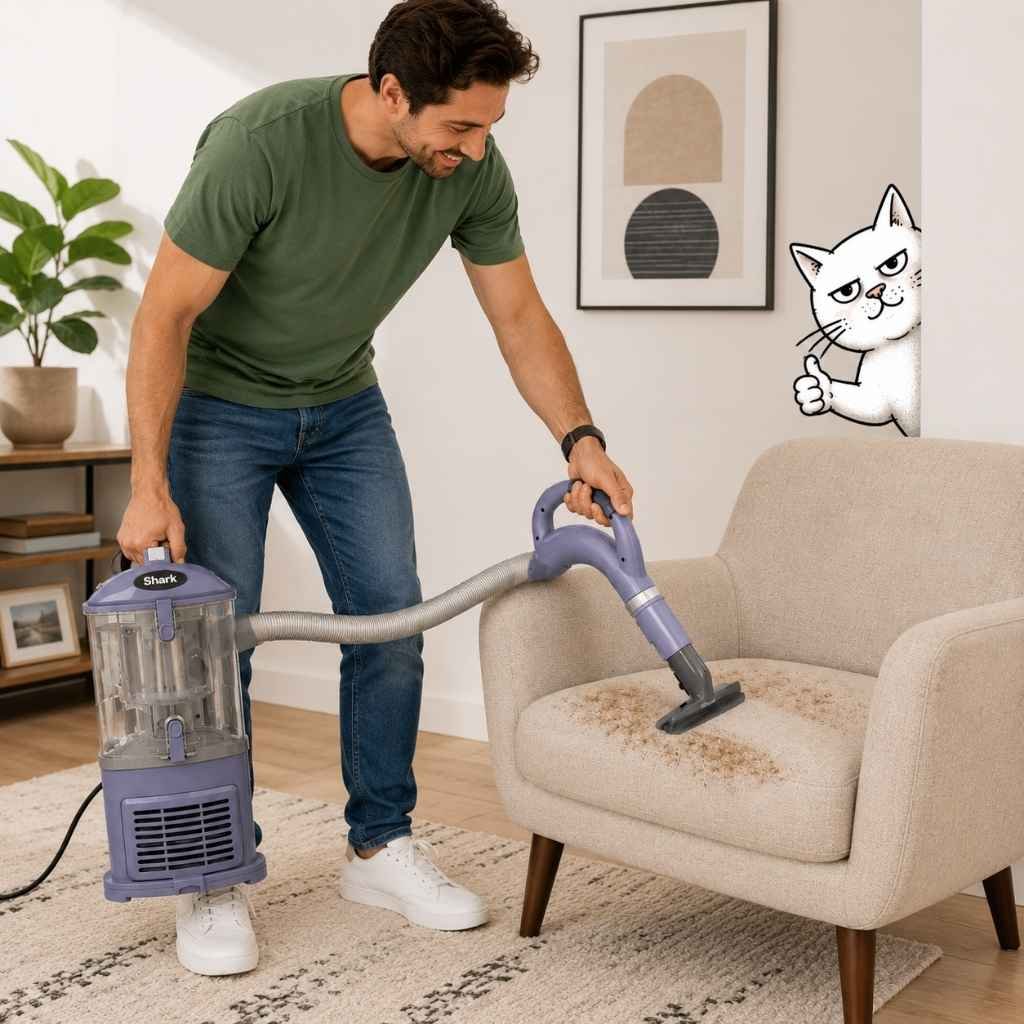
Shark NV352 Navigator Lift-Away — The sensible option, which I mean as a neutral observation rather than an insult. It picks up 38% per pass, clears the threshold of acceptable performance, and the Lift-Away feature handles the stairs and the awkward corners without drama. It is slightly difficult to maneuver at full size, which several testers noted with the resigned energy of people who had expected better but were not surprised. For a one or two-cat household where the budget is a real consideration and the cat is mercifully short-haired, it does what it is supposed to do. It will not dazzle you. It will clean your floor, which was the arrangement.
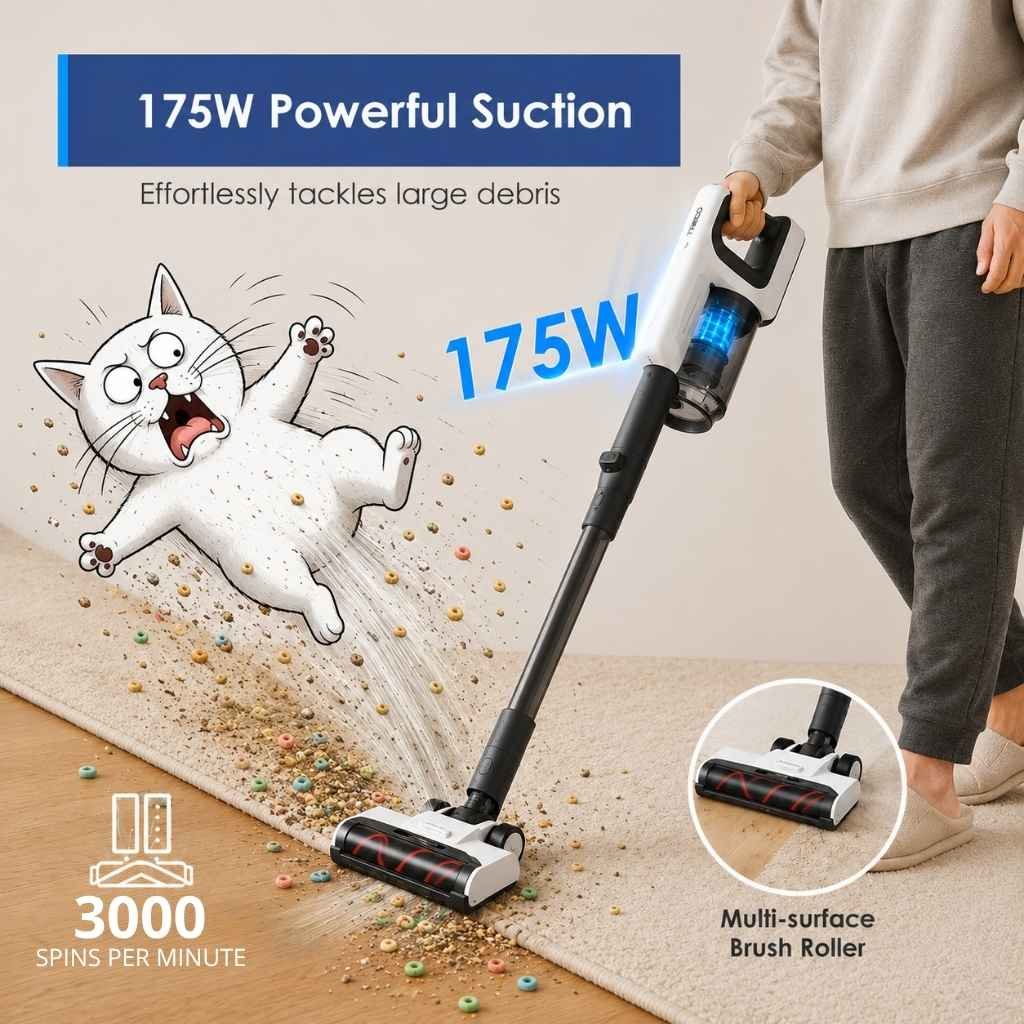
Tineco Pure One A90S — 270 AW of suction, a ZeroTangle brushroll, and an LED dust sensor that glows red while it still detects debris and shifts to blue when the area is actually clean. That last feature is more useful than it sounds because it turns out the answer to “have I finished vacuuming this spot” is very frequently “no, you have not, keep going.” The sensor removes the optimism from the equation. No auto-empty dock, which at this price is a genuine omission. Large and somewhat unwieldy body. Worth considering if you enjoy technology informing you, in real time, that you have not done enough.
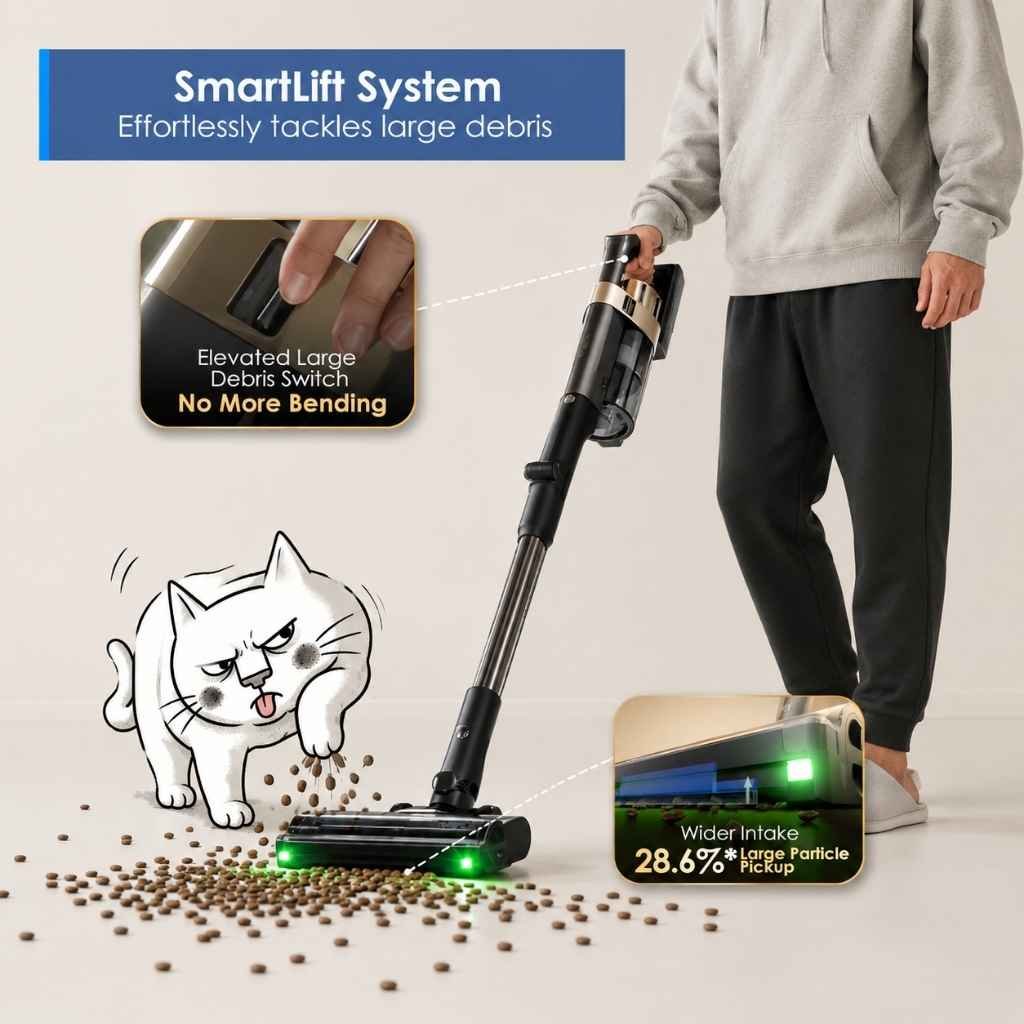
Tineco Pure One Station 5 — Performs beautifully on hardwood. Performs adequately on tile. Looks at carpet with the uncertain energy of someone who showed up to the wrong party and is trying to make the best of it. If your home is mostly hard floors and your cat is primarily a litter-tracking, water-splashing problem rather than an embedded-carpet-hair problem, this is a reasonable and affordable cordless option. If your home has significant carpet, this machine will do its best and its best will leave you wanting. Return to the top of the list and make a different choice.
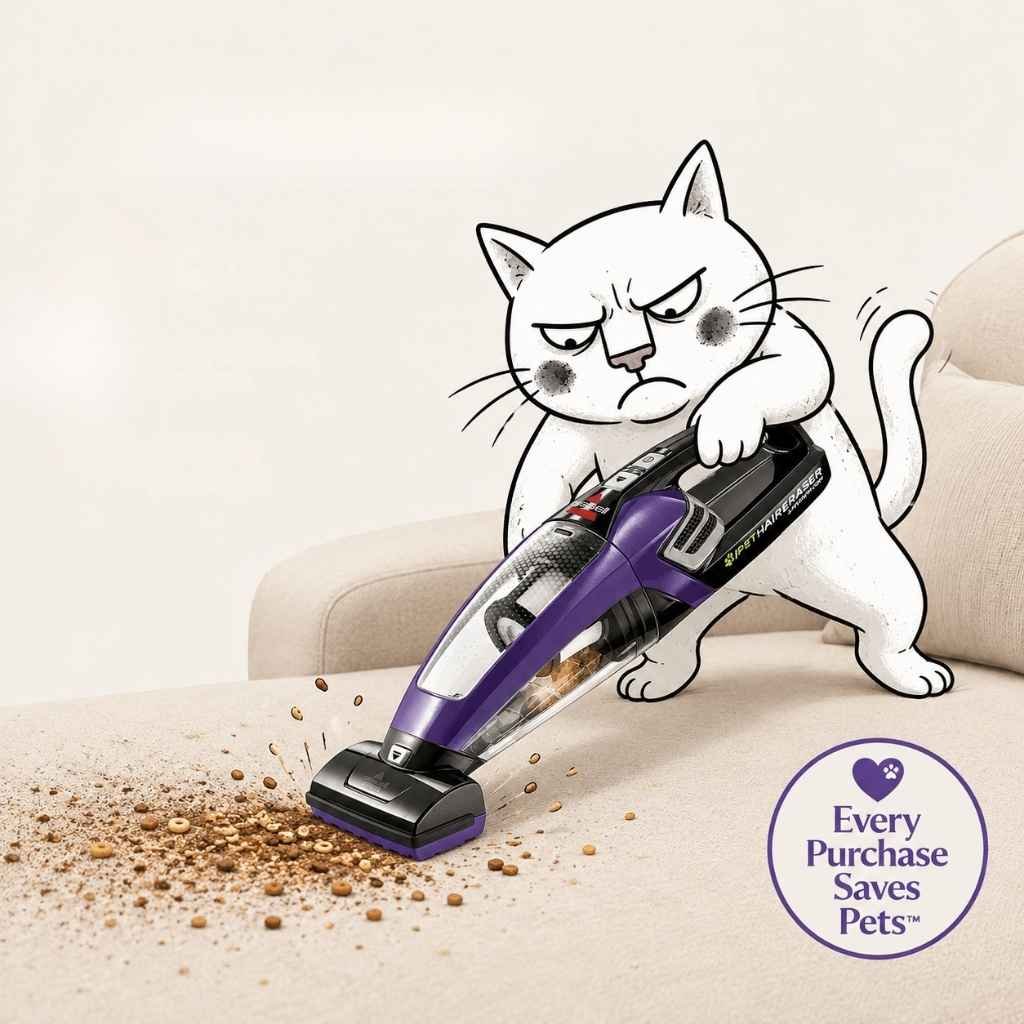
Bissell Pet Hair Eraser 2390 — A handheld that picked up 94% of debris on medium-pile carpet in a single pass, which is an extraordinary performance for something you hold in one hand and charge on a shelf. The use case for cat owners is specific and important: this is for the sofa, the armchair, the duvet you have given up trying to keep cat-free, the cat tree that has become a solid object made entirely of compressed fur, and the car seat that you keep meaning to address. It handles all of them. The upholstery brush is difficult to clean afterward in a way that will test your patience. It is heavier than a handheld has any right to be. For the targeted removal of cat hair from upholstery specifically, nothing on this list performs better, and if you own a cat and a sofa — which you do, because these things travel together — this is worth having alongside whichever full-size machine you choose.
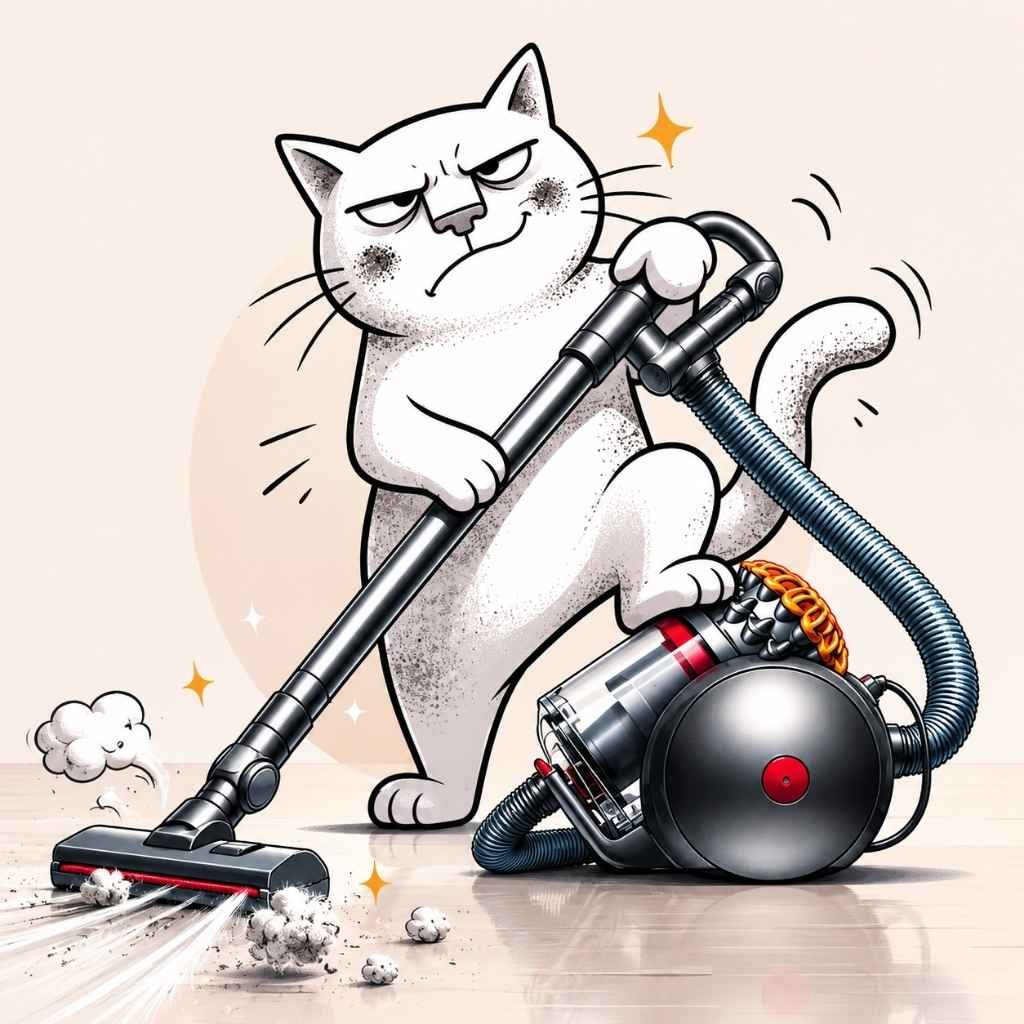
Dyson Big Ball Multifloor — Not a dedicated cat vacuum, which it will never let you forget by not having a motorized pet tool in the box. What it does have is a self-righting chassis that pops back upright when it tips over, which happens more than you would expect in a home organized around the needs and whims of a cat. Above-average suction. An articulating handle that reaches baseboards and vents without attachment changes, which matters when the baseboards are where the fur tumbleweeds go to retire. Good general performance. Expensive for a machine that is not specifically trying to solve your specific problem, but capable enough that it solves it anyway out of sheer competence. Respect, grudgingly given.
What to Look for Before You Buy
Bin capacity.
Cat hair is a liar.
It is light. It is airy. It floats into the bin looking like it is barely taking up any space at all, giving you the impression that you could vacuum for another thirty minutes before emptying. You cannot. What you are looking at is a loose, deceptive cloud of fur that will compress the moment you stop and reopen the bin, at which point you will discover it was actually full twenty minutes ago and you have spent the last portion of your cleaning session essentially redistributing hair at slightly reduced power while feeling productive.
Aim for a bin of around one liter. Check it more often than seems necessary. A full bin means the suction drops, the hair stays on the floor, and you are just pushing a loud machine around your home for the psychological comfort of motion.
Cat hair will make a fool of you. Do not let the bin help.
Tangle-resistant roller bars.
Here is a thing that will happen if you buy the wrong vacuum.
You will start vacuuming. You will feel good about vacuuming. You will notice after approximately four minutes that the suction has dropped significantly. You will flip the vacuum over. You will find a solid cylinder of compressed cat hair wrapped so thoroughly around the brush roll that it has become structural. You will go to find scissors. You will cut. You will pull. You will find more hair underneath the hair. You will eventually free the brush roll, reattach it, stand up, vacuum for three more minutes, and repeat this entire process.
This is not vacuuming. This is a hostage negotiation with your own appliance.
A tangle-resistant brush roll is not a luxury feature. It is the difference between a vacuum that cleans your floor and a vacuum that gives you a project. Long cat hair — and Persian owners, Maine Coon owners, Ragdoll owners, you know exactly who you are — wraps with a commitment that borders on personal. Look for brush rolls designed to resist it.
HEPA filtration.
I need you to understand something important about what your cat is doing to the air in your home.
The hair you can see is actually the least of it. Beneath the visible shedding is a continuous, invisible blizzard of dander — microscopic skin particles your cat releases into the atmosphere simply by existing, moving, breathing, and sitting in the one spot you just cleaned. It travels. It settles on your pillow. It gets into your HVAC system. It has been in every meal you have cooked in that kitchen for years.
A vacuum without proper filtration collects the visible hair and then fires the dander back out through the exhaust in a fine, triumphant mist. You have now vacuumed while simultaneously redecorating the air. Well done. The floor looks slightly better. The air is worse.
A true HEPA filter captures 99.97% of particles at 0.3 micrometers. It keeps the dander inside the machine where it belongs, contained and defeated.
One more time, because this is important: “HEPA-type” and “HEPA-like” are not HEPA. They are the filtration equivalent of a restaurant that describes its tap water as “inspired by Evian.” Do not be flattered. Read the label. Insist on the real thing.
Suction power.
Cat hair does not sit on top of carpet waiting patiently to be collected. It works its way down. Into the fibers. Into the weave. It embeds itself with the quiet determination of a cat that has decided your lap is its lap and is not moving regardless of your plans.
Raw suction power is what gets it out. A machine with weak suction will skim the surface, collect the loose stuff, and leave the embedded hair exactly where it has been for the past three weeks looking smug.
The trade-off for cordless models: higher suction means shorter battery life. This is a real constraint, not a technicality buried in the manual. If you are vacuuming a large home on a single charge, you will need to decide whether you want power or endurance, because you are unlikely to get both at the budget end of the market. Know your home. Know your cat. Plan accordingly.
Attachments.
Your floor is not where the cat hair problem actually lives. I want to be very clear about this.
The sofa is where it lives. The armchair is where it lives. The windowsill, the top of the bookcase, the stairs, the baseboard behind the radiator, the gap between every seat cushion, and every elevated surface your cat has claimed as sovereign territory — that is where the hair lives. The floor is simply where it falls after it has finished living everywhere else.
A motorized brush attachment is non-negotiable for upholstery. Without it, you are dabbing at embedded hair with suction alone, which works about as well as trying to remove a tattoo with a damp cloth. A crevice tool handles the gaps and the baseboards. A dusting brush manages the shelves, the sills, and every elevated surface your cat has treated as both a bed and a personal broadcasting station.
The machines that come with all three are worth owning. The machines that do not are asking you to buy them separately at a cost that will, in retrospect, make the more expensive complete package look quite reasonable.
Buy the complete package. The cat has already claimed all the surfaces. You may as well have the tools to address them.
Questions, Answered Briefly and Without Enthusiasm
How often should I actually vacuum if I have a cat?
More often than you are currently doing it. I know this because I have seen how often you are currently doing it, and the answer is “when company is coming” or “when I finally found the remote and it was under a hairball.” That is not a schedule. That is a crisis response system.
Short-haired cat, one cat, normal-sized home: twice a week. Long-haired cat: daily, or accept that you live in a fur biome now and adjust your personality accordingly. Multiple cats: you should be vacuuming so frequently that the vacuum has a nickname and a regular spot at dinner. This is the life you chose. Maintain it.
My cat hair situation has become genuinely overwhelming. Where do I start?
With the cat. Specifically, with a deshedding brush and the acceptance that this was always going to happen.
A proper deshedding brush removes the loose undercoat before it escapes into the wild and colonizes your sofa, your clothing, your leftovers, and that one friend’s jacket who has never fully forgiven you. The hair that does not leave the cat cannot end up in your water glass — and yes, I know it has ended up in your water glass, because it always ends up in the water glass, and you drank it anyway, and here we are.
Brush the cat. Regularly. Not once in a hopeful moment and then never again. Regularly. This is prevention. The vacuum handles what gets through. Do not ask the vacuum to do everything. It is a machine, not a therapist.
What actually makes a pet vacuum different from a regular one?
A regular vacuum encounters cat hair, wraps it enthusiastically around the brush roll, loses suction, and then stands there humming at reduced capacity while you wonder why the floor looks the same as before you started.
A pet vacuum has a brush roll designed to resist tangling, filtration built for fine particulate, and the general constitution of something that has been told what it is getting into. The difference is not marketing. It is felt immediately, in the first pass, when the hair actually disappears from the carpet instead of relocating to a slightly different part of the carpet.
A regular vacuum in a cat home is like bringing a mop to a swimming pool. Technically related to the problem. Not the correct tool.
Does it matter what kind of filter the vacuum has?
Oh, you thought the hair was the whole problem.
How sweet.
Cat dander — the microscopic skin particles your cat sheds continuously, without effort, without apology, as a passive byproduct of simply existing — is one of the most common household allergens on earth. It does not stay on the floor. It travels. It settles on counters, in bedding, inside your lungs, on the pillow directly next to your face.
A vacuum with poor filtration collects the visible hair and then blows the dander back into the air in a fine invisible mist, which means you have technically vacuumed while making the air quality worse. Congratulations on your activity.
A HEPA filter captures 99.97% of particles at 0.3 micrometers. It contains the dander. It keeps it in the machine where it belongs. If anyone in your home has allergies — or if you simply feel that the air in your home should remain, at a basic level, air — HEPA filtration is not optional. It is the whole point.
Also, “HEPA-type” and “HEPA-like” are not HEPA. They are words arranged near the word HEPA to imply a relationship that does not legally exist. Read the label. I cannot do everything for you.
Which one should I buy?
I already told you. At the top. In detail. With explanations.
But since you have scrolled directly to the bottom looking for a shortcut, here it is: the Shark NV752 for the best balance of price and performance. The Narwal Flow 2 if the vacuum needs to operate independently because you clearly will not be operating it yourself. The Miele Guard L1 if your cat is a long-haired shedding catastrophe and you have carpet throughout. The Dyson Gen5detect if cordless reach matters more than your bank account’s feelings.
Any of them will outperform whatever you are currently using. I suspect what you are currently using is a handheld from 2019 with a cracked dustbin and one working wheel, deployed twice a month with great optimism and poor results.
Do better. Your cat is watching. Your cat is always watching.
You have your answer. Go vacuum. My hair will be waiting for you when you are done.
— Purrnando
Affiliate disclosure: if you buy through our links, we earn a small commission. Purrnando has been informed of this and is choosing to be offended that it isn’t larger.