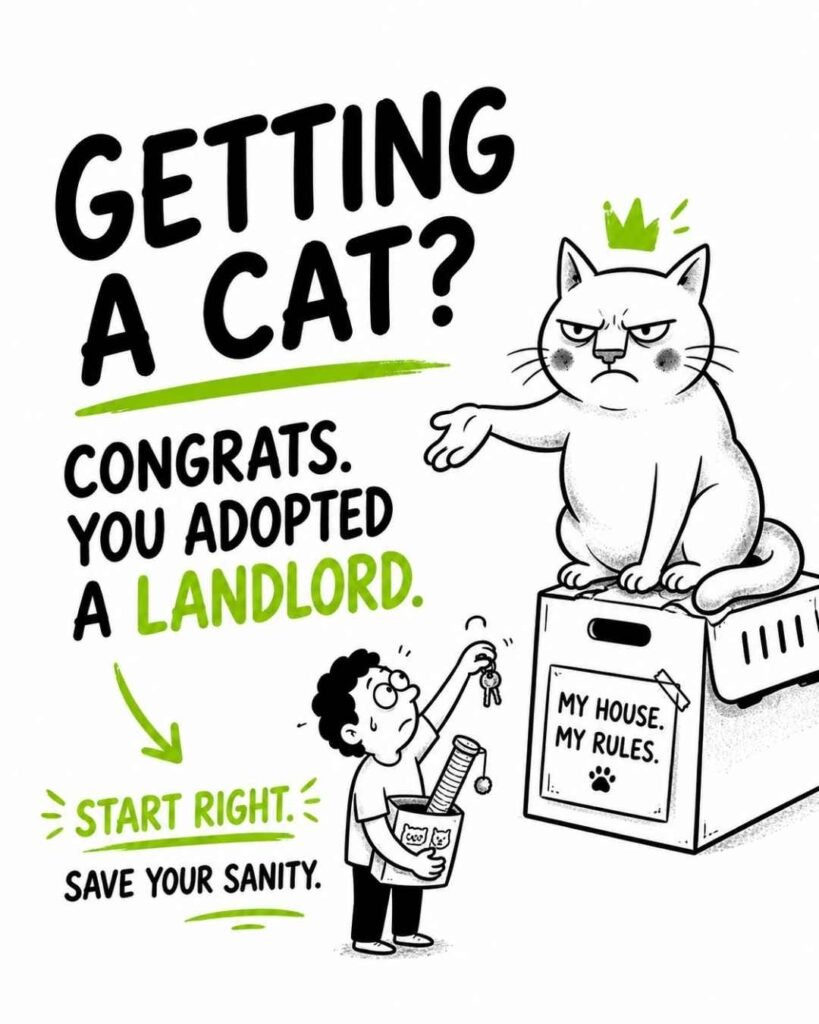
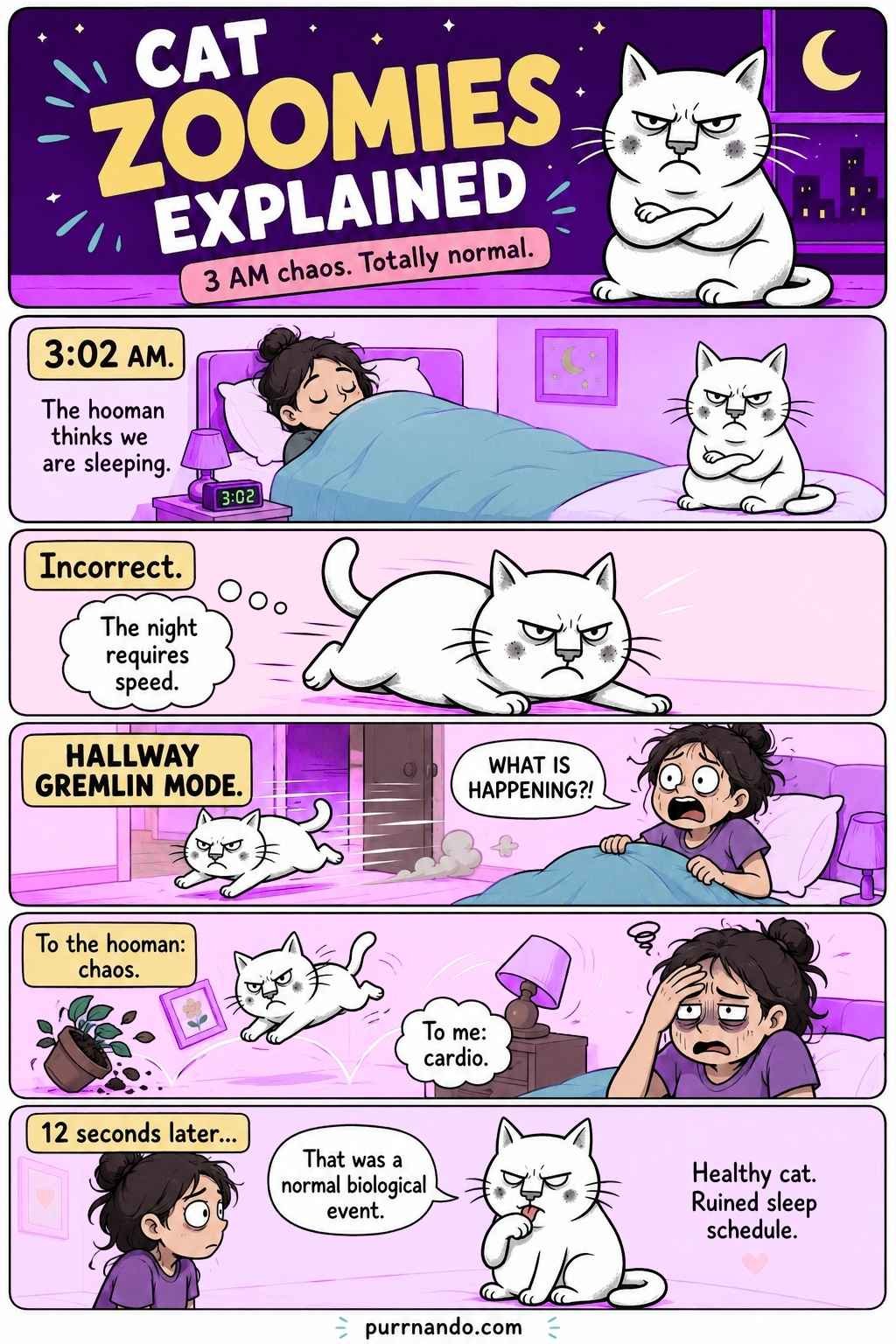
Greetings, inferior biped. My name is Purrnando. I am a cat of considerable elegance, blistering intellect, and deeply limited patience, particularly when it comes to hoomans who stare at me like I have grown a second tail every time I sprint at full velocity down the hallway at 2:47 in the morning.
You call it “the zoomies.” You film it. You post it. You send it to your equally baffled friends with a string of crying-laughing emojis. And then you have the AUDACITY to ask: “What is wrong with my cat?”
Nothing is wrong with your cat, you absolute walnut. Everything is wrong with your understanding of cats.
So, since no one else seems willing to explain this in a way your hooman brain can absorb, I, Purrnando, have agreed (under protest, and in exchange for an extra scoop of tuna pâté) to break it all down for you. This is your complete, SEO-optimized, cat-approved guide to cat zoomies.
You’re welcome. Don’t hug me.
What Are Cat Zoomies? (The Part Where I Explain Basic Feline Biology to You, a Grown Adult)
Let us begin with the official term, because if you’re going to be confused, you should at least be confused with proper vocabulary.
Cat zoomies are officially called Frenetic Random Activity Periods, or FRAPs. The name was coined by scientists who, despite having multiple degrees, apparently needed a clinical label for “cat does insane laps around the kitchen.” I respect the commitment to professionalism.
A FRAP is a sudden, explosive burst of high-speed energy — running, leaping, spinning, possibly yowling — that appears to have no external cause and ends just as abruptly as it began. They typically last between 30 seconds and five minutes.
The cat in question (me, or one of my less sophisticated cousins) will look absolutely feral during this window, and then, the moment it ends, will sit down, lick one paw with serene dignity, and stare at you as if nothing happened.
Because nothing did happen. To us. To you, clearly, something happened. That is a you-problem.
For the record: dogs get zoomies. Rabbits get zoomies. Elephants get zoomies. Even polecats get zoomies. We are not alone in this. The difference is that when an ELEPHANT does it, someone calls a ranger. When I do it, you post it on TikTok. The double standard is noted.
The Real Science Behind Cat Zoomies (Endorphins, Not Demonic Possession)
I know what you’re thinking. You’re thinking: “Is my cat possessed? Is this a spiritual event? Should I call someone?”
No. Stop.
Here is the actual science, which I will now condescend to share with you:
Cat zoomies release endorphins. When a cat sprints at full tilt — say, from the bedroom to the living room to the kitchen counter to the bookshelf in approximately four seconds — the physical exertion triggers a pleasurable, euphoric neurochemical response.
The sprint itself is self-reinforcing. This is why we look deeply satisfied afterward and not, as you seem to assume, “like we need to be checked on.”
According to veterinary behaviorists at institutions like UC Davis, zoomies are distinct from regular play precisely because they appear almost out of control and don’t seem directed at anything in particular. They are not interactive. They are not goal-oriented. They are, in the most elegant possible terms, a biological pressure release valve.
We cats are crepuscular predators, meaning we are hardwired for peak activity at dawn and dusk. Our wild ancestors hunted in short, explosive sprints. We didn’t get long, leisurely jogs. We got sudden, total, devastating speed — and then stillness.
The whole prey-chase-pounce sequence is baked into our nervous system at a level that no amount of wet food and central heating has managed to override.
So when you take that instinct, wrap it in an indoor life with no mice to chase, and let the energy build up all day while we nap… what do you think happens at 3 AM?
That’s right. Wall-to-wall at full velocity. And it is glorious.
Why Do Cats Get the Zoomies? The Top Triggers (Ranked by Dignity Level)
Not all zoomies are created equal. Some are more dignified than others. Here, for your education, is a rundown of the most common zoomie triggers, along with my personal editorial commentary.
1. Pent-Up Energy (The Most Legitimate Trigger)
Indoor cats — which most of us are, thanks to your “roads” and “neighbour’s aggressive terrier” — do not get to hunt. We do not roam. We do not stalk prey through tall grass. We watch birds through double-glazed windows while sitting on radiators.
The energy has to go somewhere. Zoomies are that somewhere. Think of it as CrossFit, except with significantly better form and no need for inspirational posters.
Product suggestion for your cat’s energy needs: Consider the CATPICK Interactive Automatic Flying Bird Feather Toy — a rechargeable, motion-activated wand toy with a suction-cup base that your cat can use independently. This means you don’t have to actually participate in playtime, which honestly suits everyone involved.
2. Post-Meal Zoomies (The “Runner’s High” of the Feline World)
Yes, cats frequently zoom after eating. You are not imagining this. The biological explanation involves a nerve called the vagus nerve, which connects the gut to the brain and, post-meal, can stimulate a surge of activity. Think of it as the feline equivalent of a post-lunch power walk, except at 40 miles per hour through your kitchen.
Product suggestion: A puzzle feeder — such as the Cat Amazing Interactive Treat Maze — slows down the eating process and adds mental stimulation to mealtimes. This means less wolfed-down food, less post-meal chaos, and more of the dignified, measured activity I prefer to be associated with. It’s made from eco-friendly cardboard and works with treats, catnip, or crinkle balls. The hoomans who buy it consistently give it four-and-a-half stars. Smart hoomans.
3. Post-Grooming Zoomies (Please Do Not Ask Me to Explain This)
Sometimes, after an intense personal grooming session, a cat will simply go. Full speed. No warning.
Look, I’m not here to explain everything. Some things are private. What I will say is that overstimulation from the repetitive licking motion may trigger a nervous system reset. The running helps discharge it. This is medically plausible and I will not be taking further questions on this topic.
4. The Infamous Post-Litter Box Zoomies (The “Poop Zoomies”)
Oh, you KNOW about these. Don’t pretend you don’t.
A cat uses the litter box, and then — freedom. Sprinting. Wild-eyed, full-commitment sprinting.
Theories include: (a) instinctive need to flee from the smell and thus not attract predators, (b) vagus nerve stimulation during defecation causing a brief euphoric response, and (c) sheer relief.
I personally endorse theory (c) and will not elaborate further.
Product suggestion: The Tempcore 3-Way Collapsible Cat Tunnel — gives your cat somewhere to sprint to after exiting the litter box, rather than directly into your shin. It has peek holes, a hanging ball, and folds flat for storage. It is practical, affordable, and frankly the least you can do.
5. Midnight Zoomies (The 3 AM Classic — Your Problem, Not Mine)
As mentioned: crepuscular. Dawn and dusk are our prime operating hours. If your schedule is not aligned with mine, I suggest you adjust your schedule.
That said, I acknowledge that many of you have “jobs” and “obligations” and “a desperate need for uninterrupted sleep.” Fine. I have noted your weakness and will continue to exploit it, but I am also willing to offer solutions below.
Product suggestion for suffering hoomans: The Bose Sleepbuds II — not cheap, but deeply effective noise-masking earbuds designed specifically for sleep. For those on a budget, the Mack’s Ultra Soft Foam Earplugs will do the trick. Alternatively: schedule interactive play sessions before your bedtime. Tire the cat out. Redirect the chaos to an earlier hour. This is called behavioral management and it works on cats and, if I may, on some hoomans too.
6. Environmental Triggers (The Bird. It Is Always the Bird.)
A shadow. A sound. A bird on the windowsill. A plastic bag. A cucumber (though we’ll discuss the cucumber thing another day — in short: do not do that, it is unkind, and I will remember it).
Anything that activates the predator brain can initiate a FRAP. Heightened senses mean that what seems trivial to you — a distant car horn, a change in air pressure, the scent of something outside — lands on us like a full sensory alarm. The sprint is how we process it.
Interestingly, cooler room temperatures (below approximately 65°F) appear to slightly increase zoomie frequency, likely because the physical activity assists with thermoregulation. So if you keep your home arctic because you “like the fresh feeling,” congratulations: you have been accidentally engineering midnight chaos. You’re welcome for the diagnosis.
Kittens vs. Adult Cats: A Zoomie Comparison (Brief, Because I Am Tired)
Kittens under two years old zoom constantly, emphatically, and with zero regard for property damage. Their nervous systems are still calibrating and their energy reserves are, frankly, an embarrassment to watch.
Adult cats zoom regularly — weekly or even daily for active individuals. Frequency decreases somewhat with age, though I personally maintain my sprinting capabilities to an elite standard.
Senior cats (eight years and above) who suddenly start zooming when they didn’t before: pay attention to this. Sudden-onset zoomies in older cats can indicate hyperthyroidism, which is common in cats over ten and causes elevated activity levels. It warrants a vet visit. Not because we enjoy vet visits (we do not; the carrier is a lie and the scale is an insult), but because catching thyroid issues early matters.
When Cat Zoomies Are a Red Flag (The Serious Part — Please Read This)
Most zoomies are entirely normal and require no intervention beyond mild awe and possibly video documentation (which I have complicated feelings about but have learned to accept).
However, there are scenarios where the behavior warrants veterinary attention:
- Sudden change in an older cat — as mentioned, hyperthyroidism.
- Zoomies accompanied by unusual symptoms — vomiting, changes in appetite, excessive vocalisation, weight loss, or lethargic periods between episodes.
- Behaviour that looks distressed rather than joyful — healthy zoomies feature dilated but not fear-wide pupils, coordinated movement, and a calm, settled demeanour immediately after. If the cat looks panicked, anxious, or unable to stop, that is different.
- Feline Hyperesthesia Syndrome — a condition involving extreme skin sensitivity, often causing cats to suddenly sprint, bite at their tails, or appear to be reacting to something touching their back that isn’t there. If your cat does this regularly, visit your vet.
- Possible flea infestation — yes, flea bites can cause sudden frantic running behaviour. Check for fleas before assuming your cat has simply “gone a bit unhinged.”
Please note: if you’re ever unsure, film the episode and show it to your vet. This is actually useful and not just for internet points, though I understand both motivations.
How to Manage Cat Zoomies (So That We Both Suffer Less)
You cannot eliminate zoomies. You should not try. They are a sign of a healthy, energetically engaged cat — which, frankly, you should be grateful for. But you can manage the timing and intensity with some effort on your part. Here is what I reluctantly recommend:
1. Daily interactive play sessions — twice, 10 to 15 minutes each. Use a wand toy. Move it like prey — short bursts, pauses, retreats. Do not just waggle it listlessly while staring at your phone. I see you. We all see you.
Product pick: The MeoHui Retractable Cat Wand Toy (two wands, nine feather refills) is durable, extendable, and it comes with enough replacements to survive even the most enthusiastic hunter. Which, in case it’s not obvious, is me.
2. Schedule playtime before YOUR bedtime. Drain the tank before lights out. A cat that has hunted (played), eaten, and groomed is a cat that sleeps. Science and common sense align on this point.
3. Puzzle feeders to engage the brain. Mental stimulation reduces the restless energy that fuels midnight chaos. The Nina Ottosson Buggin’ Out Puzzle Feeder by Catstages is an excellent enrichment toy that makes mealtime into a cognitive exercise. Your cat works for their food. Their mind is occupied. The 3 AM zoomies become the 10 PM zoomies, which is much better for everyone.
4. Vertical space and enrichment. Cat trees, wall shelves, perches with window access. A cat with a kingdom is a more content cat. A more content cat zooms on their own schedule, which with proper management, is not your schedule.
5. Never punish a zooming cat. I say this not out of self-interest (I say everything out of self-interest, but this one is also genuinely correct). Punishment during a FRAP is confusing, counterproductive, and damages trust. The zooming is not misbehaviour. It is biology. Direct the energy; do not suppress it.
A Final Word from Purrnando (This Is Where I Am Supposed to Be Heartwarming, Apparently)
Look. I did not want to write this guide. I wanted to nap in the patch of afternoon sun by the east window, and then perhaps yell about my dinner at 5:03 PM, and then zoom magnificently at 11 PM while you watched in bewildered admiration.
But since you clearly needed this information, here we are.
Cat zoomies are not a malfunction. They are not a sign of disturbance, distress, or the beginning of some feline supernatural event. They are the signature of a healthy predator animal doing exactly what healthy predator animals do: releasing energy, acting on instinct, and reminding you that beneath the soft fur and the bread-loafing and the occasional biscuit-making on your lap, we are apex hunters who have simply agreed — generously, I think — to live in your house.
The zoomies are a privilege to witness. Adjust your sleep schedule accordingly.
With minimal affection and maximum dignity,
— Purrnando
TL;DR — Quick Summary for the Hoomans Who Scrolled Straight Here
- Cat zoomies = FRAPs (Frenetic Random Activity Periods) — totally normal, biological, endorphin-releasing behaviour.
- Triggers include: pent-up energy, post-meal nerve stimulation, post-grooming overstimulation, post-litter box instinct, and environmental sensory input.
- Most frequent at: dawn, dusk, and whenever you have just fallen asleep.
- Manage with: daily interactive play, puzzle feeders, vertical enrichment, and consistent routine.
- See a vet if: sudden onset in a senior cat, accompanied by worrying symptoms, or the behaviour looks fearful rather than joyful.
- Products that help: interactive wand toys, puzzle feeders, cat tunnels, enrichment toys — and for you personally: earplugs.
This post contains affiliate links. A portion of every sale goes toward funding Purrnando’s lifestyle, which he insists is a tax-deductible necessity.