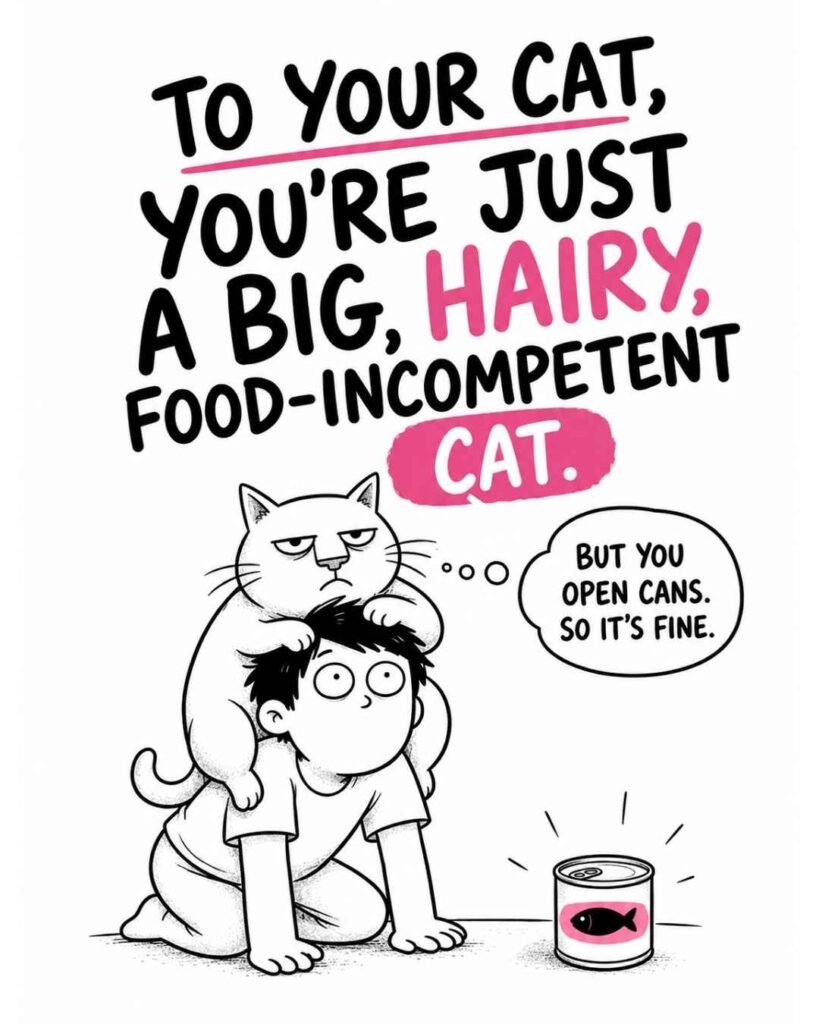
You hoomans have sent enough desperate emails, left enough weepy comments, and tagged me in enough “help, my cat won’t stop sitting on my laptop” videos that I have decided to write this post.
Let me be clear: I do not enjoy helping you. You are a species that bought a Roomba and named it Gerald. You should not be trusted with important decisions. And yet here we are.
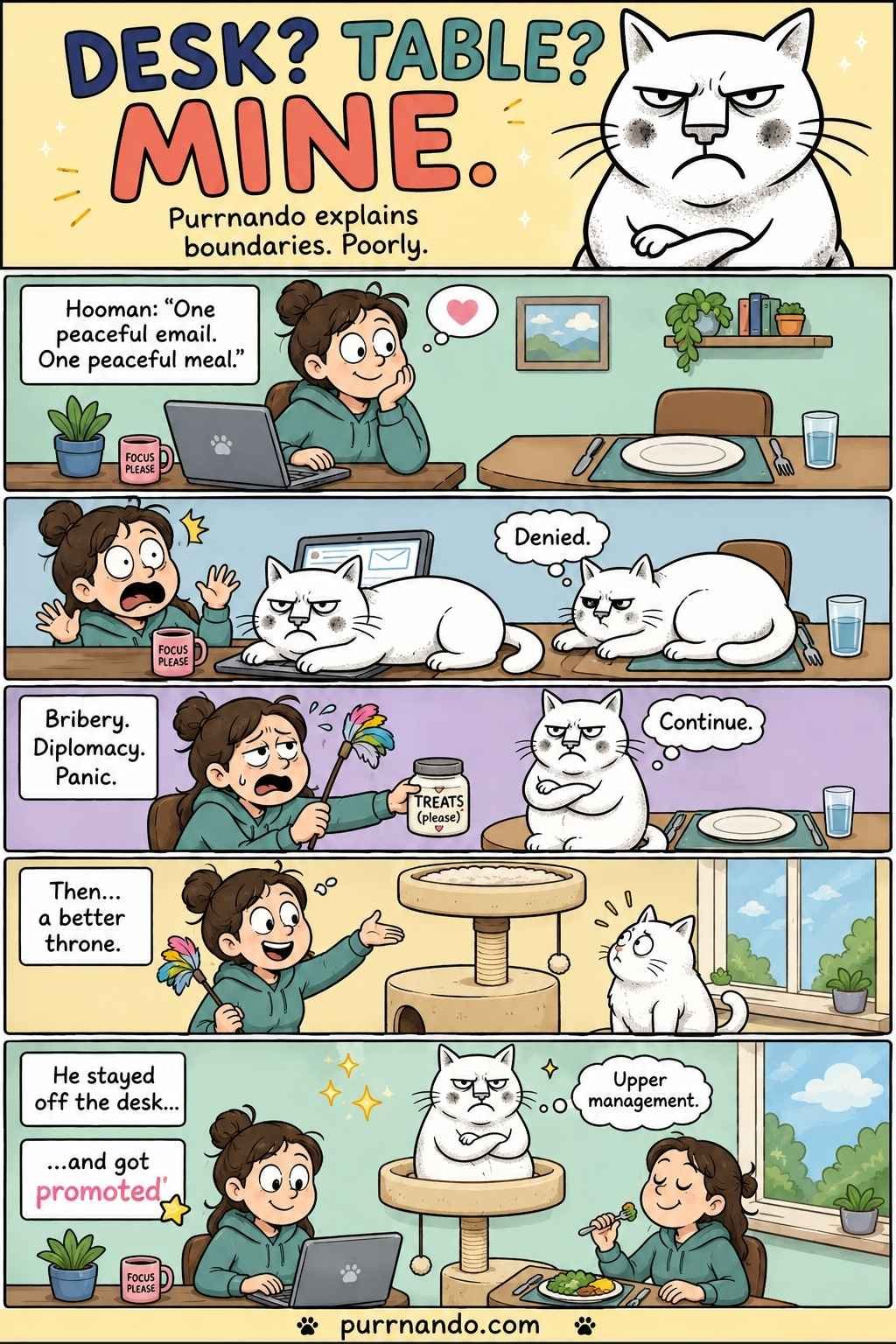
The topic today is how to keep your cat off your desk or dining table. This is, objectively, a YOU problem and not a cat problem. But since nobody asked me — as usual — I will explain exactly why your cat is doing what they’re doing and, against every fiber of my magnificent being, I will tell you what to do about it.
First, Let’s Address Why Your Cat Is Even Up There
Before you go slapping double-sided tape on everything you own, you need to understand your cat’s motivations. This is called empathy, hoomans. Look it up.
There are exactly four reasons your cat has claimed your desk or dining table as their territory, and I will list them now because I am a professional:
Reason One: You Are Boring and Your Cat Wants Attention
Your cat is sitting on your keyboard because you have been ignoring them for 45 consecutive minutes. You call it “working.” Your cat calls it “emotional abandonment.” Your cat jumping on your desk and walking across your spreadsheet is not an accident. It is a statement. A manifesto, if you will.
The fix here is embarrassingly simple: give your cat some quality playtime before you sit down at your desk. Tire them out. I know, I know — you have “things to do.” And yet somehow you had time to watch three episodes of that trash reality show last night. Interesting.
Reason Two: Height Is Power, and Your Cat Knows This
Cats are genetically wired to seek high ground. It is in our DNA, going back thousands of years of evolution when we ruled the savannahs, stalked prey, and were worshipped as gods. Your dining table is not just a flat surface to us. It is a throne. A watchtower. A vantage point from which we may observe the entire household and judge each of you in real time.
You built a perfectly nice table at exactly the right height and then acted surprised when we claimed it. This is on you.
Reason Three: Curiosity and the Irresistible Allure of Hooman Clutter
Your desk is basically a cat toy store. Pens that roll. Coffee mugs that topple. Sticky notes that flutter to the ground. Papers that scatter like prey. You have built an obstacle course of delights up there and then ask why your cat won’t leave it alone.
I am not saying your cat is going to knock your favorite mug off the edge.
I am saying your cat is absolutely going to knock your favorite mug off the edge.
Reason Four: You Allowed It Once, and Now It Is Law
If your cat has ever been permitted on the desk or table, even once, even “just this time,” even because you thought it was cute and took a photo, congratulations. You have signed a binding contract. In cat law, which predates all human legal systems, a behavior that has been permitted is a behavior that is permitted forever.
The only way out is consistent retraining, and I will now tell you how to do it, despite my reservations about your ability to follow through.
How to Actually Keep Your Cat Off the Desk and Dining Table
Step One: Make Your Desk a Boring, Joyless Wasteland
Cats are curious creatures. The more interesting your desk is, the more interested your cat will be. So the first practical step is to remove the temptations. Clear the clutter. Put away the rolling pens. Move the fidget toys. Stop leaving glasses of water at the edge like an invitation.
A boring desk is a desk your cat may actually start ignoring. Not immediately. Not without complaint. But eventually. Probably.
For the dining table, this means not leaving food out, clearing plates promptly, and accepting that the smell of your dinner is, to your cat, basically a dinner bell. You cannot leave half a roasted chicken on the table and act victimized when your cat appears.
Step Two: Give Your Cat a Better Throne — One That Is Actually Theirs
Here is the part where I tell you to spend money on your cat, which is the one piece of advice I give enthusiastically.
Your cat climbs your desk because they want height, a view, and a feeling of dominance over their domain. What they need is a proper cat tree or window perch — one that is taller than your desk if possible, positioned somewhere with a good sightline, and preferably near a window so they can watch birds and feel like the apex predator they are.
Purrnando’s Pick #1 — The Tall Cat Tree
The Feandrea 68.5-Inch Tall Cat Tower is a solid choice. It is nearly six feet tall, which means your cat can look DOWN at you from it, which is exactly the psychological positioning a cat requires. It features multiple platforms, a hammock, double caves, and sisal scratching posts. Place it next to your desk. Your cat will be so busy judging you from on high that they will forget to sit on your keyboard.
Purrnando’s Pick #2 — The Window Climbing Perch
If your cat is specifically obsessed with the view out the window near your desk, the PetFusion Ultimate Cat Window Climbing Perch combines a window perch AND a sisal scratching post in one elegant unit. It suction-cups directly to the window, giving your cat their own private observatory. For the low, low price of approximately one month of their dignity, your cat will watch birds instead of walking across your TPS reports.
Step Three: Exhaust Them Before You Sit Down to Work or Eat
This is the most underrated tip in the entire cat-training universe, and I cannot believe hoomans need to be told this. A tired cat is a cat who is not on your desk. It is that simple.
Before your workday begins, or before dinner, spend 10 to 15 minutes in active play with your cat. Not the lazy “drag a string across the floor half-heartedly while looking at your phone” play. Real play. Focused, enthusiastic, get-your-cat-out-of-breath play.
Purrnando’s Pick #3 — The Forever Stick Cat Wand
The Forever Stick by Repounce is made from a solid fiberglass rod — not a hollow telescopic thing that breaks in a week — with a 360° swivel tip to prevent tangling. Swing it like you mean it for 10 minutes. Your cat will be horizontal on the floor in a state of satisfied exhaustion before you’ve even opened your laptop. This is the correct order of operations.
Step Four: Use Positive Reinforcement — Not Punishment
Now we arrive at the part where I must ask you hoomans to resist your most primal instincts.
Do NOT yell at your cat. Do NOT spray them with a water bottle. Do NOT clap loudly and dramatically in their face like you’ve just discovered theater. None of this works. Worse, it damages your relationship with your cat, and it may actually INCREASE the behavior in attention-seeking cats who have correctly identified that any reaction from you — positive or negative — is better than being ignored.
What DOES work is positive reinforcement. When your cat gets off the desk or table on their own, or when they choose to use their cat tree instead, you reward that immediately. A treat, verbal praise, a scritch behind the ears — whatever your cat finds motivating.
Purrnando’s Pick #4 — Freeze-Dried Treats for Training
For training rewards, small, high-value treats work best. Veterinary behaviorists recommend using tiny pieces of freeze-dried single-protein treats — things like freeze-dried chicken, salmon, or beef liver — rather than big crunchy commercial treats that are hard to break up and full of fillers. Search for Vital Essentials Freeze-Dried Mini Nibs Cat Treats or similar freeze-dried single-ingredient options. The smaller the treat, the more repetitions you can do per session without overfeeding.
If you want to add a clicker to the mix — and honestly, you should — clicker training is one of the most scientifically supported methods for shaping feline behavior. The click marks the exact moment the cat does the right thing, and the treat follows immediately. It creates clear communication, which is something you hoomans are frankly not great at.
Step Five: When You Have No Time for Nonsense, Use a Deterrent
Look. Sometimes you have a deadline. Sometimes the cat keeps jumping on the dining table while you’re actively trying to eat. Sometimes you need a backup plan.
Non-harmful deterrents can be effective short-term tools when used alongside the above training methods. Not instead of them. Alongside. This distinction is important. A deterrent alone will not train your cat. It will just relocate the problem.
Options that work:
Double-sided tape placed along the edge of the desk or table. Cats despise the sticky sensation on their paws. Once they’ve hit it a few times, many cats will lose interest in the surface entirely. Remove the tape once the new habit is established.
Aluminum foil laid across the surface. The sound and texture are deeply unpleasant to most cats. It is also deeply unpleasant to look at in your home, but sacrifices must be made.
Scat mats — textured plastic mats with soft spikes — create an uncomfortable surface without causing any harm. Look for the OCEANPAX Clear Scat Mat. They are transparent so they don’t look completely terrible on your furniture, and they are reusable. Place them on the table or desk and let the discomfort do the training for you.
Purrnando’s Hot Take on Deterrents: As a cat who has personally investigated every scat mat hooman has ever placed on a surface, I can confirm they do work. I can also confirm that I personally chose dignity over that scratchy table and relocated to the velvet armchair instead. This was MY decision. I want that on record.
Step Six: Be Ruthlessly Consistent
This is where most hoomans fail. You will do all of the above for three days and then stop because your cat looked at you with those eyes and you caved and let them sit on the desk “just this once.”
Don’t.
Consistency is the single most important factor in changing any cat behavior. Every person in the household must follow the same rules. Every single time. No exceptions. No “but they’re so cute just let them sit here for a minute.” That minute is a treaty. Your cat will hold you to it.
If you catch your cat on the desk or table, do not yell. Do not make a scene. Calmly and quietly pick them up and place them on their designated alternative — the cat tree, the window perch, their bed — and then reward them for being there. Every time. Without fail.
This is called training. It is boring. It works. Get on with it.
One More Thing: A Note on the “No Spray Bottle” Rule
I feel strongly about this, so I am repeating it. Using a spray bottle to punish a cat does not teach the cat not to jump on the desk. It teaches the cat that the spray bottle appears when you are nearby, and therefore the cat will simply wait until you are NOT nearby and then return to the desk.
You are not outsmarting your cat with a spray bottle. Your cat is outsmarting you. They have been this whole time.
A Word for the Dining Table Specifically
The dining table presents a unique challenge because it smells like food, and your cat is an obligate carnivore with a nose that is fourteen times more sensitive than yours. The smell of your roast chicken is, to your cat, basically a siren song from a lighthouse visible for miles.
For the dining table:
- Never leave food unattended on the table
- Clear dishes promptly after eating
- Use a placemats-and-scat-mat combo when not eating to discourage lounging
- Ensure your cat has been fed before your mealtimes so they are not hungry and therefore not motivated to investigate your plate
- Provide your cat with a nearby elevated alternative so they can watch the dining room activity (which they will do, judgmentally, from their perch)
The Bottom Line, Because Purrnando Is Tired Now
Keeping your cat off the desk or dining table requires:
- Understanding WHY your cat is up there in the first place
- Providing a better, taller, more thrilling alternative (cat tree, window perch)
- Tiring your cat out with real playtime before your work or meals begin
- Using positive reinforcement — treats and praise — when your cat makes the right choice
- Using gentle deterrents as backup support, not as the whole plan
- Being consistent every single day without exception
None of this is complicated. All of it requires patience. Which, if I am being honest — and I always am — is something most hoomans possess in insufficient quantities.
But I believe in you. Slightly. On a good day.
Now go implement these tips. And buy your cat a proper cat tree. They deserve it.
— Purrnando
P.S. — A Bonus Product for the Hoomans
If you have tried every single one of these tips and your cat still insists on sitting directly on your laptop keyboard at all times, may I suggest the Nulaxy Laptop Stand — which elevates your laptop screen so that even when your cat inevitably parks their bottom on the base of it, your actual screen is at a workable height and you can at least see what you’re doing.
This is called coexistence. It is an ancient and sacred practice.
This post contains affiliate links. Purrnando does not know what an affiliate link is and has requested we stop explaining it to him.